Resume for Attorney: Turn Your Job Description into a JD-Driven, Defensible Resume
Learn how to build a resume for attorney roles that mirrors each job description—so your experience reads like a direct qualification story. Includes a JD-to-resume workflow and ATS keyword guidance.
Free Chrome extension
See your resume's match score for any job
JobWizard compares your resume to each job description and shows the exact keywords to add — free.
Resume for attorney roles gets results when it mirrors the job description—on purpose.
A strong resume for attorney applications doesn’t just list your experience—it translates the job description into evidence: practice-area terms, legal document work, procedural stages, and the exact skills the firm needs. When your resume wording matches what the posting is looking for, you reduce “interpretation work” for recruiters and attorneys reviewing your background.
In this guide, you’ll follow a JD-to-resume workflow you can reuse for each application: identify the skills gap, rewrite bullets with the right legal language, and double-check ATS-readability. You’ll also see how to validate your resume against the posting before you submit.
Start with the job description, then build a JD-aligned “evidence map.”
The fastest way to tailor a resume for attorney is to treat the job description like a checklist—then map each item to something you can prove. This avoids generic summaries and ensures your most relevant work appears where the reviewer expects it.
Make an evidence map with three columns: requirement (from the JD), proof (your experience), and resume rewrite (bullet phrasing you can defend). Don’t aim for “every keyword”—aim for “every requirement you can support.”
What to pull from the JD (beyond practice area)
Many attorney roles specify more than “litigation” or “contracts.” Pull these elements from the posting and treat them as your tailoring anchors:
- Legal work types: research, drafting, motion practice, discovery, contract review, deposition prep, briefing, hearings.
- Procedural stage clues: pleadings, summary judgment, dispositive motions, settlement work, trials.
- Jurisdiction and scope signals: state/federal, regulatory environment, specific counterparties, client types.
- Collaboration expectations: partner/associate workflow, supervision, team-based document production, client-facing responsibilities.
Turn the evidence map into bullet rewrites
Your bullets should read like “proof of fit,” not a job-duty diary. For each mapped requirement, convert the proof into a bullet using a consistent structure:
- Action + legal task: “Drafted…”, “Conducted…”, “Prepared…”, “Supported…”.
- Context: case type, client role, forum, timeline, or stage.
- Output: motion/brief, discovery set, contract version, memo, evidence binder.
- Quality signal: accuracy, compliance, clarity, urgency, or risk reduction (keep it truthful).
If you don’t have the exact match, your goal is to show the closest comparable work and explain how it transfers—without overstating.
Use a structure that’s ATS-friendly and lawyer-friendly at the same time.
Your resume for attorney should be easy to scan for people and easy to parse for ATS. That means clean section headings, plain text formatting, and keywords embedded where they naturally describe your work.
Before you rewrite, confirm your document has the essentials a legal review workflow expects.
Recommended sections for an attorney resume
- Contact Header: name, city/state (optional), phone, email, LinkedIn (if active), and website or portfolio (only if relevant).
- Professional Summary: 3–4 lines tailored to the JD (practice area + document types + procedural comfort + collaboration style).
- Bar/License Line (if applicable): jurisdiction and status. Keep it concise and accurate.
- Relevant Experience: reverse chronological. Use JD-targeted bullets under each role.
- Selected Matters / Representative Work (optional but powerful): include only what you can ethically disclose.
- Education: law school, degree, relevant coursework (only if it helps this JD).
- Skills (keyword-focused): legal software/tools, research platforms, drafting types, deposition/interview support, contract categories.
How to write a summary that doesn’t sound generic
Skip the “detail-oriented attorney with strong communication skills” clichés. Instead, summarize your fit in terms of what the JD requires.
Use this formula:
- Practice focus: the job’s practice area or case types.
- Work product: 2–4 document types you’ve actually produced.
- Stage exposure: where you’ve worked in the process (research → drafting → filing → hearings, etc.).
- Collaboration: partner/associate support, client-facing readiness, or team production workflow.
Don’t guess on ATS—align keywords where they matter
ATS-readability isn’t about stuffing; it’s about matching the language the posting uses to describe requirements. If you need a deeper ATS playbook, use this internal guide: How to Optimize Resume for ATS: A Practical 2026 Checklist.
Close your skills gap by translating legal tasks into JD-ready language.
A common problem with resume for attorney tailoring is that the JD lists requirements you’ve never done “exactly,” so candidates stop. Instead, bridge the gap by translating your closest real experience into the JD’s vocabulary—only where accurate.
Think in terms of transferrable legal capabilities: document drafting, legal research depth, evidence handling, and procedural familiarity. Your resume should show how those capabilities map to the posting.
Skills gap bridge: requirement → closest proof → upgraded bullet
When you see a requirement you can’t match 1:1, do this:
- Name the requirement: copy the JD phrase (e.g., “motion practice” or “discovery”).
- Match your closest work: pick your comparable experiences (e.g., research supporting motions, discovery drafting, deposition prep).
- Rewrite bullets with honest specificity: mention the document type and stage you actually touched.
- Add proof signals: show scope (types of issues, jurisdictions) and outputs (memos, pleadings, discovery responses).
Examples you can model (use only what fits your background)
- Discovery requirement: Instead of “Handled discovery,” write “Prepared and organized discovery materials, including review and drafting of document requests/response components, to support timely case-stage deadlines.”
- Motion practice requirement: Instead of “Worked on motions,” write “Researched and supported motion drafting by compiling authorities, summarizing legal standards, and organizing record materials for dispositive briefing.”
- Contract drafting requirement: Instead of “Reviewed contracts,” write “Drafted and redlined contract language for [type] agreements, focusing on risk allocation terms and operational clauses relevant to business stakeholders.”
Notice the pattern: task → context → output. That’s how your resume for attorney roles becomes evidence-based.
Keep sponsor/salary/EEO/custom questions separate from resume tailoring
Tailoring your resume should not be confused with application answers. Your content must remain accurate and defensible, and you should review any application-specific fields before submitting. (Your resume rewrite should be driven by the JD, but application questions are a separate step.)
Validate your attorney resume against the exact job description—then revise.
Before you hit submit, validate your resume for attorney against the specific posting to catch expression gaps—missing practice-area terms, missing legal document types, or requirements your bullets don’t yet prove.
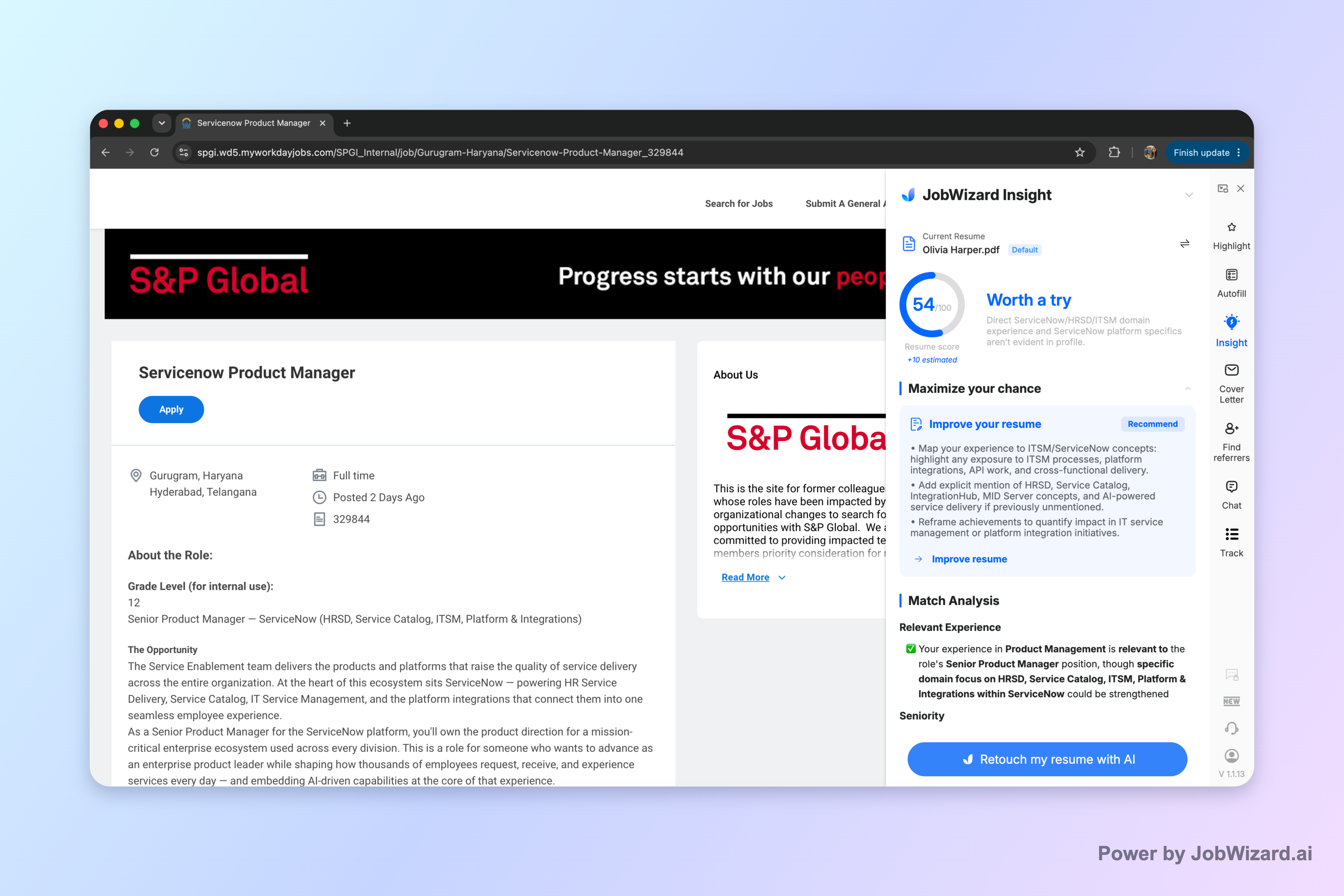
One effective approach is to compare your current resume to the job description, then use the identified gaps to generate an editable revision plan. The goal isn’t blind automation—it’s speeding up the gap-detection and making your next rewrite more precise.
What “match score” style feedback can (and can’t) do
JobWizard Insight compares your selected resume with the current job description and presents a match score, an overall assessment, and improvement suggestions. The JD-based diagnosis can identify resume expression gaps and turn them into an editable resume revision draft.
You’ll still need to verify every suggested change and keep only accurate experience. Also, the score is not a hiring probability and doesn’t guarantee ATS passage or an interview.
How to use the comparison output as a revision checklist
- Expression gaps: add missing keywords only when they reflect real work you can defend.
- Skills gap coverage: ensure each JD requirement has a bullet that proves it.
- Rewrite priority: update your summary and the top 2 roles first—reviewers often focus there.
- Final accuracy pass: re-check dates, titles, and document types to avoid overstating.
Related tailoring guides you should reuse
Different job types need different tailoring emphasis. For ATS keyword strategy and JD-driven requirements, see CIO Resume Keywords That Beat ATS: A JD-Driven Checklist for Real Requirements. And for role-specific matching style, you can borrow the “JD match template” idea from Resume for a Server Skills: A JD Match-Driven Template That Gets Noticed.
If you’re also updating related documents (like a CV for non-legal work), you can use the same tailoring discipline from Resume for Artist: How to Tailor Your CV to the Job Description and Win ATS. The key is consistent evidence mapping and ATS readability—not copying templates blindly.
Do this automatically with JobWizard
Skip the manual work — JobWizard's Match Score handles this for you.
FAQ: Resume for attorney questions (tailoring, ATS keywords, and review-before-submit).
What sections should a resume for attorney include to look credible to both hiring teams and ATS?
Use a simple, ATS-friendly structure: Contact Header, Professional Summary, Bar/License line (if applicable), Relevant Experience (reverse-chronological), Education, Skills (keyword-focused), and a short “Selected Matters / Representative Work” subsection when it fits the role. Keep headings consistent and avoid dense graphics so job-specific keywords (practice areas, motion types, litigation stages) remain readable.
How do I tailor a resume for attorney jobs when I don’t have the exact experience listed in the job description?
Create a “skills gap bridge”: map each job requirement to (1) your closest experience, (2) transferable legal work (research, drafting, discovery, briefing, deposition prep, client counseling), or (3) a credible signal (coursework, writing samples, bar activities, relevant tools). Then rewrite your bullet points to match the JD’s wording where accurate, while adding proof through outcomes like document types, stages, and jurisdictions.
Which ATS keywords matter most for a resume for attorney, and where should I place them?
Focus on requirement keywords the JD repeats: practice area (e.g., employment, IP, criminal defense), document/skill terms (e.g., motion practice, discovery, contract drafting), and procedural stages (e.g., pleadings, summary judgment, hearings). Place them in (a) the Skills section, (b) bullets in Relevant Experience, and (c) your summary—without keyword stuffing. If you’re unsure, mirror the JD’s phrasing only when it matches your real background.
Should I use a resume for attorney template, or write from scratch?
If your template keeps headings and formatting readable, it can save time—but you still need to tailor content. Use a template as a structure baseline, then replace generic bullets with JD-aligned bullets. Always verify every change is accurate and keep the document clean enough for ATS to parse.
How can I review my attorney resume against the job description before I submit?
Use a comparison workflow: take the exact job posting, paste your current resume, and check for expression gaps—missing practice-area terms, missing document types, and requirements you haven’t shown in your bullets. Treat the result as a revision draft: update only what you can defend, and leave sponsorship/salary/EEO/custom questions for your final review before you submit.
Ready to tailor faster? Use JobWizard Insight to compare your resume against the exact job description, spot expression gaps, and generate an editable revision plan—so your next resume for attorney update is JD-driven and defensible.
Frequently Asked Questions
See your resume's match score for any job
JobWizard compares your resume to each job description and shows the exact keywords to add — free.