Resume for a Teacher: Use a JD-Based Match Score to Fix Skills Gaps Fast
A strong resume for a teacher starts with matching your resume to the exact job description. Use a JD-based match score to find skills-gap wording—and rewrite only what’s accurate.

Free Chrome extension
See your resume's match score for any job
JobWizard compares your resume to each job description and shows the exact keywords to add — free.
Hiring teams don’t just scan for credentials—they scan for fit. If you need a resume for a teacher that aligns with a specific opening, start by using the job description as your blueprint, then revise your wording to close any skills gap the posting reveals.
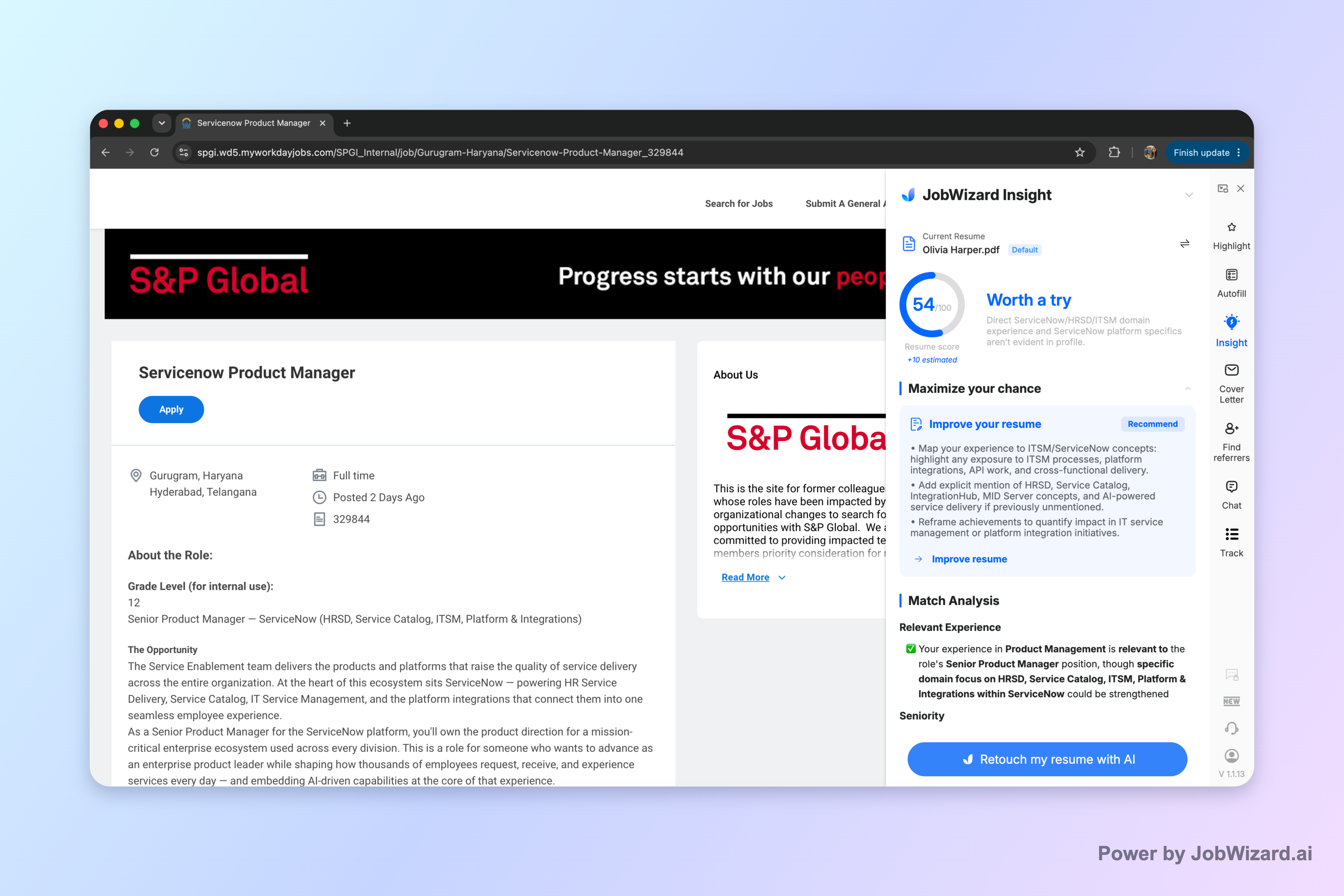
JobWizard Insight compares the resume you selected with the current job description and shows an overall match score plus improvement suggestions you can turn into an editable revision draft—so you can fix gaps with clarity instead of guessing.
What “match” really means for a resume for a teacher
Match is the overlap between how schools describe the role and how your resume describes your experience. When your bullets use different phrasing than the posting, you can look qualified on paper but still miss the keywords and evidence the system (and recruiter) expect.
For a resume for a teacher, match usually comes down to three things: (1) instructional focus, (2) student support practices, and (3) compliance/requirements. Build your resume so it reads like you’ve already done what the listing asks for—because that’s what your best-fit evidence will support.
Use the job description as your teacher resume requirements checklist
To tailor quickly and accurately, turn the posting into a checklist you can revise against. Capture these categories, then look for them in your existing resume:
- Instructional scope: grade level(s), subject area(s), and course expectations.
- Instructional approaches: differentiation, small-group instruction, UDL, guided practice, etc.
- Assessment & data: formative/summative, progress monitoring, rubrics, data cycles.
- Student support: interventions, behavior supports, collaboration for MTSS/IEP work.
- Collaboration: co-teaching, parent communication, PLCs, team planning.
- Tools & documentation: any named platforms or routine documentation expectations.
- Compliance: certifications, licensure, mandated training, or specific requirements mentioned.
Why wording gaps happen (and why they’re fixable)
Most skills-gap issues aren’t “you don’t have experience.” They’re “your resume doesn’t express the experience in the language the job uses.” For example, a posting may say “progress monitoring,” while your resume only says “tracked student work.” That’s a match problem—not necessarily a skills problem.
Once you spot that mismatch, you can rewrite a bullet so it stays truthful while reflecting the job’s phrasing. That’s exactly the kind of edit a JD-based analysis is meant to surface—then you verify everything before you submit.
How to use a JD-based match score to revise your resume for a teacher
Use the match score as a diagnosis, not a verdict, then apply the suggested improvements to create an evidence-backed revision.
Step 1: Compare your resume with the exact job description
Start with the version of your resume you actually plan to submit, and the specific job description you want. The goal is to identify where your resume expression doesn’t line up with the role’s requirements—so you can qualify faster and revise smarter.
Step 2: Review the improvement suggestions and mark what you can verify
When Insight provides improvement suggestions, treat them like draft edits. Your job is to verify that each change is accurate to your experience and that you can back it up with a real detail.
- Keep only accurate updates: if a suggestion would require skills you can’t support, don’t force it.
- Strengthen truthful claims: add missing specificity (assessment type, frequency, or collaboration routine) only when you can confirm.
- Remove mismatched or vague wording: if a bullet is generic, replace it with a targeted statement aligned to the listing.
Step 3: Turn gaps into an editable bullet revision draft
The JD-based diagnosis can identify resume expression gaps and turn them into an editable resume revision draft. Use it to rewrite bullets—not just to “add keywords.” For a resume for a teacher, the best edits read like: requirement → what you did → how you measured or documented it.
Concrete example: closing a “data & interventions” skills gap
Imagine a job posting asks for “progress monitoring” and “intervention documentation.” Your current resume bullet says: “Monitored student progress and supported learners.” Here’s how to make it match without inventing:
- Original: “Monitored student progress and supported learners.”
- Rewritten (example): “Used formative checks and progress monitoring to identify skill gaps early, then implemented targeted intervention groups with documented notes for follow-up.”
If you didn’t document interventions in a specific format, adjust the phrasing so it’s truthful (“maintained records,” “tracked data,” or “communicated progress” as applicable).
ATS + readability: build a resume for a teacher that both people and systems can parse
ATS-friendly doesn’t have to mean robotic. The most effective resume for a teacher is clear, scannable, and specific to the posting.
Where to place teacher resume keywords (so they don’t feel stuffed)
Instead of sprinkling random terms, embed the role’s language in the sections that naturally support it:
- Summary: mirror the posting’s grade level/subject focus and instructional focus.
- Experience bullets: replace generic phrases with specific methods, assessment, and support routines.
- Skills or classroom toolkit: list strategies and any tools named in the job posting.
- Certifications: ensure licensure matches the required state/level if listed.
Keep your “evidence notes” to protect accuracy
Teacher resumes often include skills you learned during coursework or training. That can be useful, but only if you label it correctly. When revising for match, create a quick “evidence note” for each updated bullet so you can confirm accuracy before submission.
- Requirement: pull the exact phrasing from the posting.
- Your evidence: note the classroom routine, artifact, or documented practice you can defend.
- Resume wording: rewrite the bullet using truthful language that reflects the job’s terms.
Use JD-driven tailoring as a repeatable workflow
If you tailor repeatedly, your process matters. Here’s a simple workflow that scales across multiple applications:
- Start with a targeted resume version for the grade/subject band.
- Diagnose with a JD-based match score to find expression gaps.
- Edit only the bullets that need specificity or keyword alignment (not your entire resume).
- Verify every suggested change and keep only accurate experience.
If you want a deeper ATS-first approach for any education role, use How to Optimize Resume for ATS: A Practical 2026 Checklist alongside this job-description approach.
Teacher resume examples you can adapt for common job requirements
Adaptable examples help you rewrite faster while keeping your resume for a teacher aligned to what schools actually ask for.
Example bullets by requirement category
- Instruction (differentiation): “Differentiated instruction using flexible grouping and targeted practice plans to meet diverse readiness levels.”
- Assessment (formative checks): “Administered weekly formative assessments to identify misconceptions, then adjusted instruction based on data patterns.”
- Interventions (progress monitoring): “Implemented intervention groups supported by progress monitoring, documenting outcomes and communicating next steps.”
- Collaboration (PLC/team): “Collaborated with grade-level teams and PLCs to plan instruction, analyze results, and refine strategies.”
- Family communication: “Provided timely updates to families on progress and learning goals using clear, respectful communication routines.”
- Behavior support: “Applied consistent classroom management procedures and supported students using documented strategies and data-informed adjustments.”
What to tailor (and what to leave alone)
Tailor the statements that map to the posting. Leave stable elements alone, like long-term education details—unless the job calls for something specific (like a certification requirement).
- Tailor: the experience bullets closest to the role’s exact needs.
- Verify: certifications, license wording, and any named tools.
- Keep: education details that remain correct across applications.
Quick “skills gap” rewriting template
When you see a gap, rewrite with this structure:
Action + method + evidence/measurement + result for students (only if you can back it up).
Example: “Used [method] to assess [learning goal], then adjusted instruction using [evidence] and documented progress to [student-centered impact].”
While your role is teaching, the same JD-matching logic can help in other resume formats too—so if you’re cross-applying or using specialized lesson roles, you may also find these JD-matching resources useful: Resume for Artist: How to Tailor Your CV to the Job Description and Win ATS and Resume for a Server Skills: A JD Match-Driven Template That Gets Noticed.
Do this automatically with JobWizard
Skip the manual work — JobWizard's Match Score handles this for you.
FAQ: Resume for a teacher
Common questions can keep you from wasting time—here are direct answers for building and refining your resume for a teacher.
How do I tailor a resume for a teacher to a specific job description?
Copy the key requirements from the posting (standards, classroom levels, instructional methods, interventions, and any stated software) into your tailoring checklist, then revise your resume to mirror that language where it’s true to your experience. Keep a short “evidence note” under each updated bullet so you can verify accuracy before you submit.
What is a JD-based match score, and does it guarantee ATS approval or an interview?
A JD-based match score is an insight that compares your selected resume with the current job description and shows an overall assessment plus improvement suggestions. It’s not a hiring probability and it doesn’t guarantee ATS passage or an interview—always review every suggested change and keep only accurate experience.
How can I identify skills-gap wording on my resume for a teacher?
Look for requirements in the job description that don’t appear in your resume as specific claims (or appear only vaguely). Then rewrite the closest truthful bullet to include the missing skill’s job-title wording—without padding. If you don’t have direct experience, replace with a relevant substitute (coursework, formal training, or documented volunteer work) and label it accurately.
Should I use ATS keywords on a resume for a teacher if I’m worried about sounding robotic?
Yes—use ATS keywords as signals of what you’ve actually done. The best approach is to pair keywords with concrete outcomes you can stand behind (assessment types, classroom strategies, collaboration routines, or documented intervention plans). This keeps your resume readable while still matching how schools describe the role.
What sections matter most on a resume for a teacher?
Start with a focused summary (1–3 lines), then build an experience section with role-relevant bullets that reflect the job description’s requirements. Follow with education, certifications/licensure, and a skills section that matches the posting (instructional strategies, assessment, student support, and any tools). End with optional sections like professional development or leadership only if they support the target role.
Next step: make your resume for a teacher match the job you want
Don’t guess—compare your resume to the exact job description, review the JD-based match score improvement suggestions, and revise the specific bullets that close your skills gaps.
Invite yourself to act: use JobWizard to compare your current resume against a target posting, then edit with confidence by keeping every suggested change accurate before you submit.
If you’re also optimizing for systems beyond a teacher role (or you’re targeting leadership positions), check out CIO Resume Keywords That Beat ATS: A JD-Driven Checklist for Real Requirements for a JD-first mindset you can reuse.
Frequently Asked Questions
See your resume's match score for any job
JobWizard compares your resume to each job description and shows the exact keywords to add — free.