Human Resource Resume Keywords That Pass ATS: Use Job Descriptions Like Evidence
Human resource resume keywords help your resume reflect what recruiters actually look for in job descriptions. Learn a repeatable ATS-focused workflow—so you can tailor faster and still stay accurate.
Free Chrome extension
See your resume's match score for any job
JobWizard compares your resume to each job description and shows the exact keywords to add — free.
If you’re searching for human resource resume keywords that help your resume get noticed, you’re already on the right track—because HR hiring teams tend to filter for the exact things the job posting asks for. The catch: it’s not enough to sprinkle in generic buzzwords. You need keywords that reflect the job description—its responsibilities, qualifications, and required tools/processes—then show them in your resume with truthful, specific evidence from your experience.
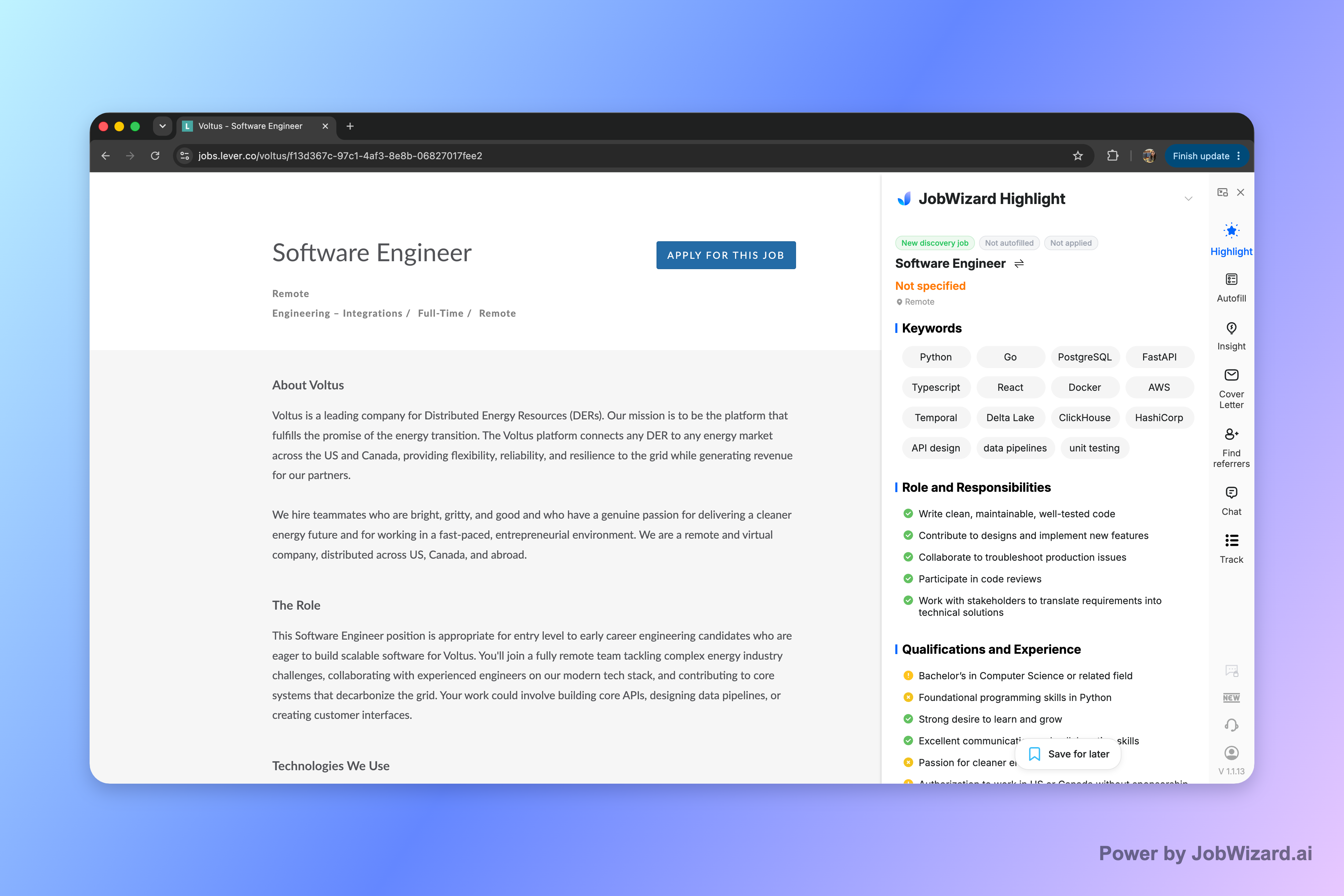
JobWizard can turn a long job posting into a structured view of the role’s key requirements, including keywords, responsibilities, and qualifications—so you can review what the employer is actually asking for in a more systematic way.
Why human resource resume keywords fail (and how to fix them)
Most HR resumes don’t “fail” because they’re poorly written. They fail because the resume doesn’t use the language of the job description closely enough, or because the keywords you chose aren’t supported by your experience.
- Keyword mismatch: You use HR terms you’ve heard (or skills lists from other roles), but the job description uses different phrasing.
- Evidence gap: You add a keyword without adjusting the bullets to show real work that supports it.
- Section misplacement: Some applicants add skills in a list, but the resume experience bullets never reinforce the same terminology.
- Over-copying the job post: Copying large chunks of the job description can read unnatural and still not match your actual background.
The solution is a controlled workflow: extract keywords from the job description, map them to your real experience, and rewrite a few targeted lines—not everything. That’s how you get human resource resume keywords that sound like you, and align with what the employer is screening for.
Build your HR keyword list from the job description (not from guesswork)
Start with the job posting itself. Your goal is to capture the language the employer uses so you can mirror it accurately in your resume (again: accurately—no inventing.) Focus on three buckets:
1) Responsibilities → action keywords
Look at the “Responsibilities” section and note the actions and outcomes the employer expects. These often translate directly into resume bullets.
- If the posting says screening candidates or coordinating interviews, use parallel wording in your recruiting/onboarding bullets.
- If it includes handling employee relations or managing HR casework, reflect the type of situations you supported (and the process you followed).
- If it mentions maintaining HR records or updating HRIS, mirror the tool/process language where appropriate.
2) Qualifications → credibility keywords
Qualifications reveal what the employer expects you to already know. Capture both the role requirements and the “proof” phrasing (years, compliance domains, reporting expectations).
- Compliance / HR policy keywords (use only what fits your background).
- Reporting keywords (e.g., HR metrics, headcount reporting, recruiting reporting).
- Stakeholder management keywords (e.g., partnering with hiring managers, supporting cross-functional teams).
3) Tools and systems → ATS-friendly technical terms
Many HR roles include HR tech. These keywords matter because they signal immediate relevance.
- HRIS / ticketing / scheduling tools (name them if you’ve used them).
- Applicant tracking systems (recruiting workflow tools).
- Learning management or onboarding platforms.
Rule of thumb: Your human resource resume keywords should be pulled from the job description, then confirmed by your experience. If you can’t support it, skip it or rephrase based on what you truly did.
Turn keywords into resume edits: a practical HR tailoring workflow
Once you’ve collected the job-specific keywords, your next task is to place them into the right resume locations so they read naturally and map to your history.
Step 1: Choose 8–15 primary HR keywords to prioritize
Don’t try to cover every term. Pick the ones that show up repeatedly or are central to the role. Typical HR keyword clusters might include:
- Recruiting operations: sourcing coordination, screening support, interview scheduling
- Onboarding: onboarding coordination, documentation, new hire setup support
- Employee relations: case support, policy guidance (only if it’s accurate to your experience)
- HR operations: HR records maintenance, HRIS updates, data hygiene
- Reporting: HR metrics, recruiting funnel reporting, workforce reporting
- Compliance: policy/process adherence (again, only what you can support)
Step 2: Map each keyword to one bullet in your resume
For each priority keyword, identify where it belongs:
- Summary: 2–4 lines that capture your HR focus area and key strengths (use a few top keywords).
- Skills section: a tight list of tools and competencies aligned with the job.
- Experience bullets: the “proof” section—this is where keywords matter most.
Concrete example (HR recruiting support):
- Job description language: “coordinate interviews,” “support candidate screening,” “maintain recruiting reports.”
- Resume bullet rewrite: “Coordinated interview schedules across stakeholders and maintained candidate tracking for timely movement through the recruiting pipeline.”
- Keyword coverage: coordinate interviews, candidate tracking (or reports), recruiting pipeline support.
Concrete example (HR operations / HRIS):
- Job description language: “update HRIS records,” “ensure HR data accuracy,” “generate HR reports.”
- Resume bullet rewrite: “Updated HRIS records to support onboarding changes and ensured data accuracy for internal HR reporting workflows.”
Step 3: Use a resume vs. job description comparison to spot gaps
After your first pass, compare your resume to the specific job posting. JobWizard’s Insight compares the selected resume with the current job description and presents a match score, an overall assessment, and improvement suggestions. It also identifies resume expression gaps and can turn them into an editable resume revision draft.
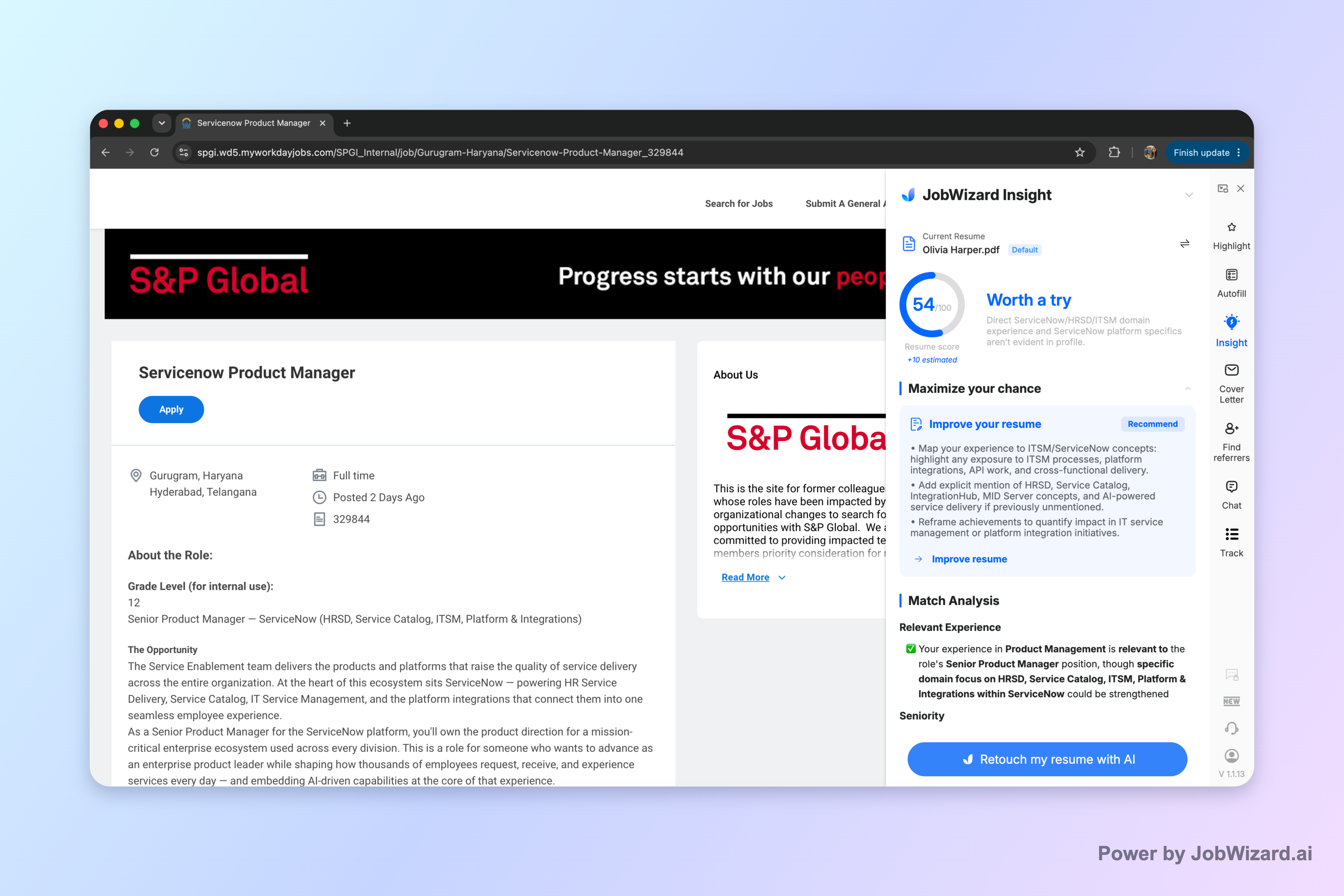
Insight compares the selected resume with the job description and turns the gaps into specific next steps.
Important limitation to keep you safe: the score isn’t a hiring probability and doesn’t guarantee ATS passage or an interview. You still need to verify every suggested resume change and keep only accurate experience.
Step 4: Rewrite with verification—don’t “keyword-flood”
When you incorporate human resource resume keywords, treat them like claims. Every keyword you add should correspond to something you can defend in an interview and support in your past work.
- If a keyword is a tool you didn’t use, swap it for the closest truthful system/process or remove it.
- If a responsibility is broad, focus on the part you actually owned (e.g., “coordinated onboarding documentation” rather than “owned end-to-end onboarding strategy”).
- If the job emphasizes reporting, add one bullet that describes what you reported and how you maintained data quality.
For deeper ATS keyword mechanics, you can also cross-check phrasing against the job description using these guides:
- ATS Software Keywords: Turn Job Descriptions Into Resume Phrases Hiring Teams Can Parse
- How to Optimize Resume for ATS: A Practical 2026 Checklist
HR resume keyword examples by specialization (copy the structure, not the exact text)
Human resources is broad. Below are specialization-focused human resource resume keywords patterns you can use to tailor your resume sections. Replace the placeholder items with your real experience and tools.
Recruiting / Talent Operations
- Keywords to look for in the posting: candidate screening support, interview coordination, scheduling, recruiting pipeline tracking, hiring manager coordination
- Resume bullet template: “Supported [recruiting activity] by [specific action], improving [quality outcome you can support].”
- Example bullet: “Coordinated interview schedules, communicated updates to candidates and stakeholders, and maintained candidate tracking to support timely progression through the recruiting pipeline.”
Onboarding / HR Coordinator
- Keywords to look for: onboarding coordination, new hire setup, documentation, HR records updates, compliance with onboarding processes
- Resume bullet template: “Coordinated [onboarding component] including [documentation/data tasks], ensuring [data/process quality].”
- Example bullet: “Coordinated new hire onboarding steps, ensured HR documentation completion, and updated HR records to support a smooth start for employees.”
HR Operations / HRIS / People Ops Admin
- Keywords to look for: HRIS updates, data accuracy, HR reporting, record maintenance, system administration support
- Resume bullet template: “Maintained [system/process] by [specific actions], supporting [reporting/workflow need].”
- Example bullet: “Maintained HRIS records for employee lifecycle changes and supported HR reporting workflows by keeping data accurate and up to date.”
Compliance / Employee Relations support (only if it matches your background)
- Keywords to look for: policy adherence, investigation support, case documentation, employee relations process support
- Resume bullet template: “Supported [ER/compliance process] by [documentation/coordination step], ensuring [accuracy/consistency].”
- Example bullet: “Supported employee relations processes by documenting case notes and coordinating information flow to maintain consistency with HR policy.”
If you’re tailoring for a specific HR-adjacent sub-function (like finance-adjacent HR operations or HR roles with strong recruiting analytics), the key method stays the same: keyword extraction from the job description, then evidence-backed resume bullets.
For how this plays out in other ATS-heavy functions, you may find these specialized keyword systems useful as references for structure:
- Accounts Receivable Resume Keywords: Beat ATS with Targeted AR Phrases That Match the JD
- Resume Keywords for Sales Jobs: A Targeted System to Beat ATS Filters (2026)
Do this automatically with JobWizard
Skip the manual work — JobWizard's Match Score handles this for you.
Apply smarter: qualify first, then submit with confidence
Once your resume is tailored, you can take a more confident approach to applying. Instead of asking “Is my resume good enough?” ask “Does my resume reflect this specific job’s language and requirements?”
Use the job description as your evidence source:
- Confirm responsibilities you can support with accurate experience.
- Confirm qualifications and tools you truly have.
- Confirm that your resume bullets use parallel phrasing to the posting.
If you use JobWizard to structure the posting and compare your resume, treat the output as a drafting aid—then do your own verification pass before anything goes live. That keeps your human resource resume keywords aligned to the role without drifting into exaggeration.
JobWizard CTA: Open the target HR job posting, review its responsibilities/qualifications/keywords, and use JobWizard Insight to compare your resume against the job description—so you can identify expression gaps, draft targeted improvements, and submit with a resume that matches the role you’re actually applying to.
FAQ: Human resource resume keywords
What are the most important human resource resume keywords to include?
The most important human resource resume keywords are the ones that match the job description—especially around HR responsibilities (e.g., recruiting support, onboarding, employee relations, HRIS/admin) and required qualifications (e.g., compliance, reporting, stakeholder management). Use the posted responsibilities and qualifications as your keyword source, then tailor only what you can truthfully support with your experience.
Should I paste the entire job description into my resume to rank for human resource resume keywords?
No. You should use human resource resume keywords to update specific sections of your resume (summary, skills, and relevant experience bullets) rather than copying the entire job description. Recruiters and ATS tools typically look for accurate, role-aligned phrasing—not large blocks of copied text.
What’s the difference between HR resume keywords and ATS keywords?
In practice, they overlap. HR resume keywords are role-specific terms for human resources work, while ATS keywords are the same terms expressed in the way the job description (and common HR systems) use them. The safest approach is to pull keywords from the job’s responsibilities, qualifications, and required tools/processes, then reflect them accurately in your resume.
How can I use a match score to decide whether to apply?
A match score is a diagnostic tool. It compares your resume with the specific job description and can point out expression gaps, but it’s not a hiring probability or a guarantee of ATS passage. Use the suggestions to draft edits, verify every change is accurate, and decide based on your fit—not the score alone.
Can JobWizard help me tailor human resource resume keywords without blind auto-apply?
Yes. JobWizard is built around autofill + review-before-submit. It helps with repetitive fields quickly, while you review sponsorship/salary/EEO/custom questions and decide what to submit. For tailoring, Insight can compare your resume with the current job description and turn gaps into specific next steps you can verify before updating your resume.
Frequently Asked Questions
See your resume's match score for any job
JobWizard compares your resume to each job description and shows the exact keywords to add — free.