How to Know If an Interview Went Well: The 7 Signals Hiring Teams Expect
Wondering how to know if an interview went well? Look for specific signals—clarity, engagement, next steps, and the right questions to ask when you follow up.
Free Chrome extension
Autofill your next job application
JobWizard is a free Chrome extension that fills applications, tracks statuses, and optimizes your resume.
How to know if an interview went well: start with the signals, not your nerves
If you’re trying to figure out how to know if an interview went well, focus on what happened during the conversation—then match it to what typically comes before a decision. Your goal isn’t to read minds; it’s to look for repeatable, behavior-based evidence.
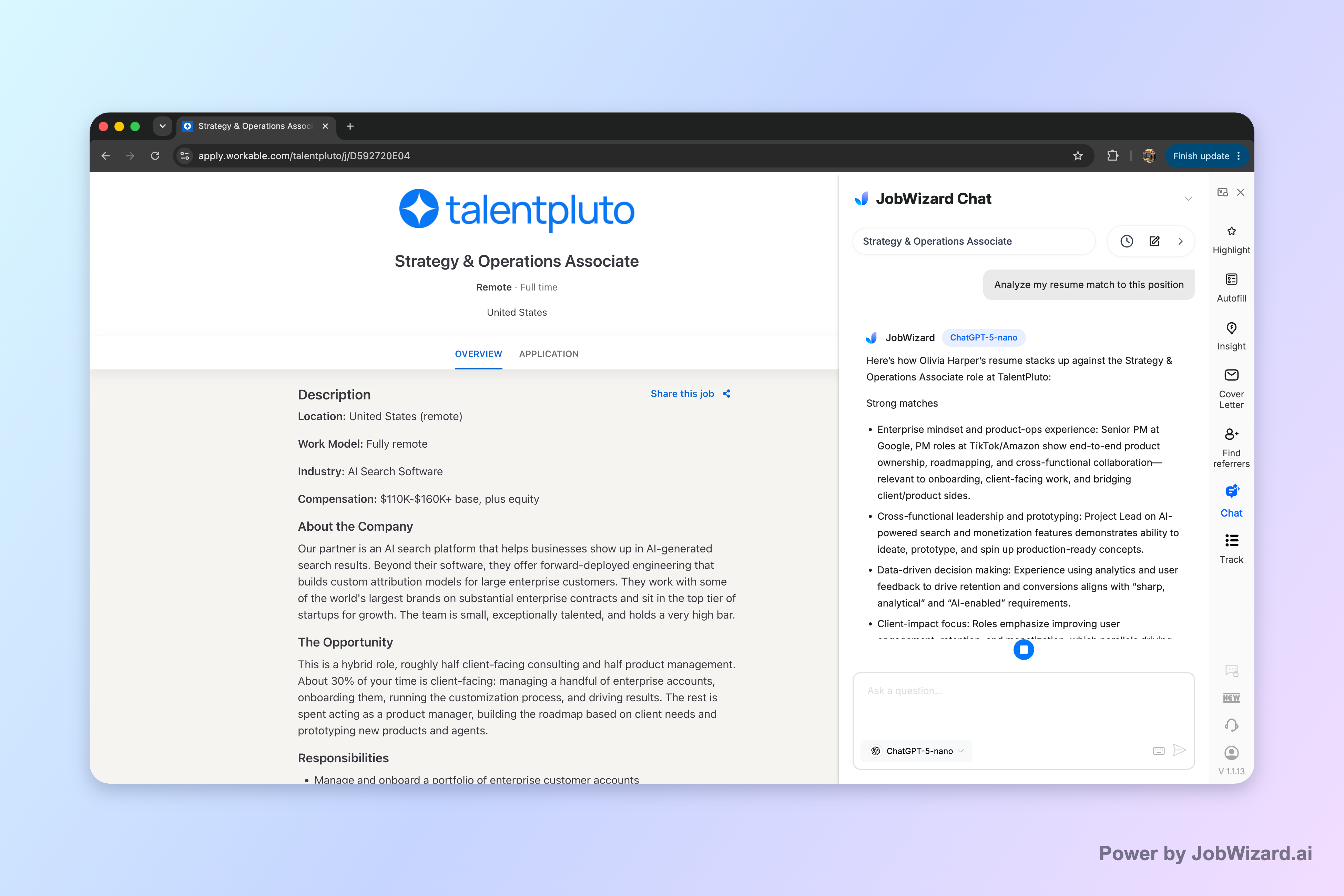
One practical way to reduce uncertainty is to sanity-check your “fit story” after the interview. JobWizard’s Career Chat keeps the current role in context so you can ask follow-up questions about resume fit and application strategy without pasting the job description again.
Since you can’t control how fast a company moves, the best indicator is often whether the interviewer treated your experience as a real option. Here are the strongest signals to watch for.
7 signals that usually mean your interview went well
These are the cues that commonly show you’re landing where the role needs you. Use them to guide your confidence—and your next follow-up message.
- They asked fit-focused follow-up questions (not just surface-level “tell me about yourself”). If you heard “that’s helpful—can you share more about…” you were actively evaluated.
- They clarified the role with specifics. For example: team priorities, success metrics, upcoming projects, or why they’re hiring now.
- Your examples matched what they cared about. If your story was building toward the competencies they were trying to assess, that’s a strong sign the interview landed.
- You felt a two-way dialogue. It didn’t feel like an interrogation or a scripted Q&A with no follow-through.
- They invited your questions and didn’t steer you away from meaningful topics (team workflow, collaboration, evaluation, scope).
- You heard concrete “next step” language. Even if it’s not a firm calendar date, terms like “the next round,” “we’ll be in touch,” or “we’d like to meet again” matter.
- You left with clarity, not confusion. You could summarize what they want and what you offered—and you didn’t feel like you missed the target completely.
If you want a quick self-check, ask yourself one question: Did my answers give them what they need to explain me to the next person? If yes, your interview likely went well.
What to listen for during the conversation (and what to ignore)
The interview transcript of your brain matters more than how confident you felt while speaking. Here’s what to treat as meaningful vs. misleading.
What’s meaningful: signals tied to evaluation
- “Why should we hire you?” style prompts or direct competency questions. These indicate they’re trying to understand your fit, not just your background.
- Behavioral follow-ups (“Tell me about a time… what was your role… what did you learn?”). Follow-ups suggest they want specifics.
- Discussion of constraints (process, stakeholder complexity, trade-offs). Teams often probe for judgment under real conditions.
What can be misleading: signals unrelated to fit
- They weren’t “chatty”. Some interviewers are brief by design. Look for substance, not friendliness.
- Your performance feels imperfect. One stumble doesn’t erase a strong overall pattern—especially if you recovered and kept the conversation aligned to their priorities.
- They didn’t mention a timeline. That alone rarely equals a “no.” Many companies finalize timelines internally.
If you want to strengthen your ability to recognize strong alignment, rehearse how you’ll answer common prompts in advance. Start with our playbook for Common Interview Questions and How to Answer Them: A Script-First Playbook for Confident Hiring Discussions.
If it “felt off,” here’s how to diagnose what went wrong
Not every uncertainty is fatal. Sometimes “it felt off” is a clue about one missing piece you can fix before you lose momentum.
Use a 3-part diagnostic after the interview
- Match topics — compare what they emphasized (skills, scope, priorities) to what you emphasized (your examples and themes).
- Check specificity — did you provide concrete outcomes and decision context, or mostly high-level descriptions?
- Revisit questions you asked — did your questions demonstrate understanding of the job’s reality, or were they too generic?
When your answers aren’t fully aligned, the fix is rarely “try harder.” It’s to adjust how you frame your experience so it connects to their language. If you want to tighten your responses to role requirements, review Interview Questions to Prepare for: How to Build Answers That Sound Like a Fit, Not a Guess and then rewrite your top 5 stories to mirror the competencies they tested.
Turn follow-up into proof of fit
Your follow-up shouldn’t only be “thank you.” It should help them evaluate you faster by clarifying the fit link. A strong follow-up often includes one specific recap and one focused question about what they care about.
For example, if they discussed team execution challenges, you can ask: “Based on what you shared about [specific priority], does my experience with [specific example] map to the way you expect this person to operate?” This gives them a chance to confirm—and it signals seriousness.
Use Career Chat to pressure-test your fit (without guessing the recruiter)
Career Chat can help you evaluate your interview positioning by keeping the role in context while you ask follow-up questions about resume fit and your application strategy.
Here’s what to do after an interview:
- Ask a follow-up question about the current role (for example, whether your resume evidence clearly supports the priority they discussed).
- Use the answer to adjust your next message so your follow-up reflects their actual focus.
- Leave sponsorship/salary/EEO/custom questions for your review—autofill-style workflows are meant to fill repetitive fields quickly while you still review before submitting.
Important: Career Chat does not present its analysis as a recruiter decision or a guarantee that you qualify. Use it to prepare and clarify, not to assume outcomes.
If you’re also discussing compensation, connect your follow-up to a clear ask later in the process. When you’re ready to negotiate, use How to Negotiate Salary in an Interview: A Clear Ask, Strong Rationale, and Safe Timing to keep your message grounded and professional.
Do this automatically with JobWizard
Skip the manual work — JobWizard's Smart Autofill handles this for you.
FAQ: how to know if an interview went well
What are the best signs an interview went well?
The strongest signs are clear two-way engagement (they ask thoughtful follow-ups), you discussed relevant experience in a specific way, and you received concrete next-step details like timing, interview stages, or who you’ll meet next.
If they didn’t mention next steps, does that mean the interview was bad?
Not necessarily. Some teams keep next steps vague until decisions are made. Use the conversation content—what they emphasized, whether they asked you fit-focused questions, and whether they invited questions—to judge more than the absence of a timeline.
What should I ask in a follow-up to confirm fit?
Ask a focused, role-specific question tied to what they discussed. For example: “Based on our conversation about [team priority], is my experience with [specific example] the right match?” Then verify the answer against the job description.
Can I use Career Chat to help me evaluate interview feedback?
Yes—Career Chat can keep the current role in context so you can ask follow-up questions about your resume fit and application strategy without reposting the job description. Just remember it’s not a recruiter decision or a guarantee you qualify.
How soon should I send a follow-up message after an interview?
Send your follow-up promptly while the discussion is fresh, and include one specific reference from the interview plus a question that helps clarify role fit. (For timing guidance, see our follow-up timing article.)
Ready to turn “maybe” into a confident follow-up? Use JobWizard’s Career Chat to ask one focused follow-up question about the current role, then double-check your fit against what they emphasized in the interview before you send your message.
Related: If you want a script you can adapt for common prompts, revisit Common Interview Questions and How to Answer Them: A Script-First Playbook for Confident Hiring Discussions.
And for role-specific clarity in written responses, use How to Answer Job Application Questions: A Field-Tested Method for Confident, Consistent Responses.
Frequently Asked Questions
Autofill your next job application
JobWizard is a free Chrome extension that fills applications, tracks statuses, and optimizes your resume.