How to Answer What Is Your Minimum Salary Requirement Without Pricing Yourself Out
Learn how to answer what is your minimum salary requirement with a researched range, a clear floor, and language that keeps the conversation open. Use the scripts to respond on applications, with recruiters, and in interviews.

Free Chrome extension
Let AI answer these questions for you
JobWizard fills sponsorship, work-auth, and availability answers correctly on every application — free.
How to answer what is your minimum salary requirement without underselling yourself
The safest answer is a researched salary floor—or a realistic range with that floor as its lower end—paired with flexibility about the full compensation package. If an employer asks how to answer what is your minimum salary requirement, they want to know whether your expectations fit the role’s budget. You want to answer honestly without anchoring yourself below what you would actually accept.
Decide your number before the conversation. Research the role and location, consider your relevant experience, and set a private minimum based on your needs and priorities. Then choose whether to share a number, a range, or a brief question about the employer’s budget.
Keep the rest of your application consistent. Salary questions are one part of a broader set of screening prompts. For a repeatable approach to forms and written responses, read this field-tested method for answering job application questions.
Set a salary floor before you share a number
Your minimum should be a figure you would genuinely accept, not a negotiating tactic you hope to revise later. Start with market research, then adjust for the role’s responsibilities, your experience, location, and the parts of the offer that matter to you.
Separate your private floor from your stated target. Your floor is the lowest base salary you would consider under acceptable conditions. Your target is the figure or range you hope to negotiate, based on the position and the overall package. Keeping these distinct helps prevent a rushed answer from turning your minimum into your opening bid.
- Research comparable roles: Look for compensation information for similar jobs in the relevant location and industry.
- Consider the scope: Account for the responsibilities, seniority, and qualifications described in the posting.
- Review the whole package: Benefits, bonuses, schedule, and other terms can affect how attractive an offer is, but do not assume they make an unacceptable base salary workable.
- Choose a defensible range: If you give a range, its low end should still be an amount you would accept.
Avoid choosing a number based only on what you made before. A new role may have different responsibilities, and the employer’s budget may be structured differently. Use your previous compensation as context if it is relevant to your decision, not as the sole measure of the position’s value.
Scripts for applications, recruiter calls, and interviews
Match your answer to the format of the question and how much flexibility you have. A required form field calls for a concise response; a live conversation gives you room to ask about the employer’s range and clarify total compensation.
For an application form: If the field requires a number, enter a researched figure you would consider. If it accepts text, you can write: “My compensation expectations are negotiable based on the role’s responsibilities and the overall package.” For more context on this related prompt, see how to answer salary expectations on a job application.
For a recruiter call: You can respond, “I’m looking for a competitive offer that reflects the scope of the role and my experience. Could you share the approved range for the position?” If the recruiter needs a number, share your researched range and make clear that its lower end is a real minimum.
For an interview: Keep the answer brief, then return the focus to fit: “Based on my research and the responsibilities we’ve discussed, I’d consider opportunities in the range of [your range]. I’d also like to understand the full compensation package.” Replace the bracketed text with figures you have researched; do not leave placeholders in an application or spoken answer.
For a required single number: Choose the amount you would actually accept, rather than using an artificially low figure to get through the form. If the employer’s range is unclear, you can ask the recruiter before submitting when the process allows it.
Answering other screening questions takes similar preparation. For example, questions about work authorization can require precise, context-sensitive wording; use this guide to answer “What is your current visa status?” without confusing it with your compensation response.
Handle a low range and keep negotiation grounded
If the employer’s stated range is below your floor, ask whether there is room to discuss the offer before deciding. You might say, “Thank you for sharing the range. My minimum for this role is [your floor]; is there flexibility in the base salary or the overall package?”
Do not agree to a number you already know will not work. If the employer cannot meet your minimum, decide whether other terms genuinely change the value of the opportunity. If they do not, it is reasonable to withdraw politely rather than accept under pressure.
- Confirm what the figure covers: Ask whether the range refers to base salary or includes other compensation.
- Ask about flexibility: Find out whether the employer can adjust the base salary or other offer terms.
- Consider the trade-offs: Evaluate the full package against your priorities instead of treating benefits as an automatic substitute for salary.
- Make a clear decision: Continue if the offer could meet your needs; step away if it cannot.
Stay factual and professional. You do not need to justify your personal expenses or share private financial details. State your expectations, explain that they reflect your research and the role, and invite a conversation about the employer’s range.
Use Career Chat to prepare a role-specific answer
Career Chat can keep the current role in context while you ask follow-up questions about application strategy. You can ask how to frame a salary response for the position without pasting the job description again, then check the suggestion against the employer’s posting and your own research.
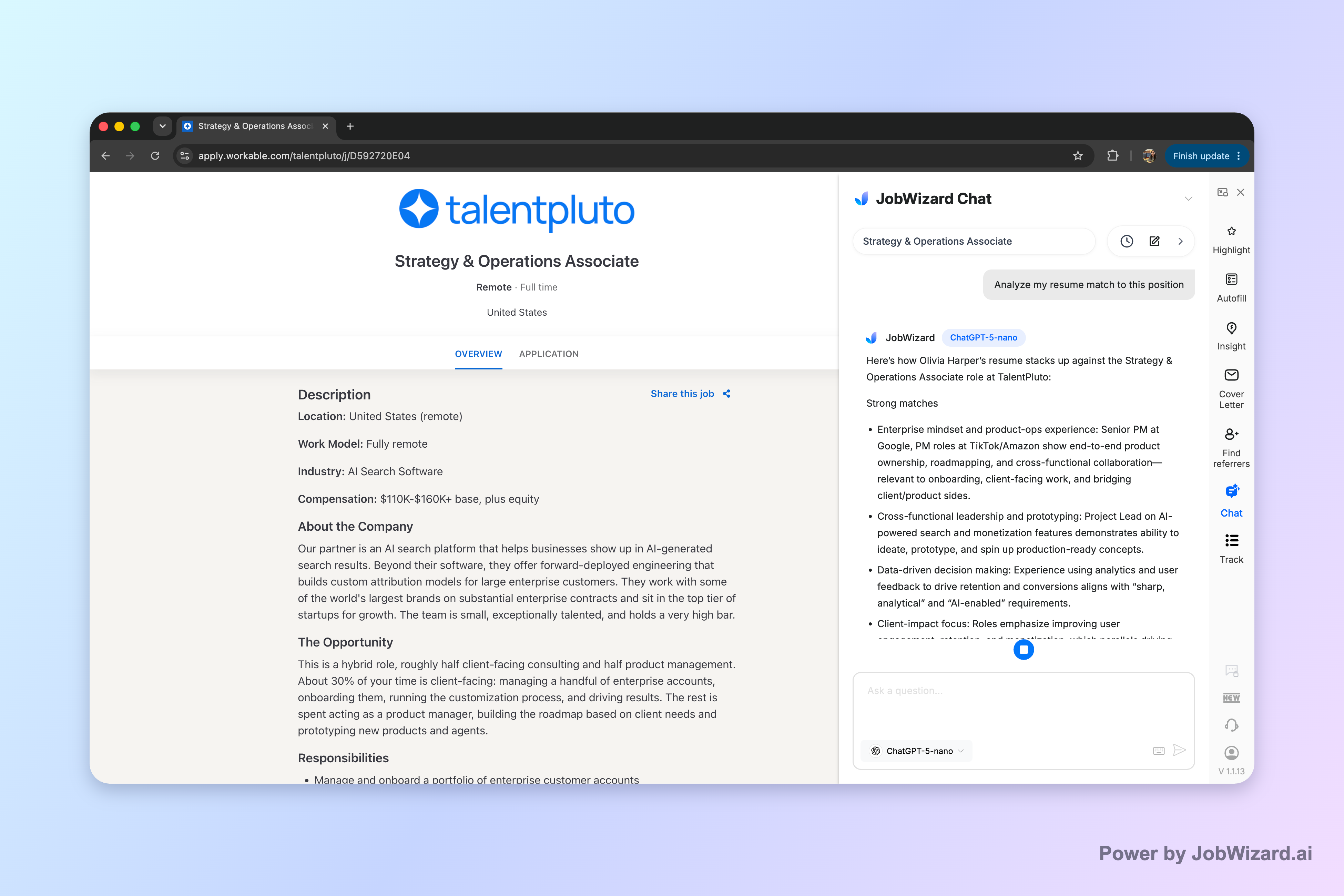
Use it to sharpen your preparation, not to outsource your decision. For example, ask what details in the job description might affect your salary range, or whether your draft clearly distinguishes your minimum from your target. Its analysis is not a recruiter’s decision or a guarantee that you qualify, so verify the answer against the job description and your priorities.
Try a focused follow-up about the current role. Ask JobWizard Career Chat what compensation factors the posting emphasizes, review its response against the job description, and decide on a minimum you would genuinely accept.
Do this automatically with JobWizard
Skip the manual work — JobWizard's Smart Autofill handles this for you.
Frequently asked questions
These quick answers cover common decisions about sharing a salary floor. Use your research and the role’s details to choose the wording that fits your situation.
Should I give a number when asked for my minimum salary requirement?
If the form or recruiter requires a number, give a researched figure or range that reflects your actual floor and the role’s market value. If you can defer, ask about the approved range and total compensation before naming a minimum.
How do I answer a minimum salary requirement question on an application?
Use a researched amount or range that you would genuinely consider, and check whether the field accepts text or only numbers. If it allows a response instead of a figure, you can say that compensation is negotiable based on the role and total package.
Is it better to give a range or one number for salary requirements?
A range can show flexibility, but employers may focus on its lower end. Set that low end at a figure you would accept, and make sure the upper end is realistic for the position and your experience.
What if the employer’s salary range is lower than my minimum?
Ask whether there is flexibility in the base salary or other parts of the compensation package. If the employer cannot meet your genuine minimum, politely decide whether the role is still worth pursuing.
Frequently Asked Questions
Let AI answer these questions for you
JobWizard fills sponsorship, work-auth, and availability answers correctly on every application — free.