What Is Your Current Visa Status? How to Answer—Scripts for Recruiters, Forms, and Interviews
If you’re asked, “what is your current visa status how to answer,” this guide gives you role-safe wording for applications and interviews—plus what to verify before you submit.
Free Chrome extension
Let AI answer these questions for you
JobWizard fills sponsorship, work-auth, and availability answers correctly on every application — free.
“What is your current visa status how to answer” — what to say when a form asks this
You answer “what is your current visa status how to answer” by matching what the job needs (work authorization now and whether sponsorship may be required), not by volunteering every immigration detail.
Imagine you’re filling out an application at 11:47 p.m., and the form forces a yes/no dropdown plus a free-text box. If you hesitate, you risk saying something vague—or worse, something that doesn’t match your documents. This guide helps you craft a confident, recruiter-friendly response you can reuse for forms and interviews.
Key goal: tell the recruiter what you can legally do for this employment right now, and what (if anything) you need next.
What does “current visa status” mean on a job application?
On applications, “current visa status” usually refers to your current legal immigration/work situation for employment in the job’s location, not your travel history.
Most employers use it to understand whether they can legally hire you and whether they might need to sponsor you in the future. Sometimes it’s a dropdown (e.g., authorized / need sponsorship / not authorized). Other times it’s a short text field where you may be asked to add specifics.
Practical translation: Your answer should map to “Can you work for us now?” and “Will we need to sponsor you later?”
What should I put for “current visa status” if I’m already authorized to work?
If you’re authorized to work now, your cleanest answer is the one that clearly states you can work for the employer, plus any relevant limitation only if asked.
Use wording that’s consistent with your documents and your understanding of employer permissions. If the form asks whether you need sponsorship, you should answer that part accurately too.
- Dropdown option: Select the choice that matches “authorized to work” (or equivalent).
- Text box (optional): Add a short line like “Authorized to work in the role/location.”
- Limitations (only if required): If the form explicitly requests constraints, keep them factual and brief.
Copy/paste example (short text): “Authorized to work for this employer in the job location.”
How should I answer “Are you authorized to work?” if I’m on a visa?
Answer “authorized to work” based on whether your current visa/work authorization permits the employment you’re applying for.
Recruiters often treat this as a compliance checkpoint. Don’t interpret it as a request for legal advice—just be accurate and align it with the scope of your authorization.
| Application item | What it typically means | Recommended action |
|---|---|---|
| “Current visa status” (dropdown/text) | Your current immigration/work situation for the job location | Choose the option that matches your current work authorization; add a brief factual clarification only if the form asks |
| “Are you authorized to work?” | Whether you can legally work for the employer right now | Answer yes/no based on your real authorization for the employment |
| “Will you now or in the future require sponsorship?” | Whether the employer may need to sponsor you later | Only state what you know: if sponsorship is likely/needed, say so; if you’re uncertain, use language that accurately reflects your situation and be ready to clarify |
| Free-text “Explain” box | Give the recruiter context without overwhelming detail | Use 1–2 sentences: (1) current authorization, (2) sponsorship/next step if relevant |
Rule of thumb: Match each part of the form with the most truthful, least ambiguous interpretation.
What should I say if I’m waiting for a visa approval or renewal?
If you’re waiting, your best answer states what’s pending and—most importantly—whether you can work now.
Recruiters typically need to know whether there’s a gap between your current authorization and the employer’s hiring timeline. Don’t guess about legal status—if you truly don’t know, say what you know and offer clarification when needed.
- Pending but work-authorized: If you currently can work, say you’re authorized to work while the renewal/extension is pending.
- Pending and not work-authorized: If you can’t work yet, say that authorization is pending and keep it brief.
- Be ready to document: Offer to provide documentation if requested.
Copy/paste template: “My [renewal/extension] is pending. I [am/is not] currently authorized to work for this employer. I can provide documentation if needed.”
Do I need to mention my visa category (F-1, H-1B, etc.) in my answer?
Generally, only mention your visa category if the form asks—or if the recruiter requests it.
In many cases, the employer’s real question is whether you can legally work and whether sponsorship is required. Including visa categories can be helpful when requested, but it can also create confusion if the form doesn’t provide context or if the details are easy to misstate.
- If the form lists categories: select the exact category that matches your situation.
- If it’s free text: focus on authorization and sponsorship rather than naming every label.
- If a recruiter asks in an email: you can confirm the category and add one sentence about work authorization.
Short answer: Prioritize “can you work now?” over “which visa is it?” unless asked.
How do I respond in an interview when they ask about visa status?
In interviews, lead with current work authorization first, then add sponsorship/next-step context only if relevant.
Recruiters usually want a clear, compliance-aligned summary—not a long immigration timeline. Keep your answer to 20–40 seconds and invite follow-up questions.
- Current authorization: “I’m authorized to work for this employer/job location.”
- Sponsorship (only if applicable): “I may need sponsorship in the future / I will not need sponsorship / sponsorship requirements depend on…”
- Close confidently: “If it helps, I can provide details documentation during the process.”
Copy/paste interview script (neutral): “I’m currently authorized to work for this employer in the job location. Regarding sponsorship, my situation is [no sponsorship needed / sponsorship may be required], and I’m happy to clarify if you need more detail.”
When a recruiter asks “Do you need sponsorship?” what is the best way to answer?
The best way is to answer the sponsorship question directly, then support it with a short, factual next-step statement.
Even if your visa category is complicated, you can keep this simple. The recruiter doesn’t want legal analysis—they want to understand whether your employment can proceed without an employer-initiated sponsorship process.
- If you don’t need sponsorship: say so plainly.
- If you do need sponsorship later: say that sponsorship may be required in the future (and don’t promise timelines you can’t guarantee).
- If you’re unsure: say you can clarify based on documentation and invite them to ask specific questions.
Copy/paste template: “At this time, I [do / do not] need sponsorship to work in the job location. If the requirements change, I’ll communicate updates promptly.”
How to follow up after submitting your application with visa-status details
Follow up only if you have clarifying, updated information—and keep it short and recruiter-friendly.
If you submitted a form with “pending” language or you provided minimal details, a short note can reduce confusion. Don’t over-explain; reference the job and restate the essential authorization/sponsorship points.
Follow-up email template (short):
Subject: Update on work authorization for [Job Title] — [Your Name]
Hello [Recruiter Name],
I’m following up on my application for the [Job Title] role. I wanted to confirm my work authorization status: [one sentence on current authorization]. Regarding sponsorship, [one sentence on whether sponsorship is needed now or in the future].
If helpful, I can provide documentation during the process.
Thank you,
[Your Name]
- Include only what changed: If nothing changed, don’t send extra visa text.
- Use consistent wording: Match what you entered in the application to avoid contradictions.
- Keep it professional: Clear and brief beats detailed and defensive.
Key takeaway: A follow-up should reduce uncertainty, not reopen every immigration detail.
How to sanity-check your answer before you hit submit
Before you submit, verify that your form answers match each other and align with your actual work authorization scope.
Many “bad outcomes” aren’t about dishonesty—they’re about mismatch. For example, you might select “authorized,” but also write “need sponsorship,” or you might describe work authorization without addressing a “now or later” sponsorship checkbox.
Use this quick checklist:
- Consistency check: Do your “authorized to work” and “need sponsorship” answers agree?
- Scope check: Does your authorization cover the job location and employer situation as stated?
- Timing check: If you’re pending renewal/extension, do you state whether you can work now?
- Clarity check: Is your free-text explanation 1–2 sentences and easy to understand?
If you want a second set of eyes on how you’re presenting yourself for a specific role, you can also ask JobWizard’s Career Chat to help you frame your response around the job’s requirements—then verify the output against your actual details before you apply.
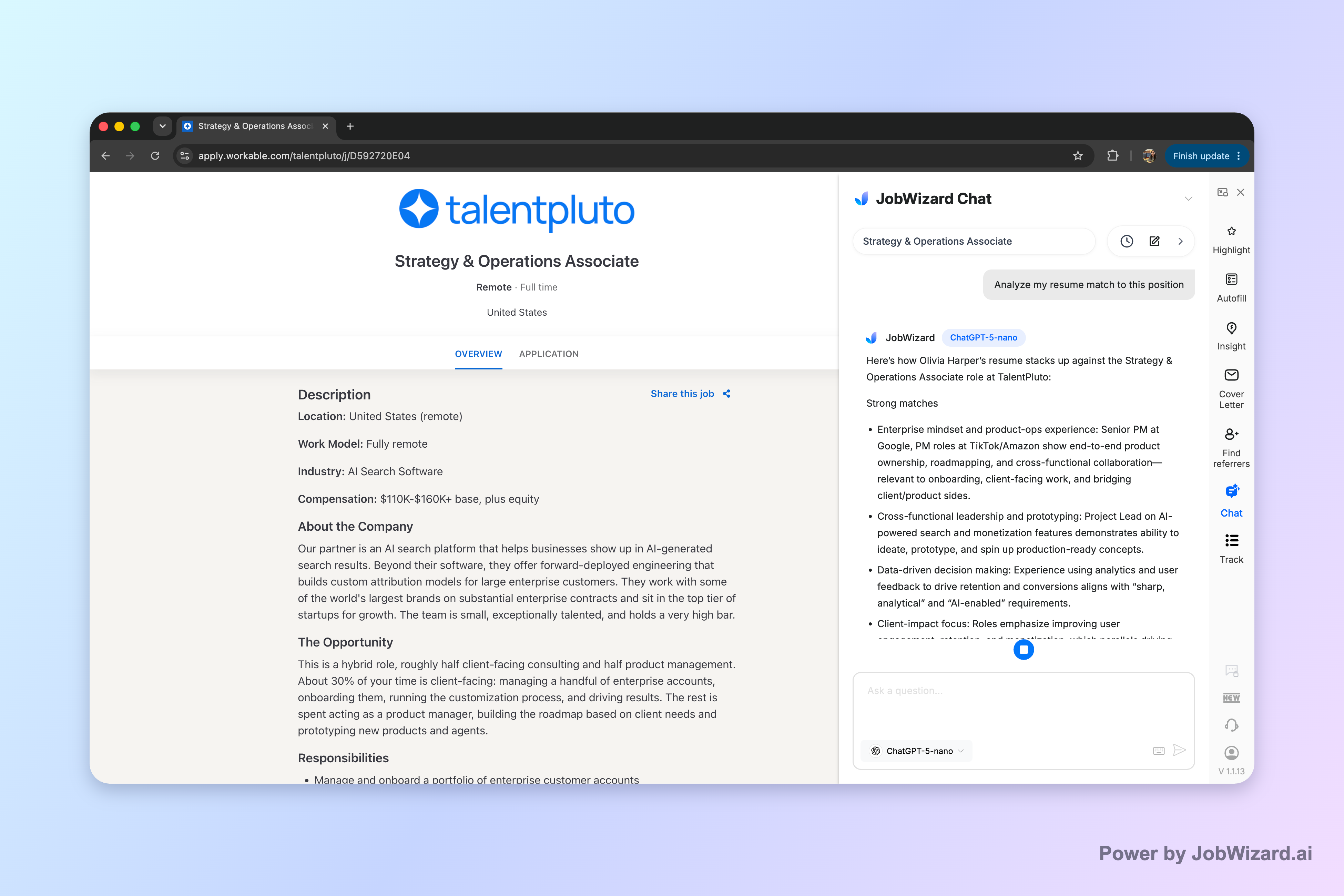
Key takeaway: Use Career Chat to refine your wording around the role, but always ensure the visa/work authorization statements are accurate to your situation.
What is the right answer if you’re not sure which option to pick?
If the dropdown options don’t match your situation, choose the closest truthful option and use the text box to clarify.
When options are vague, applicants often pick the most hopeful choice. Instead, use neutral accuracy: describe what’s true now and what’s pending later, without guessing legal outcomes. If you genuinely can’t determine the correct categorization, use the free-text field to describe the authorization status and readiness to provide documentation.
- Pick the closest truthful option: Don’t force a “yes” if you’re pending authorization.
- Clarify in one sentence: State whether you’re authorized to work now.
- Offer documentation: Make it easy for the recruiter to verify.
Copy/paste example: “My work authorization is currently [status]. I can provide documentation if needed; sponsorship [is/is not] required based on the authorization timeline.”
Do this automatically with JobWizard
Skip the manual work — JobWizard's Smart Autofill handles this for you.
FAQ: What is your current visa status how to answer
What does “current visa status” mean on a job application?
It usually asks for your legal immigration/work authorization situation in the country where the job is located (for example, whether you’re authorized to work now and whether you might need sponsorship later).
How should I answer “Are you authorized to work?” if I’m on a visa?
Answer based on your actual authorization: if you’re currently authorized to work for the employer (or have work authorization that covers the employment), say so. If you need sponsorship or your authorization depends on a specific condition, explain briefly and align it with your visa details.
What should I say if I’m waiting for a visa approval or renewal?
Be precise: explain the stage you’re in (e.g., pending renewal/extension) and whether you currently have work authorization that allows you to work while it’s pending. Keep the rest simple and offer to provide documentation if requested.
Do I need to mention my visa category (F-1, H-1B, etc.) in my answer?
Only if the form or recruiter asks for it. If it’s optional, focus on what the employer needs to know—whether you’re authorized to work now and whether you may require sponsorship—then offer to clarify details during screening if asked.
How do I respond in an interview when they ask about visa status?
Lead with current work authorization status first, then add a short sponsorship/next-step sentence only if relevant. Avoid long explanations; invite the recruiter to ask follow-ups and offer to provide supporting details.
Can I say “I’m eligible to work” if the visa permits employment?
If that statement is true for your situation, yes—but make sure it matches your real work authorization (including any limitations tied to the visa terms). When in doubt, choose wording that accurately reflects what you can legally do.
Should I follow up after submitting my application with visa-status details?
Yes, if you have new or clarifying information (for example, a document update) and the recruiter’s contact path supports it. Keep your follow-up short, reference the job, restate the key authorization point, and offer to provide documentation if needed.
What are the most common mistakes people make when answering visa-status questions?
The most common mistakes are (1) contradictions across different fields, (2) vague answers that don’t clarify authorization “now,” and (3) adding too much detail that creates confusion. Keep it factual, consistent, and brief.
Want to speed up applications without losing control of sensitive answers? Use JobWizard to autofill repetitive fields, then review-before-submit so you can personally confirm visa/work authorization, sponsorship language, and any custom questions before you send. Get started with JobWizard and tailor your final wording with confidence.
Also see: How to Answer Job Application Questions: A Field-Tested Method for Confident, Consistent Responses, How to Answer “What Is Your Availability to Interview” (Scripts That Get Replies), What Is Your Availability Meaning? How Recruiters Read Your Schedule (and How to Reply), and How to Answer “May We Contact Your Current Employer” on a Job Application (Script + Tips).
Frequently Asked Questions
Let AI answer these questions for you
JobWizard fills sponsorship, work-auth, and availability answers correctly on every application — free.