How to Answer Work Authorization Status: Scripts for Every Common Application Prompt
Learn how to answer work authorization status prompts with clear, truthful scripts and examples you can paste. Includes a review-first checklist and email follow-up template.
Free Chrome extension
Let AI answer these questions for you
JobWizard fills sponsorship, work-auth, and availability answers correctly on every application — free.
Two days after you submit your resume, a recruiter replies: “Quick question—what’s your work authorization status?” You want to answer clearly, but you also don’t want to over-share, guess incorrectly, or create confusion about sponsorship.
This guide on how to answer work authorization status walks you through what to write for each common application prompt, plus paste-ready scripts, a review checklist, and FAQs you can use when the form wording isn’t straightforward.
What does “work authorization status” usually mean on job applications?
Work authorization status is the employer’s way of confirming whether you’re legally permitted to work in the location now, and whether you’ll need sponsorship to continue employment.
Most forms ask one of two things: (1) whether you can work immediately, and (2) whether you need the company to sponsor your work authorization now or later. The exact wording varies by applicant tracking system (ATS), so it helps to answer the question you were actually asked—word for word.
Key takeaway: Treat “work authorization status” as a precise compliance question: answer what the form asks (now vs. future, sponsorship vs. no sponsorship), not what you wish it asked.
What should I put for work authorization status if I’m authorized to work in the U.S. now?
If you’re already authorized to work, answer “yes” to work authorization and keep the line short and factual.
Choose the response that matches the form’s options. If it’s a short text field, use a direct sentence. If it’s a checkbox, pick the “authorized to work” equivalent. If there’s also a sponsorship question, answer sponsorship only if the form includes it.
- Short text option: “Yes. I am authorized to work in the United States.”
- Sponsorship add-on (only if asked): “No sponsorship required.”
Key takeaway: The simplest truthful answer that matches the form wording is usually the best answer.
How do I answer “Do you now or will you in the future require sponsorship?”
For the sponsorship prompt, answer “no” if you truly won’t need sponsorship now or later, and answer “yes” only if you will.
This question is often split into “now” and “future,” so your goal is to be consistent with your real timeline. Avoid vague phrases like “maybe” or “depends on policy.” Instead, tie the answer to your authorization reality.
- If no sponsorship is needed: “No. I do not require sponsorship now or in the future.”
- If sponsorship will be needed later: “Yes. I will require sponsorship to continue employment after my current authorization ends.”
When you answer “yes,” you don’t need to list every document. Keep details minimal and accurate, then offer to discuss specifics later if requested.
Key takeaway: Don’t guess—commit to what you can support about future sponsorship needs.
What do I write if the form asks “Are you currently authorized to work in this country?”
If the form asks whether you’re authorized right now, answer for the present tense.
Employers use this to filter candidates who can start immediately without a sponsorship process. If you are authorized, say so directly. If you’re not authorized, you’ll typically need to select an option that indicates you would need authorization/sponsorship before working.
| Form prompt (what it asks) | Meaning | Recommended action |
|---|---|---|
| “Are you currently authorized to work in this country?” | Your present legal ability to work | Select the option that matches your current authorization; don’t describe future possibilities unless the form asks |
| “Do you now or will you in the future require sponsorship?” | Whether the employer must sponsor you now or later | Answer yes/no based on your actual future timeline; keep it brief |
| “Will you need sponsorship now or in the future?” | Similar to sponsorship prompt; wording varies | Translate “now vs future” into your situation; avoid vague terms |
| “Work authorization” (single dropdown) | A category combining current authorization and sponsorship status | Pick the closest matching category; if unsure, look for a sponsorship sub-question |
| “Explanation” (free-text field) | Optional clarification if your answer needs context | Use a one-sentence clarifier; don’t list document numbers unless requested |
Key takeaway: Map the prompt to whether it’s asking about “now,” “future,” or “sponsorship,” then answer that exact part.
How should I answer if my work authorization is tied to a specific end date?
If your authorization has an end date, you can be straightforward about “authorized until” without oversharing.
Some forms allow a short explanation field. If they do, you can clarify the limitation in a single sentence that helps the recruiter understand start timing and continuity.
- Example (if you can work until a date): “Yes, authorized until [month/year].”
- Optional add-on (only if helpful and truthful): “I will discuss continued authorization as needed.”
If the form does not ask for dates, avoid stuffing one into a field that might be too short or not intended for it—use the simplest option that matches “authorized now.”
Key takeaway: Give enough clarity to reduce recruiter back-and-forth—without turning the answer into a document dump.
What if the application asks for work authorization “type” (visa/status/category)?
When a form requests a “type,” choose the category that matches your actual authorization rather than substituting a generic label.
Some ATS systems include fields that look like visa categories or work eligibility categories. If the exact label is not present, use the closest available option and consider the explanation field if one exists.
- Rule of thumb: If there’s a field for a specific category, don’t replace it with a broad phrase like “eligible to work.”
- If there’s no perfect match: Use the closest category and add a one-sentence explanation only if the form provides an explanation box.
Key takeaway: Category fields want accuracy—use the closest match and add minimal clarification when necessary.
Can I say “I’m eligible to work” instead of naming my work authorization status?
You can sometimes use “eligible to work,” but only when the form accepts that level of specificity.
Many prompts are designed for a yes/no response or a dropdown that implies sponsorship status. In those cases, replacing details with a broad phrase might create ambiguity or lead to mismatched options.
- If the form is checkbox-like: prefer the closest “authorized” option.
- If the form is free-text: a concise “authorized/eligible” line may be fine—especially if sponsorship is handled separately.
If you’re unsure which phrasing the employer expects, answer the form exactly as written and keep a consistent record for later (interviews and any follow-up questionnaires).
Key takeaway: Match the form’s expected granularity; use “eligible” when it fits the prompt, not when it replaces the needed category.
Should I mention EAD, CPT, OPT, or visa type in my application answer?
In most cases, mention document or visa specifics only if the prompt asks for it.
If the question is simply “authorized to work,” you can answer with a short, accurate statement and handle document details later if requested. Some employers don’t need the acronym list up front; they mainly need to know whether you can legally work and whether sponsorship is required.
- If the form includes fields for it: provide what it requests.
- If it doesn’t: keep the answer concise, and be prepared to share details later if asked.
Key takeaway: Don’t over-share acronyms—answer the question the ATS asks, then expand only if requested.
How do I handle mistakes or follow up after submitting an application?
If you submit and then realize your work authorization status answer needs clarification, send a short follow-up that corrects the record.
Your goal is to be transparent and concise. Avoid defensive language. State what you answered, what’s accurate, and offer to provide supporting details through the proper channel if requested.
Copy-paste follow-up email template (after applying)
Subject: Work authorization clarification for [Position Title] — [Your Name]
Hi [Recruiter Name],
I wanted to quickly clarify my work authorization status for the [Position Title] role. I am [authorized/not authorized] to work in [country/state], and [no sponsorship is required / sponsorship may be required in the future] based on my current authorization.
If helpful, I can provide additional information through your standard process.
Thank you for your time,
[Your Full Name]
Key takeaway: Keep corrections factual, short, and easy for the recruiter to file correctly.
How can JobWizard Career Chat help me craft a confident work authorization status answer?
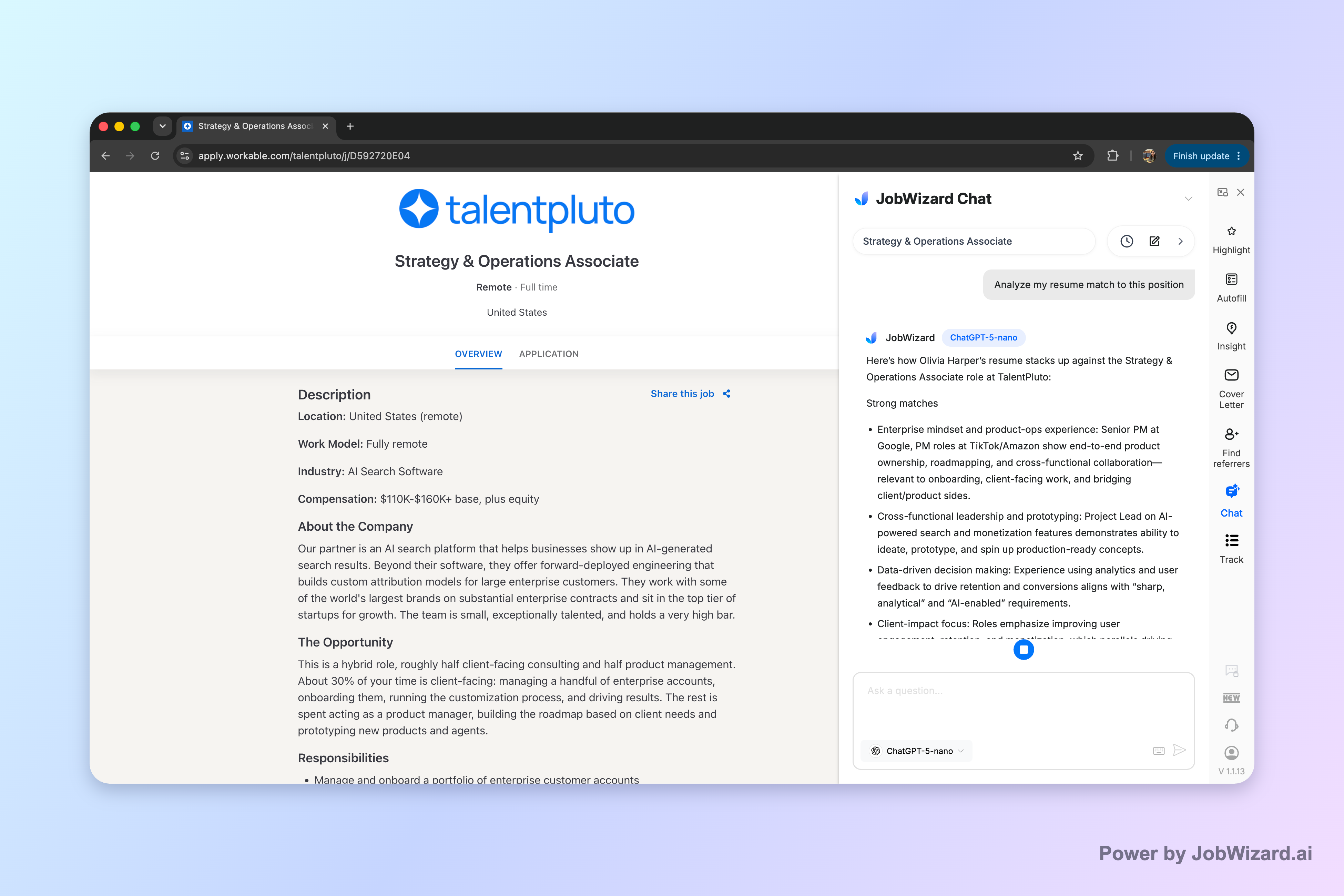
JobWizard Career Chat can help you refine a clear, truthful response by keeping the current role in context as you draft and tighten your wording.
Career Chat keeps the current role in context so you can ask follow-up questions about your resume fit and application strategy without re-pasting the full job description. It’s not a recruiter decision or a guarantee that you qualify—so you should review any suggestions before submitting.
- What to ask: “Given this role, what’s a concise and compliant way to answer this work authorization question?”
- What to verify yourself: your current authorization, your future sponsorship needs, and the exact prompt wording on the application.
- How to reduce errors: paste the exact question from the form and ask for a one-sentence response that matches it.
Key takeaway: Use Career Chat for wording and consistency checks—then submit only what you can support.
What’s the fastest way to review my work authorization status answer before I submit?
Use a quick consistency pass so your answer matches the form prompt and what you’ll likely say later.
Here’s a checklist you can run in under two minutes:
- Step 1: Copy the prompt exactly (including “now” vs “future”).
- Step 2: Confirm your current status and whether you can start work immediately.
- Step 3: Confirm future sponsorship needs (yes/no) based on your real timeline.
- Step 4: Match the form’s expected output (checkbox vs dropdown vs free-text).
- Step 5: Remove guesswork—no vague language like “maybe.”
- Step 6: Consistency check against any later forms you may see (or your interview talking points).
If you’re still stuck, start with the exact prompt and search for examples, then adapt to your situation using truthful, minimal phrasing.
Key takeaway: The fastest “good answer” is the one that’s precise, prompt-matched, and consistent with your real authorization timeline.
Do this automatically with JobWizard
Skip the manual work — JobWizard's Smart Autofill handles this for you.
FAQ: how to answer work authorization status
What should I put for work authorization status if I’m authorized to work in the U.S. now?
State that you are authorized to work now (and briefly note the basis) using a direct, truthful line like: “Yes. I am authorized to work in the United States.” Then add a one-liner that matches your situation (e.g., “No sponsorship required.”) if the form asks.
How do I answer “Do you now or will you in the future require sponsorship?”
If you do not need sponsorship, answer “No” and keep it simple. If you will need sponsorship in the future, answer truthfully with a forward-looking line (e.g., “I will require sponsorship to continue employment after my current authorization ends.”) and keep details minimal unless the form requests specifics.
What if my work authorization is tied to a specific date or status—how specific should I be?
Be specific about the high-level constraint the form is asking for, not every document detail. Example: “Yes, authorized until [month/year].” If the application allows, also add a short clarifier like “I will discuss continued work authorization as needed.”
Can I say “I’m eligible to work” instead of naming my work authorization status?
Sometimes. If the form accepts a checkbox or short text like “eligible/authorized,” that can be appropriate. If it asks a more detailed category (e.g., visa type or sponsorship required), choose the category that matches your situation rather than a broad label.
Should I mention EAD, CPT, OPT, or visa type in the application answer?
Only if the prompt is asking for it (or the form includes fields where that information is required). If it’s a general work authorization status question, a concise “authorized to work” plus a sponsorship-required or not-required statement is often enough. You can save the document details for later steps if requested.
What should I do if I’m not sure which option matches my work authorization status?
Pick the option you can support with accurate information, and don’t guess. Re-check the form’s exact wording and definitions if provided. If needed, ask the hiring team a short clarification question after submitting (or before, if the application has a contact field).
How can I double-check my answer before I submit?
Read the question verbatim, confirm your current authorization and any future sponsorship needs, and ensure your answer matches what you’ll likely say in interviews. Then do a quick consistency pass: the short application answer, your resume summary (if you include authorization info), and any later forms.
Can I use JobWizard Career Chat to refine my work authorization status response?
Yes—use Career Chat to keep your current role in context while you refine a short, truthful response and confirm how it aligns with the job description. It does not decide whether you qualify, so review the output and submit only what you can support.
Related reads: How to Answer Job Application Questions: A Field-Tested Method for Confident, Consistent Responses, Work Authorization Question Examples for International Students: How to Answer Clearly (and Confidently), How to Answer "Do You Have Work Authorization?" on a Job Application, and How Did You Hear About Us Interview Question? Use This Answer Framework to Sound Intentional.
Ready to apply with fewer mistakes? Use JobWizard to keep your application answers consistent and review-focused—then use Career Chat to refine a concise, truthful response to the exact work authorization prompt before you submit.
Frequently Asked Questions
Let AI answer these questions for you
JobWizard fills sponsorship, work-auth, and availability answers correctly on every application — free.