
How to Answer Desired Salary on Online Application Forms Without Undervaluing Yourself
Learn how to answer desired salary on online application forms with a researched range, a clear minimum, and a plan for required fields. Use practical examples to protect your negotiating room without leaving the question unanswered.

Free Chrome extension
Let AI answer these questions for you
JobWizard fills sponsorship, work-auth, and availability answers correctly on every application — free.
How to answer desired salary on online application forms can feel like a high-stakes decision: enter too little and you may undervalue your work, enter too much and you may worry about screening yourself out. The best response is grounded in research, respects your actual minimum, and leaves room to discuss the full compensation package.
Before typing a number, check whether the field accepts a range, free-text response, or only one figure. Then decide what you would genuinely consider, rather than guessing what an employer wants to hear.
How to answer desired salary on online application forms
Give a researched answer that reflects the role, location, and pay you would actually accept. The right entry depends on the form: a range can preserve flexibility, while a required numeric field may call for one carefully chosen figure.
Start by separating three figures in your own notes:
- Your minimum: The lowest compensation you would realistically accept after considering your expenses and alternatives.
- Your target: The amount you believe is fair for the work and your qualifications.
- Your stretch: A higher amount you could support with relevant experience, specialized skills, or unusually broad responsibilities.
These are planning tools, not numbers you must disclose together. In particular, avoid entering your private minimum as your desired salary just because you want to appear flexible. If the employer’s range is higher, a low number may anchor a later conversation below what the position can support.
Research comparable positions in the same area and industry. Look at the job’s scope, seniority, required skills, and whether compensation is described as base salary or total compensation. If the listing names a range, compare your expectations with that range rather than treating salary figures for different locations or levels as interchangeable.
For the broader application-question strategy, see How to Answer Job Application Questions: A Field-Tested Method for Confident, Consistent Responses. It can help you keep your compensation response consistent with the rest of your application.
How to answer desired salary on an online application when the field varies
Match your answer to the exact field instead of forcing the same response into every form. A free-text box, a range selector, and a mandatory numeric field each call for a different approach.
| Field type | Practical response | What to check |
|---|---|---|
| Free-text box | “Open to discussing a competitive range based on the role and total compensation.” | Make sure the wording is clear and professional, not evasive. |
| Range accepted | Enter a researched range you would genuinely consider. | Confirm the lower end is not below your minimum. |
| One required number | Choose a researched figure that meets your minimum and fits the role. | Check whether the form specifies annual, monthly, or hourly pay. |
| Optional field | Leave it blank if you prefer to discuss compensation later. | First confirm that the field is truly optional. |
If the form allows text, a short statement can express flexibility without suggesting that compensation does not matter. For example: “I’m open to discussing a competitive range based on the responsibilities and total compensation.” Use this only if it accurately reflects your position.
If a range is allowed, make it purposeful. The bottom should be an amount you would accept, not a placeholder you hope to negotiate upward. The top should be plausible for the role and your qualifications, rather than an arbitrary figure added to make the range look wide.
If the application demands a single number, do not treat that number as a promise to accept any eventual offer. Enter an informed figure you would seriously consider, and be ready to explain how you arrived at it if compensation comes up later.
Build a salary range without giving away your leverage
A useful range is based on evidence and your minimum, not on a guess about what will keep the employer interested. Choose a defensible span you can explain and that accounts for the position’s actual scope.
- Review the posting. Note the listed level, duties, required experience, location, and any employer-provided compensation range.
- Compare similar jobs. Use credible salary information for comparable roles in the same market, and check whether figures refer to base pay or total compensation.
- Assess your fit. Consider the experience and skills you bring that directly match the responsibilities, without assuming that every qualification guarantees a higher offer.
- Set your private minimum. Decide what makes an offer workable for you before entering a number into a form.
- Choose a range you can defend. Keep its lower end at or above your acceptable threshold and its upper end within a plausible, researched target.
For example, imagine a posting gives a salary band and asks for your desired range. If your research and experience point to compensation in the upper half of that band, you might name a range within that area rather than repeating the entire employer range. The specific figures depend on the job, market, and your situation; there is no universal range that fits every application.
Be careful with very broad ranges. A span that covers almost any possible offer may make it harder for the employer to understand your expectations, while an overly narrow range can suggest you have little flexibility. Use the narrowest range that still reflects what you would consider and what your research supports.
For questions worded specifically around a minimum, use a response that protects your floor without confusing it with your ideal target. See How to Answer “Minimum Salary” on an Application Without Closing Doors for that related scenario.
Examples for common desired-salary fields
Use a response that answers the form clearly while keeping your reasoning consistent. These examples are starting points; adjust them to the employer’s wording and your real compensation needs.
- Text field, flexible: “I’m open to discussing a competitive range based on the responsibilities and total compensation.”
- Text field, range requested: “Based on the role and my experience, I’m targeting a researched range that aligns with the position’s scope and overall package.” If the form expects actual figures, provide them rather than leaving the statement vague.
- Numeric field, annual salary: Enter one researched annual figure that you would genuinely consider and that is not below your minimum.
- Hourly pay field: Confirm that the form requests an hourly rate, then enter a figure based on comparable work and your acceptable minimum.
- Optional question before you know the range: If you can skip it, consider waiting until you understand more about the role. If you choose to answer, state your flexibility honestly.
When a form asks for a “desired salary,” it usually seeks an expectation, not necessarily your absolute minimum. A “minimum salary” field is different: it asks for your floor. For more wording and context, read How to Answer “What Are Your Salary Expectations” on a Job Application.
If the wording asks for your minimum salary requirement, keep the distinction explicit in your own thinking. The article How to Answer What Is Your Minimum Salary Requirement Without Pricing Yourself Out focuses on answering that version without treating it as identical to a desired-salary prompt.
What to do after you submit the application
Keep your reasoning ready so you can revisit your expectations when you learn more about the role. An application field is one part of the hiring conversation; it may not capture benefits, bonus structure, work arrangements, or the final scope of the job.
Before an interview or recruiter conversation, write down why your range is reasonable. Tie it to comparable roles, the responsibilities listed, and relevant experience. This makes it easier to explain your answer calmly without improvising or lowering your expectation simply because someone asks whether it is flexible.
If an employer shares a compensation range later, compare it with your minimum and consider the entire package. Ask clear questions about what the stated figure includes, such as whether it refers to base salary or includes variable compensation. Avoid assuming that two offers with the same headline salary have identical value.
Career Chat can help you think through a follow-up question about the current role while keeping that role in context, so you do not need to paste the job description again. Its analysis is not a recruiter decision or a guarantee that you qualify; verify suggestions against the job description and your own priorities.
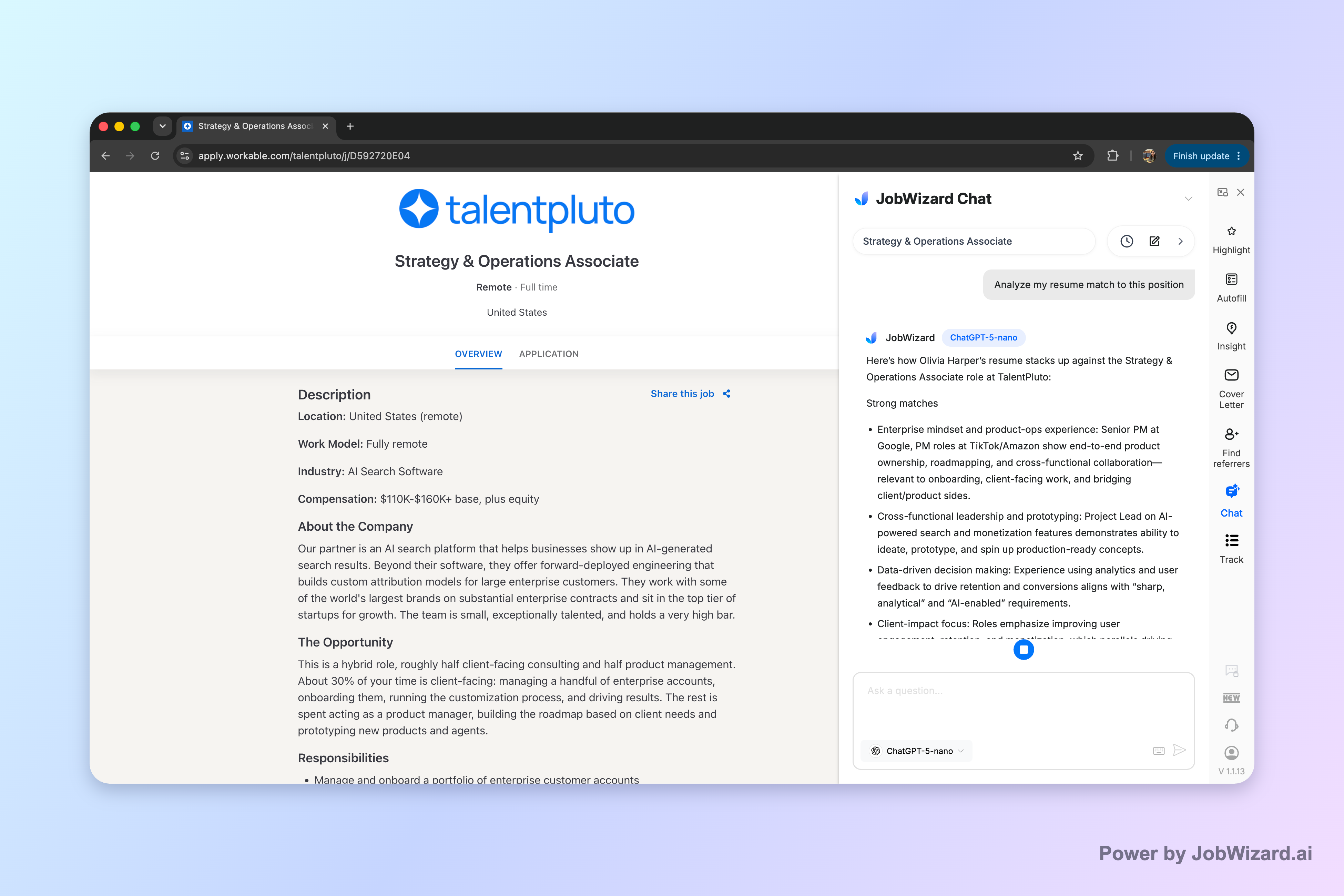
Use JobWizard Career Chat to ask a focused follow-up question about the role and your application strategy, then check the answer against the job description before deciding what to say.
Do this automatically with JobWizard
Skip the manual work — JobWizard's Smart Autofill handles this for you.
Frequently asked questions
How to answer desired salary on online application forms when the field is required?
If the field requires a number, enter a researched figure that meets your minimum acceptable pay and fits the role and location. If it accepts text, use a concise response such as “Open to discussing a competitive range based on the role and total compensation.”
Should I put a range or one number for desired salary?
Use a range when the form allows it and you have a reasonable basis for both ends. If it accepts only one number, choose a researched figure you would genuinely consider rather than a number below your minimum.
What if I do not know the salary range for the job?
Research comparable roles in the same location and industry, then account for the responsibilities and your experience. If the form permits text, say that you are open to discussing compensation based on the full role and package.
Can I negotiate after entering desired salary on an application?
Often, the application response is an initial compensation signal rather than a complete negotiation. Be prepared to explain your research and revisit the number when you learn more about the role, benefits, and overall package.
Frequently Asked Questions
Let AI answer these questions for you
JobWizard fills sponsorship, work-auth, and availability answers correctly on every application — free.