
Foreman Resume Keywords: How to Mirror Job Requirements Without Guessing
Learn how to use foreman resume keywords by extracting requirements from the job description, mapping them to your experience, and verifying each edit before you apply. Use JobWizard to structure job requirements and identify resume expression gaps.

Free Chrome extension
See your resume's match score for any job
JobWizard compares your resume to each job description and shows the exact keywords to add — free.
You’re applying for a foreman role and wondering why your resume isn’t getting traction. A common culprit is the way your experience is described—not whether you have the right experience. That’s where foreman resume keywords come in: the specific terms job postings use for responsibilities and qualifications (like crew supervision, safety compliance, scheduling, quality checks, and workflow coordination). When your resume mirrors those requirements with accurate language, you improve how easily screening systems and recruiters can spot fit.
In this guide, you’ll learn a job-driven workflow for choosing foreman resume keywords—then validating them so your edits are truthful. You’ll also see how JobWizard helps you structure a job description into reviewable components and diagnose expression gaps.
What “foreman resume keywords” really mean (and what they don’t)
“Keywords” can sound like a trick, but for foreman roles it’s more practical than it sounds. Think of foreman resume keywords as the employer’s vocabulary for evidence—the words they use to define what a good foreman does and what they require.
Typically, foreman job postings include terms under categories like:
- Responsibilities: leading crews, coordinating daily tasks, reviewing work progress, scheduling labor, managing workflow
- Qualifications: years of experience, trade knowledge, leadership history, safety training, communication skills
- Requirements: compliance expectations (for example, jobsite safety), quality standards, documentation habits
What foreman resume keywords are not: they’re not a guarantee that an ATS will “approve” your resume, and they’re not a reason to add phrases you can’t support. Your aim is to use the job’s categories and terminology as a mapping tool—then back it up with real examples from your work history.
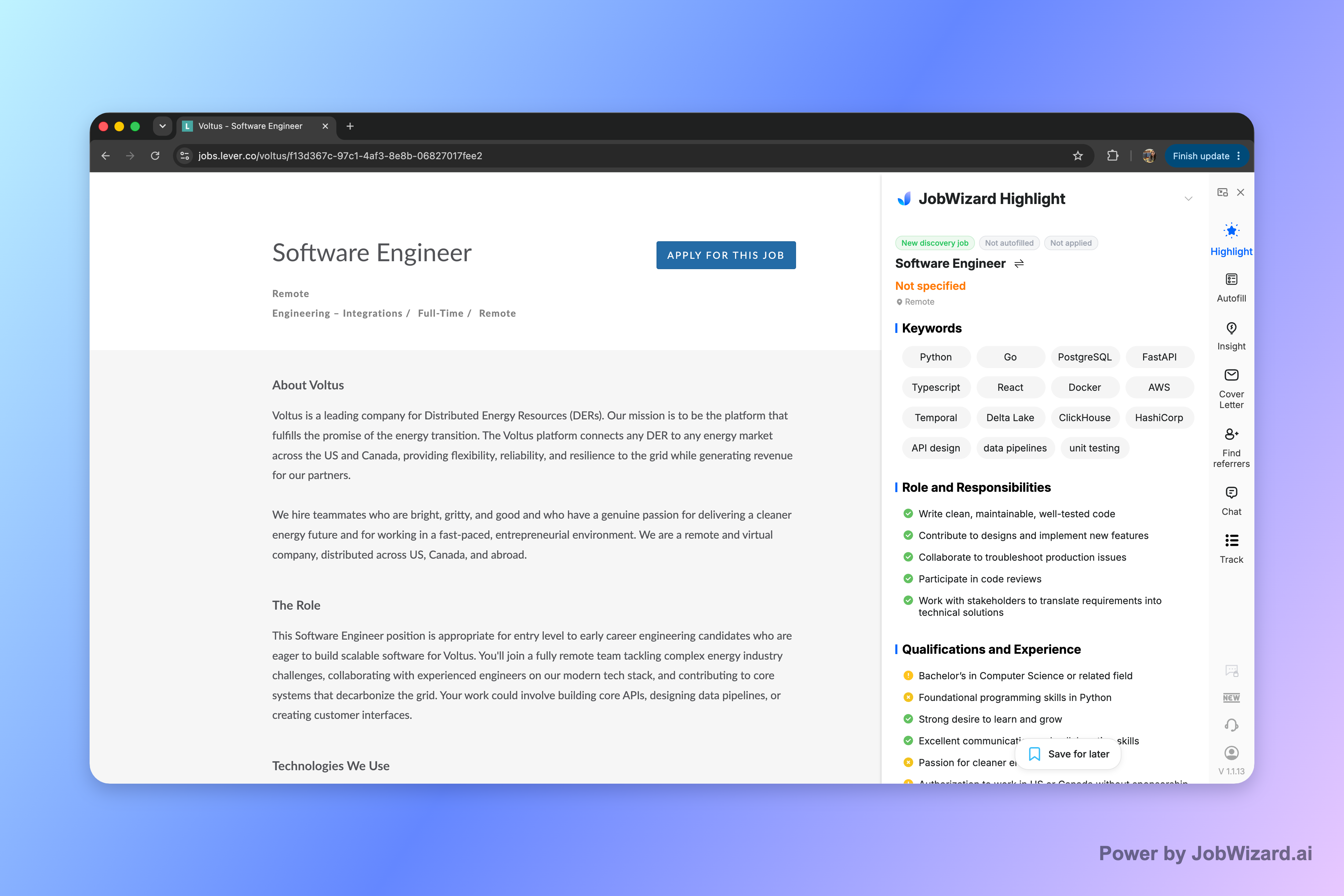
JobWizard can organize a job description into keywords, role responsibilities, and qualifications so you can review requirements more systematically.
Step-by-step: How to extract the right foreman resume keywords from the job posting
If you want your resume to align with what matters, start where the hiring manager started: the job description. Here’s a repeatable workflow you can run for each foreman role.
1) Pull keywords from responsibilities (not just the “requirements” section)
Many applicants focus only on qualifications. For foreman resume keywords, responsibilities are often where the strongest evidence hides—because that’s where the daily work language appears.
Example (how to convert job text into resume-ready phrases):
- If the posting says “supervise crew daily” → choose resume language like “supervised daily crew activities” (if accurate)
- If it says “coordinate workflow and ensure work aligns with schedule” → use “coordinated workflow to maintain schedule alignment” (again, only if true)
- If it says “verify completed work meets quality standards” → use “performed quality checks on completed tasks”
2) Pull keywords from requirements—and keep them grouped
Create a simple list in three buckets so you can tailor quickly:
- Safety & compliance (training, safety practices, incident reporting, compliance language)
- Leadership & coordination (crew supervision, shift coordination, subcontractor coordination, communication)
- Technical scope (trade-specific knowledge, jobsite responsibilities, documentation, quality control)
This grouping matters because it prevents keyword stuffing. Instead of randomly sprinkling terms, you place them into the right bullet categories.
3) Use JobWizard to diagnose resume expression gaps (not just keyword matching)
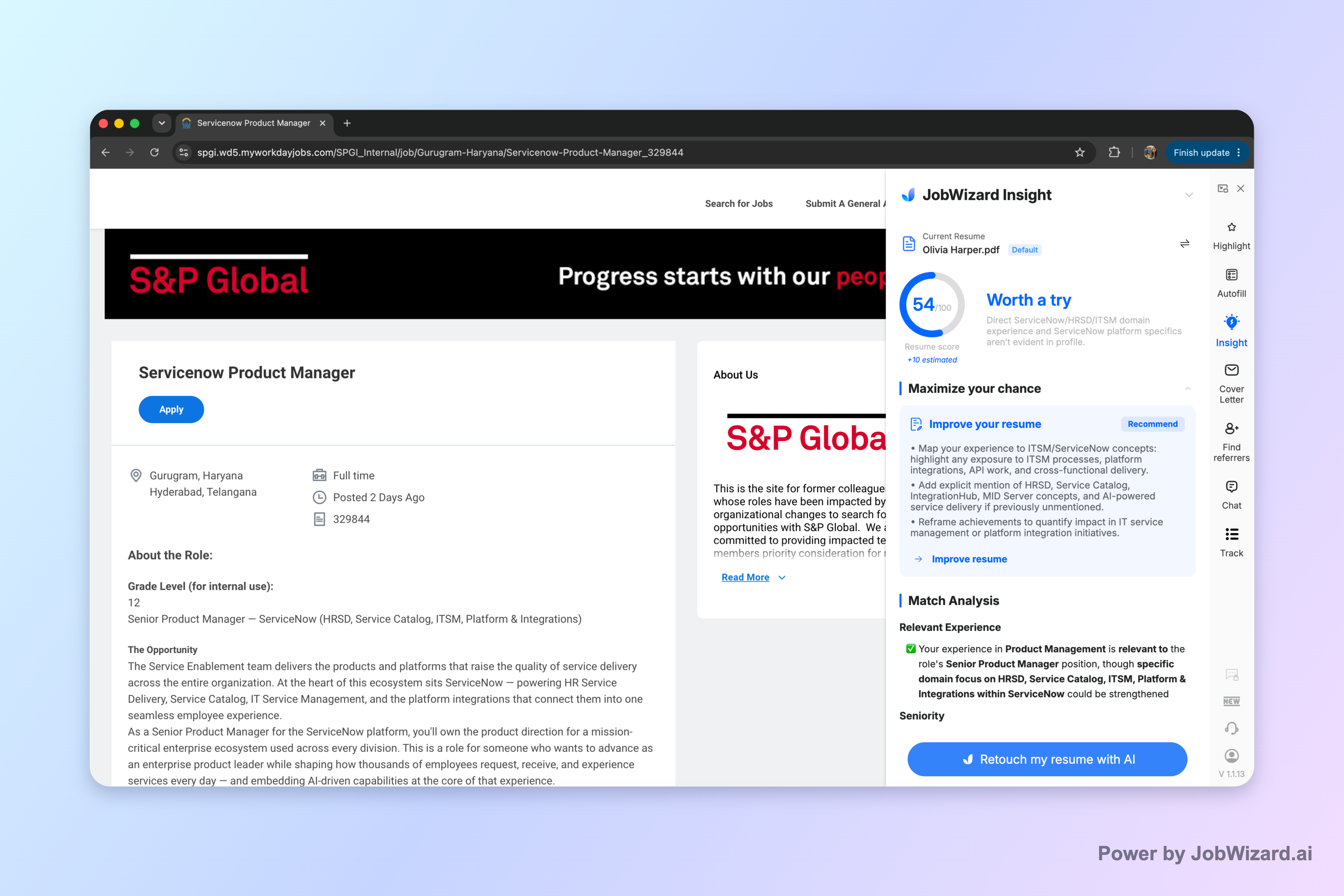
Once you’ve pulled keyword buckets from the job description, compare them to your current resume. JobWizard’s Insight compares your selected resume with the current job description and presents a match score, an overall assessment, and improvement suggestions. It can also turn the JD-based diagnosis into an editable resume revision draft—so you can address the gaps you actually have.
Important limitation: the score is not a hiring probability and does not guarantee ATS passage or an interview. Use it as a direction finder, then verify every suggested resume change and keep only accurate experience.
Translate keywords into bullets: foreman resume examples that actually show proof
Foreman resume keywords work best when they appear in context: the “keyword phrase” should connect to a real responsibility you performed. That means rewriting bullets so they read like evidence.
Below are examples of how to convert common foreman JD categories into resume bullets. Adapt the wording to fit your exact background.
Safety & compliance bullet examples
- Safety compliance: “Enforced jobsite safety procedures during daily operations, supporting compliance with company and site requirements.”
- Documentation: “Completed safety and daily documentation to track task status, hazards, and corrective actions.”
- Quality + safety overlap: “Coordinated safety checks before work progression to reduce rework and ensure correct execution.”
Leadership & crew coordination bullet examples
- Crew supervision: “Supervised crew workflow across shifts, assigning tasks and tracking progress against daily priorities.”
- Communication: “Coordinated with project stakeholders to align crew activities with job requirements and changing field conditions.”
- Scheduling support: “Supported schedule adherence by planning daily labor needs and updating work progression based on site status.”
Quality & workflow bullet examples
- Quality checks: “Performed quality verification on completed work to confirm specifications were met prior to handoff.”
- Work sequencing: “Managed workflow sequence to maintain continuity between tasks and minimize production downtime.”
- Issue resolution: “Addressed field issues by coordinating corrective actions with relevant teams to restore production targets.”
Don’t over-optimize: how to avoid common foreman resume keyword mistakes
Targeting foreman resume keywords is effective when it’s honest and structured. Here are the most common mistakes—and how to fix them.
Mistake 1: Keyword stuffing without proof
If your resume lists a cluster of keywords but your bullets don’t show corresponding responsibilities, you create suspicion (and you don’t help ATS find real evidence). The fix is simple: each keyword you add should belong in a bullet that explains what you actually did.
Mistake 2: Copying the job description blindly
Using job language is smart; copying it word-for-word can cause inaccuracies. For example, if the posting emphasizes a type of safety documentation you’ve never completed, don’t invent it.
Rule of thumb: keep the keyword categories, but write from your own experience.
Mistake 3: Ignoring the “how” behind responsibilities
Foreman roles reward practical execution details: how you scheduled, how you coordinated handoffs, how you verified quality, how you managed daily workflow. Your keywords should be paired with the execution method you used.
Instead of: “Responsible for quality.”
Use: “Performed quality checks on completed tasks prior to handoff to confirm alignment with specifications.”
Mistake 4: Tailoring only the headline—then leaving your bullets untouched
Many applicants update a summary line with the right terms but forget to revise the bullets. ATS indexing and recruiter scanning often depend heavily on body content. Tailor the bullets where the responsibilities show up.
Where JobWizard fits in (and how to use it safely)
JobWizard supports a job-driven tailoring workflow. You can:
- Organize the job description into keywords, responsibilities, and qualifications so you can review requirements systematically.
- Compare your resume to the current job description using Insight to identify resume expression gaps and generate an editable revision draft.
And since you’ll be responsible for accuracy, it helps to understand the safety model. JobWizard fills repetitive fields quickly as part of autofill + review-before-submit. That means sponsor/ salary/ EEO/ custom questions remain for your review before you submit—so you control what gets sent and you keep tailoring focused on your resume language rather than blind auto-submit behavior.
Reminder from the product limitations: do not treat any match score as a hiring probability, and do not assume that suggested edits are correct without verification. Users must verify every suggested resume change and keep only accurate experience.
Do this automatically with JobWizard
Skip the manual work — JobWizard's Match Score handles this for you.
FAQ about foreman resume keywords
What are foreman resume keywords, and why do they matter for ATS?
Foreman resume keywords are the specific terms the job posting uses to describe responsibilities and qualifications (for example, scheduling, crew supervision, safety compliance, and quality checks). Many ATS systems index resumes by the language used in your resume, so aligning your wording with the role’s requirements can make it easier for screening software and recruiters to find relevant evidence. The goal isn’t to “stuff” phrases—it’s to mirror what the employer is asking for using accurate, verifiable details from your experience.
How do I find the right foreman resume keywords for my target job?
Start with the job description. Break it into sections like responsibilities and job requirements, then list the exact qualifications and skill phrases you see repeated. Next, compare those items to your resume and identify where your experience is real but not expressed with the same terms (an expression gap). With JobWizard, you can organize the job description into keywords, responsibilities, and qualifications so you can review requirements more systematically, then use Insight to compare your resume to that same job description and turn the gaps into an editable revision draft—before you submit.
Should I copy the job description keywords word-for-word into my foreman resume?
Use the job’s language as a guide, not as a verbatim script. Copying word-for-word can lead to inaccuracies if your real experience doesn’t match every detail, and both ATS and humans benefit from clarity and truth. Instead, select the keywords that represent work you’ve actually done, then rewrite your bullets so they explain your outcomes and responsibilities using the same categories the employer uses (for example, safety compliance, daily task planning, equipment coordination, or subcontractor coordination). Always verify every suggested resume change and keep only accurate experience.
What should I do after I tailor my foreman resume keywords—before applying?
Before you apply, do a quick validation pass: confirm each keyword you added is supported by a real example in your work history, ensure dates and job titles are correct, and review any custom questions (like sponsorship, salary, EEO, or role-specific screening prompts) so you control what gets submitted. If you use JobWizard, you’ll autofill repetitive fields while you review sponsorship/salary/EEO/custom questions yourself, so tailoring stays focused on your resume language rather than blind auto-submit.
Can a match score guarantee my foreman resume will be accepted or get me an interview?
No. JobWizard’s Insight match score is not a hiring probability and does not guarantee ATS passage or an interview. It’s a tool to compare your selected resume with the current job description, identify resume expression gaps, and suggest improvement directions. You still need to verify every suggested resume change and keep only accurate experience before submitting.
If you’re ready to tailor foreman resume keywords for a specific job, open the target role and review its responsibilities, qualifications, and keywords—then use JobWizard to spot expression gaps and draft your revised bullets you can trust.
Next step: Try JobWizard today to structure the job description, compare your resume to the exact requirements, and generate an editable revision draft—so your foreman resume keywords reflect what the employer is actually asking for.
Want more ATS keyword strategy? See ATS Keywords That Actually Get Read: A Field-Tested Workflow to Tailor Your Resume and How to Optimize Resume for ATS: A Practical 2026 Checklist.
If you’re working through HR or ATS-focused systems, these also pair well with job-description evidence: Human Resource Resume Keywords That Pass ATS: Use Job Descriptions Like Evidence and HR Assistant Resume Keywords That Beat ATS: Use Job-Post Clues to Tailor Faster.
Frequently Asked Questions
See your resume's match score for any job
JobWizard compares your resume to each job description and shows the exact keywords to add — free.