Checking in on Interview Status With Recruiter: What to Ask (and When) After You Interview
Need a tactful way of checking in on interview status with recruiter? Use the right subject line, timing, and a “review-before-you-send” follow-up plan.
Free Chrome extension
Track all your applications in one place
JobWizard auto-tracks status changes across Workday, Greenhouse, and every major job site — free.
Checking in on interview status with recruiter: what you should do first
You sent your interview thank-you, and now days have passed—so you’re checking in on interview status with recruiter and trying not to sound pushy. The trick is to (1) wait the right amount of time and (2) ask for one clear next step, not a courtroom-level status report.
In this guide, you’ll get message templates for common situations like “pending” and “under review,” plus a simple tracking workflow so you don’t email the wrong person or ask for information you already have.
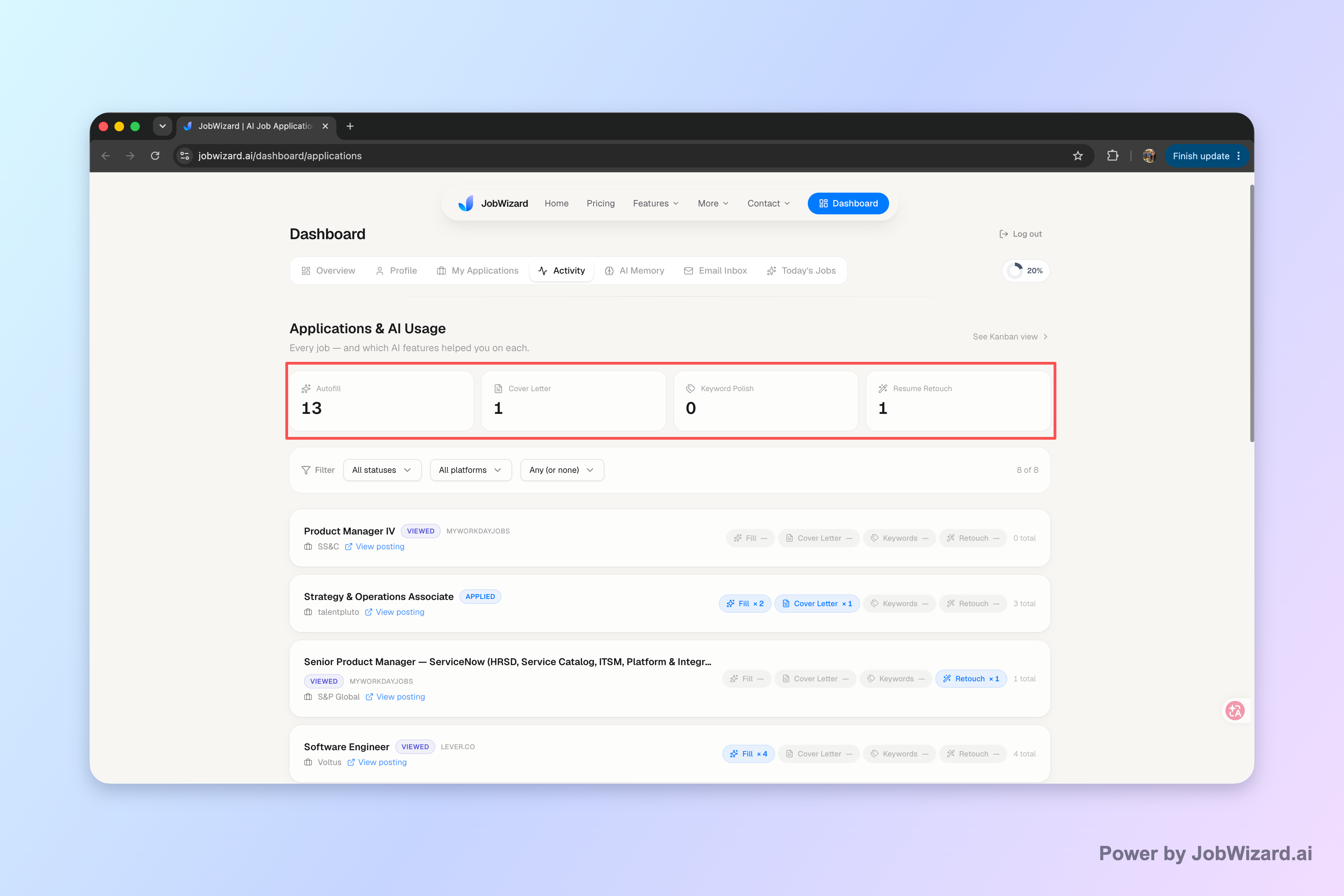
Key idea: Keep your “what do we know?” facts in one place so every follow-up is accurate. JobWizard’s Activity/Job Track view is designed to show application status and which JobWizard tools were used for each role.
What does “pending” mean after an interview?
“Pending” usually means the decision process isn’t finalized yet—either the recruiter is waiting on approvals, completing internal review, or coordinating schedules for the next round.
When you see “pending” (in a tracker or in recruiter messaging), your best follow-up goal is not to force a yes/no. Instead, ask whether the role is still in consideration and what the next step/timeline looks like.
Key takeaway: Treat “pending” as “not decided yet,” and ask for next steps and an estimated timeline.
What does “under review” mean after interviews?
“Under review” indicates your materials are still being evaluated—and that the recruiter may be comparing candidates, collecting internal feedback, or waiting for a hiring manager decision.
Your message should acknowledge that evaluation takes time while gently prompting for process. If you interviewed with multiple people, you can reference the last interaction (date + round) to help them find you quickly.
| Status you see | Likely meaning | What to ask in your follow-up | What to avoid |
|---|---|---|---|
| Pending | Decision not finalized; next step not scheduled yet | “Are we still on track for next steps, and is there an expected timeline?” | Demanding an immediate outcome |
| In progress | Recruiting workflow is active (interviews completed or ongoing) | “Is there anything else you need from me to keep things moving?” | Asking for an exhaustive report |
| Under review | Interviews/materials are being assessed; waiting on internal input | “Has the team completed review, and what’s the next step?” | Sounding surprised or accusatory |
| In final stages (if mentioned) | Short list / near-decision window | “Do you have an ETA on when you expect to make a decision?” | Negotiation-first questions in the same message |
| Not retained / declined (if you learn this) | Process ended for you | “Would you consider me for similar roles?” | Debating the outcome at length |
Key takeaway: Match your question to the stage—timeline + next step is the sweet spot.
How do I time my check-in on interview status with recruiter?
Timing is about respecting their process while still showing professionalism. If the recruiter gave a timeframe, follow it. If they didn’t, wait until at least a few business days have passed after your last interview-related email.
If you’re trying to choose between “too soon” and “too late,” remember: recruiters manage many candidates and internal calendars. Your goal is a message that’s easy to respond to and makes sense in the sequence of their work.
- Confirm last contact: Note your last interview date and the last email you sent.
- Check any promised timeline: If they said “we’ll follow up next week,” use that as your first checkpoint.
- Send one clear follow-up: Keep it short and ask about next steps/timing.
- Wait for their reply or a meaningful gap: Then decide whether a second check-in is appropriate.
Key takeaway: A single, well-timed follow-up beats repeated messages that create noise.
What should I email to check in on interview status with recruiter?
Keep the email simple, specific, and action-oriented. Recruiters respond best when your message makes it obvious who you are, what you discussed, and what you want to learn.
Below is a copy-paste template designed specifically for checking in on interview status with recruiter after an interview. Edit only the bracketed details.
Subject: Following up after [Interview Role/Team] — [Your Name]
Hi [Recruiter Name], I hope you’re doing well. I wanted to follow up regarding my interview for the [Job Title] role on [Interview Date]. Thank you again for your time and for walking me through the team’s priorities.
I’m still very interested in the position and wanted to check on the status of next steps. Is there an expected timeline for decisions or a follow-up round?
If it would be helpful, I’m happy to provide anything else you need. Thanks again for your time, and I look forward to hearing from you.
Best regards, [Your Full Name] [Phone] | [Email] | [LinkedIn/Portfolio if relevant]
Key takeaway: Thank-you context + one next-step question + offer-to-help = a recruiter-friendly check-in.
Should I ask for “next steps” or a “decision date”?
Start with next steps; add a decision date only if it’s appropriate. “Next steps” is low-pressure and helps the recruiter guide you even when timelines are uncertain.
If they previously mentioned a timeframe, asking for an ETA is reasonable. If they didn’t, consider wording that acknowledges variability, like “if a timeline is available.”
- Ask “next steps” when: you’re early in the process or they haven’t mentioned timing.
- Ask for an “ETA” when: they already gave a window or discussed the hiring schedule.
- Avoid: sounding like you’re pressing for an answer they can’t control.
Key takeaway: Your best question depends on whether the recruiter already set expectations.
How can an application tracker help before I email about interview status?
An application tracker helps you follow up with confidence—so you know what you’ve already submitted, what you’ve already asked, and what you last saw in your job records.
JobWizard’s Activity view is designed to show application status and which JobWizard tools were used for each role. That can help you keep your notes aligned, especially if you’re juggling multiple applications.
Just remember the limitation: don’t assume every update is detected automatically. Use your tracker as a starting point, then confirm with the recruiter in your message when needed.
Key takeaway: Track what you know, but verify the stage with the recruiter when it matters.
How do I write a follow-up email if I interviewed more than once?
Reference the most recent interview and keep the thread coherent. If you interviewed with multiple people or rounds, your follow-up should anchor to the latest step so the recruiter can quickly locate the correct context.
When you have specifics, include them in one line: “my second round on [date]” or “the panel interview.” If they connected you with someone else, ask who the best point of contact is for updates.
Copy-paste line you can reuse: “I wanted to follow up on my most recent interview on [date], and ask if there’s an update on the next step.”
Do this automatically with JobWizard
Skip the manual work — JobWizard's Application Tracker handles this for you.
FAQ: checking in on interview status with recruiter
When is the right time to check in on interview status with recruiter after I interviewed?
A good rule is to wait until you’re inside the window you were given (if any) or until at least a few business days have passed since your last interview email. If the recruiter cited a timeframe, use that as your first checkpoint; if they didn’t, choose a conservative first follow-up and then adjust based on their replies.
What should I say when the recruiter hasn’t replied after the interview?
Start with a short thank-you reminder, confirm you’re still interested, and ask one clear question about next steps (e.g., whether there’s an expected decision timeline). Keep it brief and respectful, and avoid implying anything went wrong.
How do I ask about “pending,” “in progress,” or “under review” without sounding impatient?
Use neutral language that shows you understand delays: ask whether your application or interview is still under consideration and if there’s an estimated timeline for moving to the next step. Pair the question with a willingness to provide anything they need.
Should I check in more than once if I still haven’t heard back?
Yes, but incrementally. If you don’t hear back after your first follow-up, send a second message only after a meaningful gap (often about a week, depending on what the recruiter implied). If there’s still no update, you can send a final “closing the loop” note and then pause.
Can I use an application tracker or job tracker to know what’s happening before I email?
Yes—an application tracker can help you see the most recent status you’ve recorded and which tools you used for each job so your follow-up matches what you already know. That said, don’t assume every change is detected automatically; still verify details with the recruiter when you contact them.
What if I’m following up and the role changes (new round, different recruiter, or updated schedule)?
Acknowledge the update and re-anchor the thread: reference the last interview date and the round name if you have it. Then ask what the new next step is and who the best point of contact is going forward.
Is it appropriate to email for both interview status and salary or sponsorship details?
It’s better to separate goals. For checking in on interview status, ask about next steps and timing. If salary, sponsorship, or other eligibility questions are already on the table, ask them when it’s relevant to the stage you’re in—or when the recruiter brings up offers and logistics.
Can I check in on interview status with recruiter by phone instead of email?
Often you can, especially if the recruiter provided a phone number or you have an established relationship. But email is usually the safer first choice because it’s easy for the recruiter to reference your interview details, and it creates a clear record of your question.
What else should I read next (so I follow up the right way every time)?
If you want fewer missed follow-ups, build your follow-up plan around timing and tracking. Here are related guides that pair well with checking in on interview status with recruiter.
- How to Track Job Applications: A Practical System (JobWizard + Beyond) — organize statuses so your emails match reality.
- Follow Up Email After Interview Status: What to Send for “Pending,” “In Review,” and More — more examples by status.
- When to Follow Up on a Job Application: The Timing That Helps (Without Annoying the Recruiter) — reduce guesswork on follow-up frequency.
- How Long to Hear Back After Interview? A Follow-Up Timeline That Matches Real Hiring Pace — set expectations for when you should check in.
Key takeaway: Use one system for your application facts, then send a short, stage-appropriate email.
JobWizard CTA: keep every interview-status check in one place
Want fewer “Wait—what did I already ask?” moments? Use JobWizard to keep your application activity and next steps organized in one Activity/Job Track view, so every time you’re checking in on interview status with recruiter, your message is accurate and consistent.
Start with your job tracker, then send your follow-up email with confidence.
Frequently Asked Questions
Track all your applications in one place
JobWizard auto-tracks status changes across Workday, Greenhouse, and every major job site — free.