best auto-apply tools for job applications 2026: avoid bot submissions, use controlled autofill
“Best auto-apply tools for job applications 2026” doesn’t mean letting a bot submit for you. Learn what goes wrong with bot-style apply tools and how controlled autofill + review-before-submit helps you apply faster—without losing control.
Free Chrome extension
Autofill your next job application
JobWizard is a free Chrome extension that fills applications, tracks statuses, and optimizes your resume.
Searching for the best auto-apply tools for job applications 2026 is understandable—you want speed. But when tools actually submit for you, the fastest path can quietly become the most expensive: wrong answers on screening questions, mismatched documents, and employer-side spam filtering that hurts your reputation with companies you genuinely want.
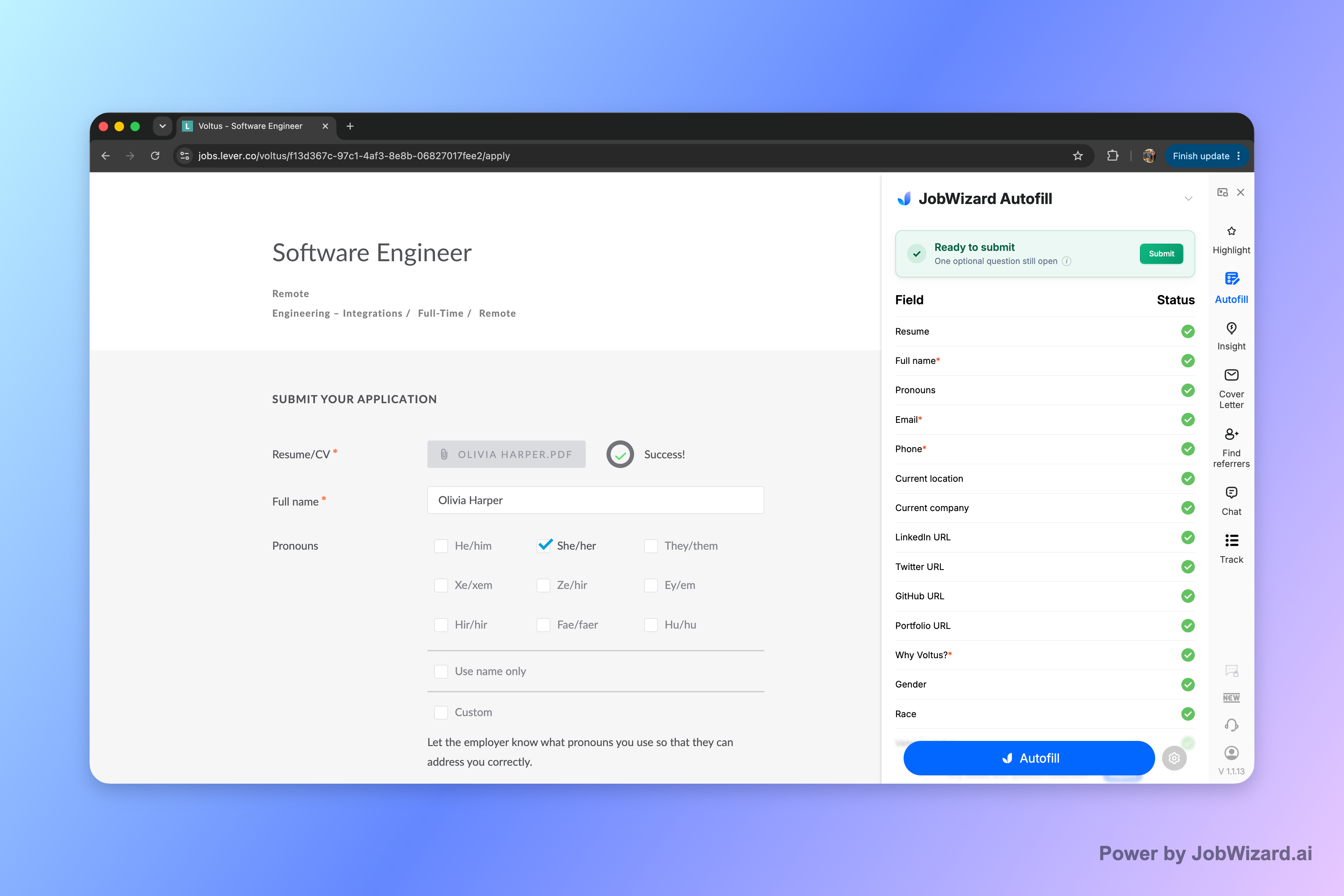
The safer alternative is controlled autofill: fill repetitive fields quickly, then review and submit yourself. JobWizard is built around that exact workflow—autofill the form fields while you stay in the loop, and use the review step to correct anything that needs your input.
Why “best auto-apply” is a trap when bots submit for you
Bot-style auto-apply can damage your applications even if it looks like “more applies.” In 2026, many job seekers still rely on automation that fires while they’re away—and that’s where the most common failure modes show up.
Here’s what can go wrong when a bot applies on your behalf:
- Wrong screening answers when your experience, availability, or eligibility doesn’t match the values the tool assumes.
- Mismatched resumes (e.g., an older version, a different target role, or a document missing a key project) that gets attached even though you meant to submit something else.
- Custom questions get bot-blind—the parts that usually require nuance (or specific phrasing) are where “close enough” turns into “not a match.”
- Employer-side spam/relevance filters may treat high-volume automated attempts as low quality, especially if the answers don’t align with the role.
- Reputation risk with a company you care about: one sloppy application can be the one you can’t easily recover later.
None of this is about “AI being dumb.” It’s about an automation setup optimizing for throughput instead of accuracy—at the exact moments where accuracy matters most.
What to look for instead: autofill + review-before-submit
The right tool should speed up form completion without surrendering your control. If your “auto-apply tool” submits while you’re away, you’re choosing speed at the cost of the review step that prevents costly mistakes.
A safer workflow focuses on two capabilities:
- Smart Autofill that fills detected fields on the application page so you don’t retype the same basics every time.
- Review-before-submit so you confirm key details (especially screening questions and anything custom to that posting) before the application actually goes out.
JobWizard is designed for that controlled flow. When a required field still needs attention, it can identify it and let you jump to the matching question—so you can fix what matters instead of guessing.
Verified usage context: JobWizard has supported 720,000+ applications submitted and 600,000+ autofill sessions, with autofill typically handling ~18 repetitive fields per application. The tool fills fast, but you still review and submit.
Job search platforms: where autofill time savings tend to show up
Autofill is most helpful when you’re repeating the same form patterns across common ATS experiences. In practice, the largest time savings tend to show up on systems like Workday.
From verified aggregate usage data: among applications submitted through JobWizard, ~65% are on Workday, ~19% are on Greenhouse, ~12% are on Ashby, and ~4% are on Lever. Workday is where it saves the most time because of how frequently job seekers encounter similar form sections across roles.
This also aligns with why “best auto-apply tools for job applications 2026” results can feel confusing: different tools market automation differently, but the real bottleneck most applicants feel is not clicking “apply”—it’s re-entering repetitive details and answering screening questions consistently.
For that reason, the best-fit approach in 2026 is still the same: use autofill to reduce repetitive typing, then take the short review moment to ensure the answers reflect you and the role you’re targeting.
How JobWizard compares with common “auto-apply” tool categories (and why it matters)
Different tools optimize different parts of the job-application flow. To choose what’s best for you, it helps to map “what the tool does” to the risks you’re trying to avoid.
| Tool category | What it typically optimizes | Primary risk to watch for | Where JobWizard fits |
|---|---|---|---|
| Bot-style auto-submit | Throughput when you’re away | Wrong screening answers, mismatched resumes, spam/relevance filtering, and reputation damage | Not the goal—JobWizard does not submit automatically. |
| Autofill + review | Form completion speed while keeping human review | Low risk if you actually review before submitting | Smart Autofill that fills repetitive fields; you review and submit. |
| Chrome extensions for applying workflows | Faster navigation and data entry | Some extensions may push toward more automation than you want | Choose a workflow that supports review-before-submit; see related guides. |
| AI “answer” helpers | Drafting responses and summarizing experience | Answers can be too generic or misaligned to a specific screening question | Use autofill to reduce retyping, then review every screening/custom response. |
If you want a practical setup, start with a controlled autofill workflow (not auto-submit). Then decide whether you want a more general browser-based workflow or a full application completion process.
Related reads:
- How to Autofill Job Applications (Step-by-Step with JobWizard)
- Best Chrome Extension for Job Search in 2026: Autofill, Tracking, and Auto-Apply Risk
- Is LazyApply worth it for job applications? The real bot-submission trade-off (and a safer autofill workflow)
- Autofill Job Applications Extension: A Chrome Workflow That Fills, Reviews, and Helps You Apply Faster
Do this automatically with JobWizard
Skip the manual work — JobWizard's Smart Autofill handles this for you.
FAQ: best auto-apply tools for job applications 2026
Are “auto-apply” tools actually good for job applications in 2026?
They can be fast, but many “auto-apply” setups submit for you while you’re away. That creates real failure modes—wrong screening answers, mismatched documents, and employer-side spam filtering—so the safer approach is autofill that you review and submit yourself.
What can go wrong when a bot applies to jobs for you?
A bot can fill screening questions with the wrong values, attach a mismatched resume or outdated info, and increase the chance an employer’s anti-spam or relevance filters flag your submissions—especially if it blasts many roles without context.
How is controlled autofill different from bot auto-submit?
With controlled autofill, a tool fills repetitive form fields, and you review the populated answers before submitting. If a required field needs attention, you can jump to the exact matching question and correct it.
Which systems does autofill commonly help with (Workday, Greenhouse, Lever, Ashby)?
Autofill workflows often show the biggest time savings on Workday; they also commonly support popular ATS experiences like Greenhouse, Ashby, and Lever so you can quickly complete the repetitive parts and then submit after review.
If I want speed, what’s the safest workflow for applying with tools?
Use autofill to complete repetitive fields quickly, then pause to review screening answers, sponsorship/salary/EEO-style items, and any custom questions. Submit yourself so you control what the employer receives.
Ready to apply faster without losing control? Try JobWizard’s Smart Autofill on your next application, review every populated answer, and submit yourself—so speed comes from fewer repetitive fields, not from risky bot submissions.
Frequently Asked Questions
Autofill your next job application
JobWizard is a free Chrome extension that fills applications, tracks statuses, and optimizes your resume.