Is LazyApply worth it for job applications? The real bot-submission trade-off (and a safer autofill workflow)
Is lazyapply worth it for job applications? Learn what goes wrong when bots submit for you—and the reviewed alternative: fill in seconds, check, submit yourself.

Free Chrome extension
Autofill your next job application
JobWizard is a free Chrome extension that fills applications, tracks statuses, and optimizes your resume.
Is is lazyapply worth it for job applications? The honest answer depends on one critical point: whether you’re letting a bot submit for you without reviewing the screening answers first.
Most “auto-apply” setups aim to save time by pushing many applications out quickly. But in job applications, speed isn’t the only variable—accuracy, consistency, and employer-specific screening responses are what get you through. In this guide, you’ll see what can go wrong with bot submission, and a safer alternative: autofill repetitive fields on the page, then review before you submit.
What “lazyapply” promises vs what you actually risk
The moment a bot submits for you, you lose the chance to catch mistakes before they matter. That’s the trade-off behind many “lazyapply” style tools: they try to reduce your effort by automating application input.
That automation can feel appealing when you’re applying at scale. But job application forms aren’t always uniform. They often ask role-specific screening questions, require precise eligibility details, and expect the content of your resume to match the posting. If your inputs are wrong—or even just inconsistent—your application can be filtered out.
To be fair, not every tool behaves the same way. Some automation helps you fill fields; others lean toward “apply for me” workflows. The key question for is lazyapply worth it for job applications isn’t whether it can make things faster—it’s whether it does so while keeping you accountable for the final answers.
What goes wrong when a bot submits your application
Bot submission failures tend to cluster around screening accuracy and data mismatches. Here are the most common ways it can backfire—especially if you don’t review what the bot filled in.
- Wrong answers to screening questions: Many screening items aren’t “resume fields.” They’re eligibility and preference questions (for example, availability, location constraints, work authorization details, or whether you meet specific requirements). If the automation guesses, you may fail the screen.
- Mismatched resume/profile details: A tool may use a single saved resume/profile across different roles. But a posting might emphasize different keywords, experience levels, or technologies. If what’s filled doesn’t align with the job, your application can look inconsistent.
- Required fields left incomplete: Even good autofill can miss a field that’s required but uncommon (a custom question, a specific dropdown, or a “select the closest match” prompt). If you don’t notice, the submission may be rejected.
- Employer-side spam/quality filters: Repeated applications that look templated, inconsistent, or low-quality can trigger moderation and filtering. Even if the form technically submits, it may not be treated as a genuine application.
- Reputation damage with companies you actually want: If the bot submits content you wouldn’t choose—such as the wrong answers or an ill-fitting resume—you can harm your chances with an employer where you’d genuinely want an interview.
None of these outcomes are “guaranteed.” But they’re the realistic failure modes of any workflow that submits without you checking the final content—especially when screening questions vary by job and form.
Why “autofill + review before submit” is usually the safer middle ground
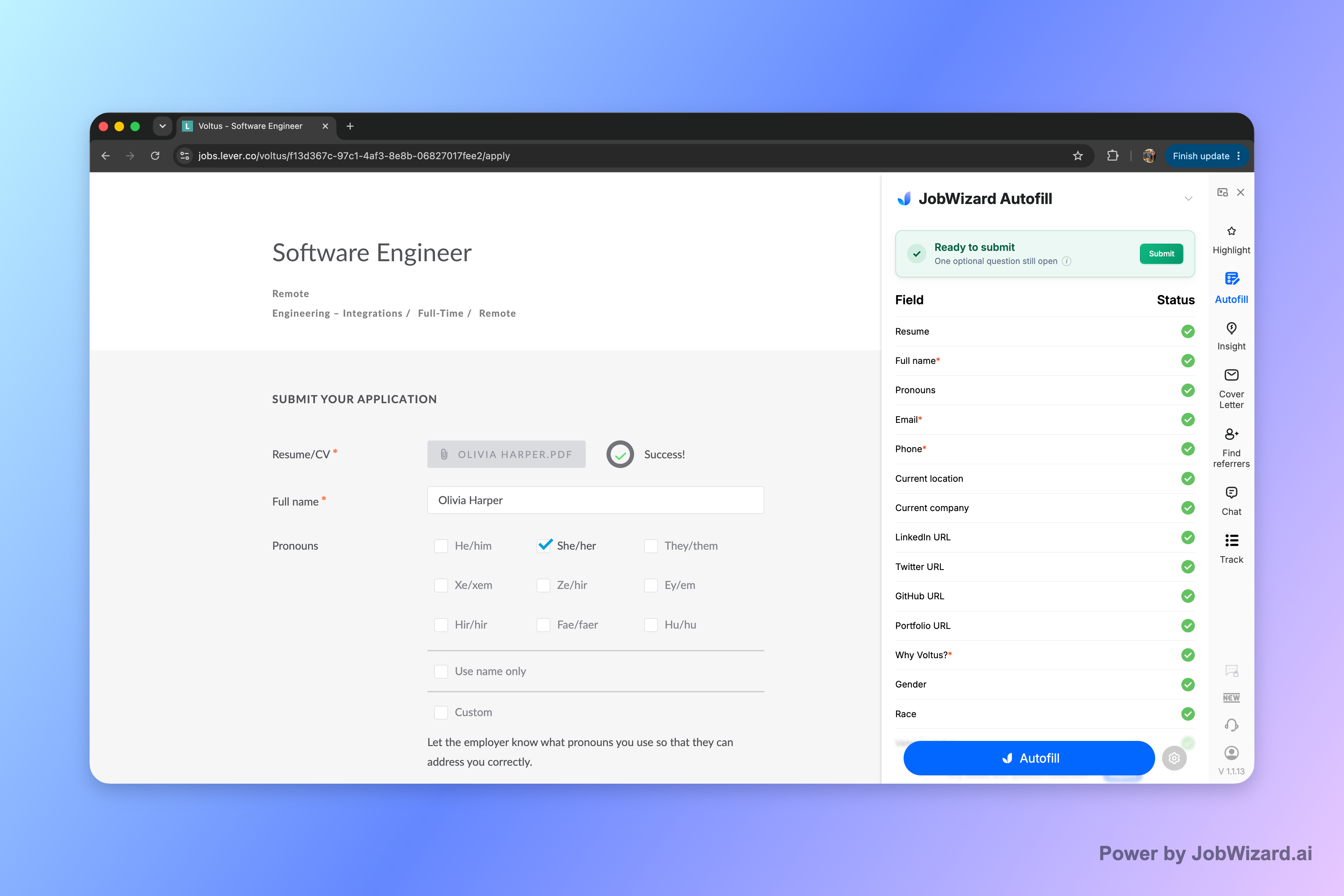
Instead of handing control to a bot, smart autofill targets repetitive fields and keeps you in the driver’s seat. JobWizard’s Smart Autofill fills detected fields using saved profile and resume data on supported application pages.
Just as importantly, the user reviews the populated fields and submits the application themselves. That review step is where you prevent the classic problems: wrong screening answers, missing required info, or inconsistent details.
And when something still needs attention, JobWizard can identify it and let you jump to the matching question—so you’re not hunting through the form trying to figure out what went wrong.
In other words, the value is “fill faster, confirm carefully,” not “submit while you’re away.” That distinction matters for is lazyapply worth it for job applications—because the goal isn’t just sending an application, it’s sending the right one.
Where LazyApply-type tools can make sense—and where they don’t
Consider lazy automation only if your workflow still includes review and accuracy checks. If your process involves sending forms you haven’t verified, the downside risks tend to outweigh the time savings.
Better fit scenarios
- High volume, low penalty applications: If the roles are low-cost to try and you still review everything immediately, the risk is lower.
- Jobs with minimal screening variation: If the application format is consistent and the questions are straightforward, there’s less room for automation to guess wrong.
- You can verify quickly: If you actively review before submit, you can catch mismatches and correct answers.
Poor fit scenarios
- Any “submit without review” workflow: That’s where wrong screening answers and mismatched details can slip through.
- Roles with strict screening: If you’re applying to roles with eligibility questions that gate the process, accuracy matters more than speed.
- Employers you care about: If you want a company for the long term, you typically don’t want templated or inconsistent submissions representing you.
Even if a tool claims it can “auto-apply,” the practical question is always the same: can you confidently verify every answer before it’s sent?
Autofill-first workflows: what to do instead of “lazy” auto-apply
You can apply faster without turning yourself into a quality-control bottleneck for a bot. The workflow below is built around one principle: fill repetitive fields quickly, then do a human review pass for anything that could be wrong.
- Open the posting: Start the application where the questions actually appear (not just a link list).
- Use autofill to populate what it can detect: Fill standard fields like contact info and repeated experience items.
- Review every screening question: Treat dropdowns, eligibility items, and “closest match” prompts as non-negotiable.
- Check resume alignment: Make sure the experience you’re presenting matches what the job is asking for.
- Submit yourself: When everything is correct, submit the application from the page with your final confirmation.
This approach pairs well with how job seekers actually work. In our usage data, JobWizard has enabled autofill + review-before-submit workflows at scale—720,000+ applications submitted and 600,000+ autofill sessions run through JobWizard. That doesn’t mean “apply blindly”; it means repetitive fields get populated quickly while the user stays responsible for the final submission quality.
Autofill is the shortcut, not the replacement: the user reviews the populated fields and submits the application themselves.
If you want to compare options or see how this differs from bot-style tools, start with: JobWizard vs LazyApply: A Practical Autofill-and-Review Showdown for Applications. For a deeper dive into setting up a faster form-filling routine, see How to Autofill Job Applications (Step-by-Step with JobWizard) and Autofill Job Applications Extension: A Chrome Workflow That Fills, Reviews, and Helps You Apply Faster. If you’re thinking about the broader strategy of using AI to reduce drudgery without risking accuracy, also read Job Search Artificial Intelligence That Actually Helps: An Autofill-First Workflow for Confident Applications.
Bottom line: if you’re asking “is lazyapply worth it for job applications,” the best answer is the one that protects your quality. Choose automation that helps you fill in seconds, but keeps you accountable for every answer before you press submit.
Do this automatically with JobWizard
Skip the manual work — JobWizard's Smart Autofill handles this for you. On these platforms: JobWizard vs LazyApply.
FAQ about whether is lazyapply worth it for job applications
Is LazyApply worth it for job applications if it auto-submits?
If it auto-submits without your review, it’s hard to control mistakes (wrong screening answers, mismatched resume content, or incomplete fields). A safer approach is autofill on the page, then review every answer and submit yourself.
What can go wrong when a job application bot submits for you?
Common failure modes include incorrect screening-question responses, resume or profile details that don’t match the specific posting, and triggering employer spam/low-quality filters—plus reputational damage if you submit something you’d never have sent yourself.
What’s the better alternative to “lazy” auto-apply?
Use a workflow that fills repetitive fields on the application page while keeping you in control for the final check—then submit after you review any custom questions, upload/resume selections, and anything required to be accurate.
Does autofill still work if I need custom answers for each posting?
Yes—smart autofill can populate what it can detect, and when a required field still needs attention, you can jump directly to that question to fill it correctly before submitting.
How do I decide whether an auto-apply tool is right for me?
Choose the approach that reduces typing without removing your responsibility. If the tool’s value depends on submitting while you’re away or without review, it’s a poor fit for roles where screening accuracy matters.
Ready to apply faster without losing control? Try JobWizard’s Smart Autofill on your next application: it fills repetitive fields while you review every answer before submitting.
Frequently Asked Questions
Autofill your next job application
JobWizard is a free Chrome extension that fills applications, tracks statuses, and optimizes your resume.