Why Auto-Apply Tools Fail on Captchas and Login Screens (and How to Fix Your Workflow)
Why auto-apply tools fail on captchas and login screens comes down to how modern application portals gate access. Here’s how smart autofill + human review avoids the bottlenecks.

Free Chrome extension
Autofill your next job application
JobWizard is a free Chrome extension that fills applications, tracks statuses, and optimizes your resume.
Why Auto-Apply Tools Fail on Captchas and Login Screens (The Real Bottleneck)
Why auto-apply tools fail on captchas and login screens isn’t because you picked a “bad” tool—it’s because modern job portals are built to require a human at key moments. Captchas and login screens are the most obvious checkpoints, but they’re also the first place automation runs out of control. Even when a tool can navigate part of the page, it often can’t safely—or reliably—complete the final steps that depend on verification, session state, and dynamic form behavior.
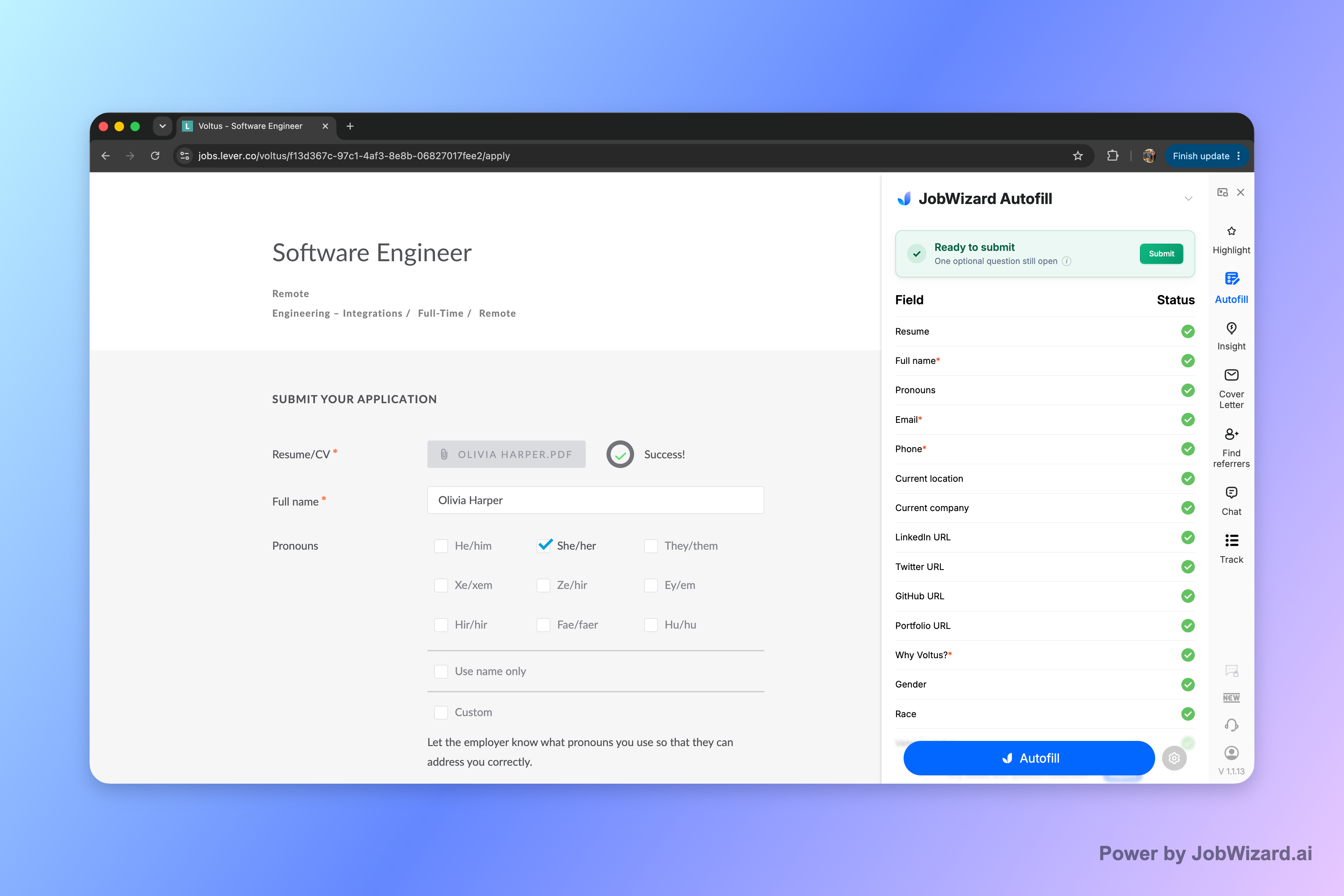
JobWizard takes a different approach: it focuses on Smart Autofill, where a Chrome extension uses your saved profile and resume data to fill detected fields on supported application pages, and then you review the populated fields and submit the application yourselves. This “autofill + review-before-submit” design is exactly what helps avoid the fragile failure points that show up at captchas and login gates.
What Actually Breaks: Captchas, Session Checks, and “Automation That Can’t Prove It’s You”
When people search for solutions to “auto-apply,” they usually mean: press a button, and the system does the rest. But captchas and login screens exist specifically to prevent that kind of unattended automation. Here’s what tends to go wrong.
1) Captchas stop unattended flow
Captchas are a deliberate interruption. Even if an auto-apply tool can reach the application form, it may stall when the portal demands a challenge that must be solved by a real user in the current session. Because the verification happens at the browser level, “continue” logic often can’t proceed without human confirmation.
2) Login screens reset what automation can “see”
Many application portals gate progress behind an authenticated session. That means the tool’s browser state matters: once you log in (or partially log in), the portal may redirect, require cookies, or load application steps dynamically. Auto-apply flows often assume the page stays in a predictable place, but login redirects can change DOM structure, introduce new steps, or re-render the form.
3) Dynamic forms create mismatched assumptions
Even after login and captcha handling, forms are rarely static. Fields can appear or change based on earlier inputs, job-specific requirements, or saved profile context. If an automation script tries to populate fields that have not loaded yet—or that have changed meaning—it can fail silently or leave the user with a partially completed application.
This is why your best next move usually isn’t “stronger auto-apply.” Instead, you want a workflow that works when interruptions happen, and that still produces clean results when portals require review. That’s where Smart Autofill fits: it fills what it detects on supported pages, and you stay responsible for the final checks.
Why “Auto-Submit” Styles Fail More Often Than Autofill + Review
It’s tempting to compare tools by how “fully automated” they feel. But captchas and login screens are only the beginning. The larger risk is what happens after the portal accepts the session and begins collecting answers.
Autofill + review-before-submit is more resilient because it treats verification and final correctness as human responsibilities. Smart Autofill uses your saved profile/resume to populate repetitive fields quickly, and then you decide what to submit. That matters because many application forms include items that can’t be safely inferred from a resume alone—especially when the portal expects role-specific context.
What Smart Autofill is designed to do
- Use your saved profile and resume data to fill detected fields on supported application pages.
- Speed up the repetitive part of the application so you can move faster without guessing.
- Keep the final step under your control: you review every populated answer and then submit.
- If a required field still needs attention, JobWizard can identify it and let you jump to the matching question.
What Smart Autofill is explicitly not
- It is not designed to automatically submit applications.
- It does not promise every field will be filled perfectly, instantly, or across universal website support.
That limitation is not a weakness—it’s a safety feature. When captchas and login screens break automation, you want a tool that still delivers value in the parts you can verify.
In the aggregate: JobWizard has enabled 720,000+ applications submitted and 600,000+ autofill sessions run. In those sessions, JobWizard autofills an average of about ~18 repetitive fields per application (typically 11–23). Of submitted applications, the distribution is ~65% on Workday, ~19% on Greenhouse, ~12% on Ashby, and ~4% on Lever.
Remember: these figures reflect autofill + review-before-submit, not blind auto-apply. The repetitive fields are filled fast, but you still review and handle any content that requires judgment.
A Practical Workflow That Survives Captchas, Logins, and Custom Questions
If you’re tired of “auto-apply” tools failing at the same points, adopt a workflow built around the reality of application portals. The goal is not to remove humans from the process—it’s to remove the repetitive typing that causes burnout.
Step 1: Reach the application page manually (login/captcha included)
Start the application as a human: complete whatever login is required and solve captchas when they appear. This is the phase where automation is most likely to break, and where the portal is explicitly asking for human verification.
Step 2: Use autofill only after the form fields are visible
Once you’re on the actual application form, Smart Autofill can populate detected inputs using your saved profile/resume data. This timing matters: if fields aren’t loaded yet, autofill can’t detect them.
Step 3: Review every populated answer before you submit
Even when fields are filled correctly, review is what prevents low-quality submissions. Pay special attention to anything that can be role-specific or compliance-related. If anything looks off—dates, locations, work authorization statements, or employment history details—correct it before submitting.
Step 4: Jump to missing required questions
When a required field needs attention, JobWizard can identify it and let you jump directly to the matching question. Instead of searching the form manually, you can focus on finishing only what’s missing.
Step 5: Submit yourself (don’t let “automation” be the last step)
Because JobWizard does not call itself automatic submission, you remain in control. This makes your final submit step more reliable—especially on portals that load a last-step review screen after you pass a captcha or a login redirect.
If you’re deciding how to structure your overall strategy, you can also compare safer approaches with “bulk auto-apply” style workflows. These related reads help you understand what breaks and what to do instead:
- How to Autofill Job Applications (Step-by-Step with JobWizard)
- Why Do Autofill Tools Miss Custom Job Application Questions? (Explained + Fixes)
Autofill vs Auto-Apply: A Clear Comparison for Portal Reliability
To make this practical, here’s how to think about the categories that matter for captchas and login screens.
| Approach | What happens at captchas/login screens | Form-filling style | Final step control | Best for |
|---|---|---|---|---|
| Auto-apply / auto-submit tools | Often gets interrupted by captcha challenges or gated login flows | May try to complete fields automatically without waiting for review checkpoints | May attempt submission without a human review step | Very consistent portals where the workflow never changes (rare in practice) |
| Autofill + review-before-submit (Smart Autofill) | You handle the captcha/login as a user; autofill runs after you reach the form | Fills detected fields using saved profile and resume data | You review populated fields and submit the application yourself | Reliable speed-up of repetitive fields without losing control |
That’s also why “bulk auto-apply” strategies can drift into low-quality outcomes: they tend to prioritize quantity and automation over accuracy. If you want to understand that failure mode in more detail, read:
And if you’re comparing alternatives that aim to reduce manual work, this guide helps you choose safer autofill-style options:
Do this automatically with JobWizard
Skip the manual work — JobWizard's Smart Autofill handles this for you.
FAQ: Why Auto-Apply Tools Fail on Captchas and Login Screens
Do autofill tools get around captchas and logins?
No. Autofill tools are intended to help fill detected application fields after you reach the application page. Captcha challenges and login steps still require you to complete them, and you then review the filled answers before submitting.
Why does an auto-apply tool stop after it logs in?
Because login doesn’t always mean the job is done. After login, portals may require captcha verification, load additional dynamic form steps, or present review checkpoints. Tools that rely on predictable navigation can stall when those checkpoints appear.
What should I do when an application asks custom questions?
When a required field needs attention, JobWizard can identify it and let you jump to the matching question. You should answer custom questions yourself to ensure your response is accurate and relevant to the role.
Which parts of the application process can autofill tools help with?
Autofill tools help with repetitive form fields on supported application pages by using your saved profile and resume data to fill detected inputs. You keep control by reviewing the populated fields and submitting the application yourself.
How can I reduce low-quality application risk when using auto-apply-style tools?
Avoid “press-and-submit” habits. Instead, use autofill to speed up repetitive entries, then thoroughly review items that can affect quality—especially custom questions and compliance/sponsorship/EEO-related fields—before you submit.
JobWizard CTA: If you’re dealing with Why Auto-Apply Tools Fail on Captchas and Login Screens, try a workflow that doesn’t depend on unattended submission. Use JobWizard Smart Autofill on your next application to prefill the repetitive fields, then review every answer before submitting.
Frequently Asked Questions
Autofill your next job application
JobWizard is a free Chrome extension that fills applications, tracks statuses, and optimizes your resume.