LazyApply Alternatives Safer Auto-Apply and Autofill Options: What Actually Works
Looking for LazyApply alternatives? This guide breaks down safer auto-apply and autofill options, and shows how JobWizard Smart Autofill helps you fill repetitive fields while you review before submitting.
Free Chrome extension
Autofill your next job application
JobWizard is a free Chrome extension that fills applications, tracks statuses, and optimizes your resume.
Trying to use LazyApply Alternatives Safer Auto-Apply and Autofill Options often comes with a frustrating tradeoff: either you save time, or you keep control. Many “auto-apply” tools blur the line between filling a form and submitting an application, which is where mistakes can happen. If you’re aiming for faster applications without losing accuracy, the goal is simple: autofill repetitive fields, then review and submit yourself.
That’s exactly the safer workflow JobWizard is built around—Smart Autofill fills the parts it can detect, then leaves the final review and submission in your hands.
What “safer” auto-apply actually means (and what to avoid)
Before you compare any LazyApply Alternatives Safer Auto-Apply and Autofill Options, get clear on the definitions—because the difference affects risk more than the tool name does.
Autofill vs. auto-submit: the key safety boundary
Autofill typically populates form fields using saved profile and resume data, while you confirm and submit. Auto-submit skips that final human check and sends the application automatically. For most applicants, the safest option is a workflow where you review every answer before clicking submit.
If you want a deeper breakdown, see The Difference Between Autofill Auto-Apply and Auto-Submit (Safest Options Explained).
Why “safe” still requires review
Even the best autofill can’t guarantee perfect matches to every job posting. Job descriptions, custom questions, and required fields vary by role and employer. Smart Autofill is designed to fill detected fields using saved profile and resume data, but you should always review the populated fields and adjust anything that needs your judgment.
- Required fields may differ from one posting to the next.
- Custom questions often need role-specific answers.
- Web forms aren’t identical even on the same ATS.
That’s the practical reason “safer” options don’t aim for blind completion. Instead, they accelerate the repetitive parts, then put the final check back on you.
LazyApply Alternatives: the safer autofill-first options to consider
When you search for LazyApply Alternatives Safer Auto-Apply and Autofill Options, you’ll usually find two categories:
- Autofill-first tools that populate form fields and stop for review
- Auto-apply tools that can submit automatically (higher risk if you’re not actively checking what was filled)
Rather than focusing on brand names, evaluate your alternatives against the workflow boundary: Does the tool support a review-before-submit flow? And does it help you find required fields that still need attention?
Option A: Autofill-first (recommended safety pattern)
This is the model where the tool fills what it can detect, then you handle the final submission. It’s a good fit when you apply to multiple roles where your core background stays consistent, but your answers to custom questions may need tailoring.
In this category, look for features like:
- Saved profile + resume data to populate detected fields
- Review-before-submit (not blind automatic submission)
- Required-field guidance so you don’t miss something
For context on how auto-apply approaches compare, read Does Auto Apply Actually Work? The Real Benefits, Risks, and Safer Autofill Alternatives.
Option B: Auto-apply (use only with active oversight)
Some tools may move faster by going beyond autofill. Even if a tool includes some autofill capability, auto-submit changes the safety equation. If you choose an auto-apply approach, the only reliably safer version is one where you still verify what will be submitted.
If you’re trying to reduce errors, start by separating concepts:
- Auto-apply can include steps beyond filling fields.
- Auto-submit means the application is submitted automatically.
- Autofill is about populating fields for you to review.
For more terminology clarity, see What Is the Difference Between Job Application Autofill and Auto-Apply?.
How JobWizard Smart Autofill supports a review-before-submit workflow
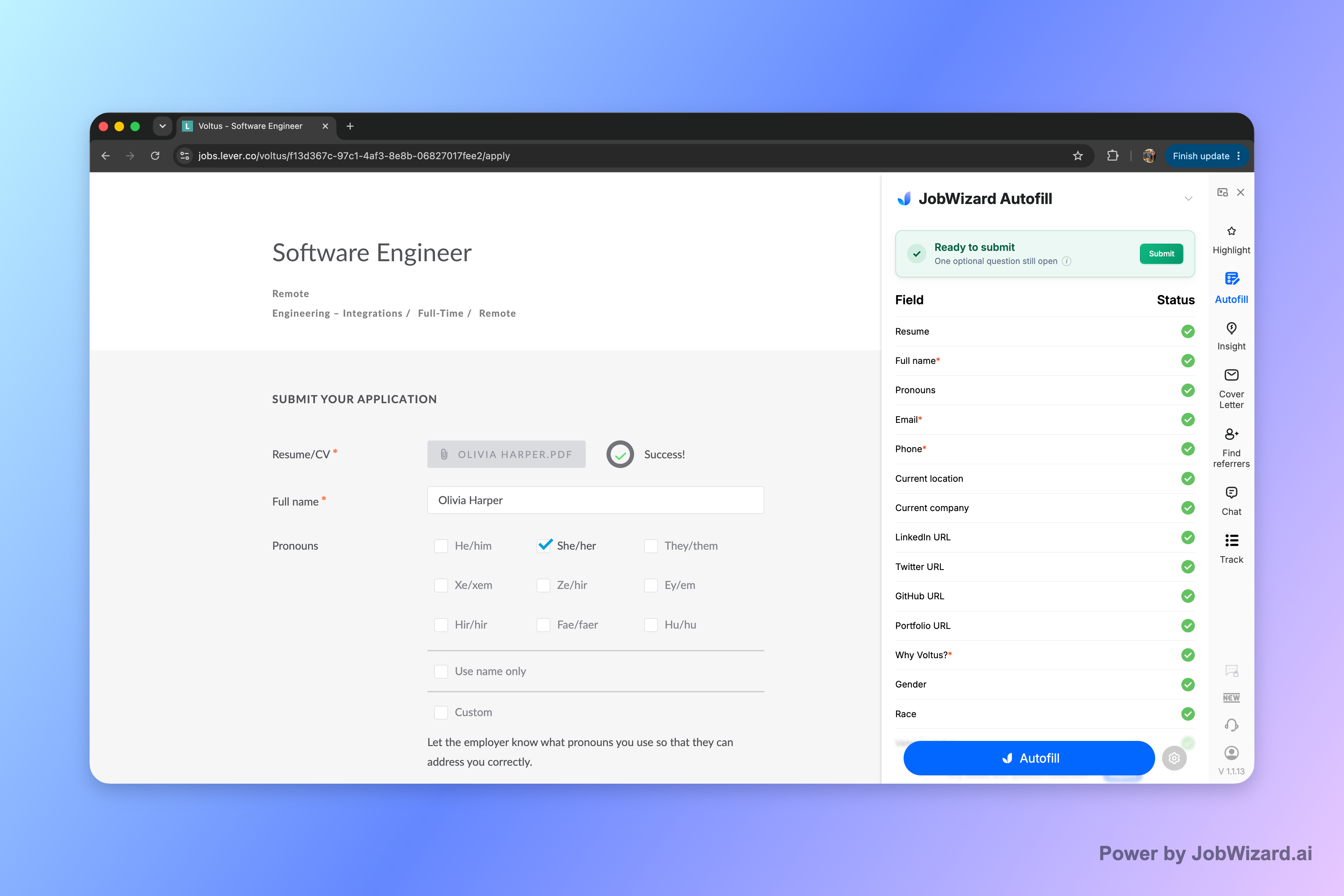
If your main goal is safer speed, JobWizard Smart Autofill is designed around exactly that: autofill + review-before-submit. Smart Autofill uses your saved profile and resume data to fill detected fields on supported application pages. Then you review the populated fields and submit the application yourself.
When the application includes required fields that still need attention, JobWizard can identify that and help you jump to the matching question—so you can confirm or correct the missing or incomplete parts before you submit.
What Smart Autofill fills (and what it doesn’t)
To stay accurate about expectations: Smart Autofill is meant for detected fields on supported pages. It can’t guarantee perfect completion of every field on every website, and it isn’t automatic submission.
- Designed to fill detected fields using saved profile/resume data
- You review populated answers before submitting
- Required fields can be identified, with a jump to the matching question
As a reminder, the point isn’t “instant perfect applications.” The point is reducing repetitive typing while keeping the final responsibility where it belongs: your review and submission.
Why ATS variety matters (Workday, Greenhouse, Lever, Ashby)
Most applicants don’t apply to one ATS forever. Smart Autofill supports popular ATS application experiences so you can keep a similar workflow across different job portals.
Across JobWizard activity, ~65% of applications are on Workday, ~19% Greenhouse, ~12% Ashby, and ~4% Lever—so Workday is where it saves the most time.
Even with ATS support, still treat autofilled content as a starting point. Your review is what makes it reliable for your specific application.
The “safer speed” workflow you can use today
Here’s a concrete, repeatable process for using a LazyApply alternative that focuses on safer autofill.
- Start your application on the job site or ATS page.
- Run autofill so repetitive fields are populated quickly.
- Scan required fields first (these are the ones that can stop submission).
- Read every custom question and update it to fit the role.
- Double-check contact + location fields for consistency.
- Submit yourself only after the filled answers look correct.
This matches the “fill fast, review before submit” model—so you get the time savings without handing off final control.
Feature-by-feature comparison: which approach fits your risk tolerance?
Use this table to compare what you’re actually trying to do with LazyApply Alternatives Safer Auto-Apply and Autofill Options. The goal isn’t to crown a single tool—it’s to choose the workflow that aligns with your standards.
| Approach | What it typically does | Where safety comes from | Best for |
|---|---|---|---|
| Autofill-first (review-before-submit) | Fills detected form fields using your saved info | You review populated fields and submit yourself | High-volume applicants who still want accuracy on custom questions |
| Auto-apply / auto-submit | May go beyond filling fields toward submission | Safety depends on whether you can reliably verify what’s submitted | Rare cases where you’re monitoring closely enough to catch mistakes |
| JobWizard Smart Autofill | Fills detected fields on supported application pages; can identify fields needing attention | Review-before-submit, plus jump-to matching required questions | Applicants applying across multiple ATS platforms who want faster form completion with human review |
What to check before you commit to any alternative
- Does it explicitly support review before submission? If it’s framed as automatic submission, be cautious.
- Can it help you locate required fields that still need attention? Missing one required field can cost you the entire application.
- Does it use your saved profile/resume data to fill detected fields? Better inputs typically mean better autofill results.
- Will you actually read the custom questions? If you won’t, autofill-first will still produce wrong answers.
If you want more step-by-step guidance for filling forms efficiently, use How to Autofill Job Applications (Step-by-Step with JobWizard).
Do this automatically with JobWizard
Skip the manual work — JobWizard's Smart Autofill handles this for you. On these platforms: JobWizard vs LazyApply.
Next steps: try autofill on your next application (the safe way)
If you’re currently avoiding applications because the form typing is draining, start smaller: use a safer autofill workflow on one new application this week. You’re not trying to remove your responsibility—you’re reducing the repetitive work so you can focus on what matters: the answers that require you.
With JobWizard Smart Autofill, you can fill the repetitive fields fast using saved profile and resume data, then review everything before submitting. If a required field still needs attention, JobWizard can identify it and help you jump to the matching question so you can confirm your answers.
CTA: Invite yourself to make your next application easier—try Smart Autofill on your next application and review every populated answer before you submit.
Is auto-apply the same as autofill?
No. Autofill fills form fields (often repetitive ones) while you review. Auto-submit is when an application is submitted automatically. The safest workflows keep the final review and submission in your hands.
Are LazyApply-type tools safer if they only autofill?
They can be safer when the tool fills repetitive fields and then stops so you can review answers before submitting. Any workflow that submits automatically can create errors if answers need your judgment (like custom questions).
How does JobWizard Smart Autofill handle required fields that need attention?
JobWizard can identify when a required field still needs attention, then help you jump to the matching question so you can confirm or correct it before you submit.
Will Smart Autofill instantly complete every field on every job site?
No. Job sites vary and even required fields can differ. Smart Autofill is designed to fill detected fields using your saved profile and resume data, but you should always review every populated answer before submitting.
Where does Smart Autofill work best?
Smart Autofill is designed to fill detected fields on supported application pages, including popular platforms such as Workday, Greenhouse, Lever, and Ashby. For best results, review what it fills and make any edits needed for the specific role.
Frequently Asked Questions
Autofill your next job application
JobWizard is a free Chrome extension that fills applications, tracks statuses, and optimizes your resume.