Where Does Availability Go on Your Resume? A Clear Section-by-Section Guide That Helps You Get Past ATS
Wondering where does availability go on your resume? Here’s the most hiring-manager-friendly placement—plus how to tailor it so your timeline reads as reliable, not vague.

Free Chrome extension
Let AI answer these questions for you
JobWizard fills sponsorship, work-auth, and availability answers correctly on every application — free.
Availability on your resume should go where recruiters look first and where ATS can parse it cleanly: a dedicated, clearly labeled line near the top. If you’ve ever wondered “where does availability go on your resume” (and whether it should live under skills, experience, or contact info), this guide will help you place it correctly, word it precisely, and tailor it to each job description.
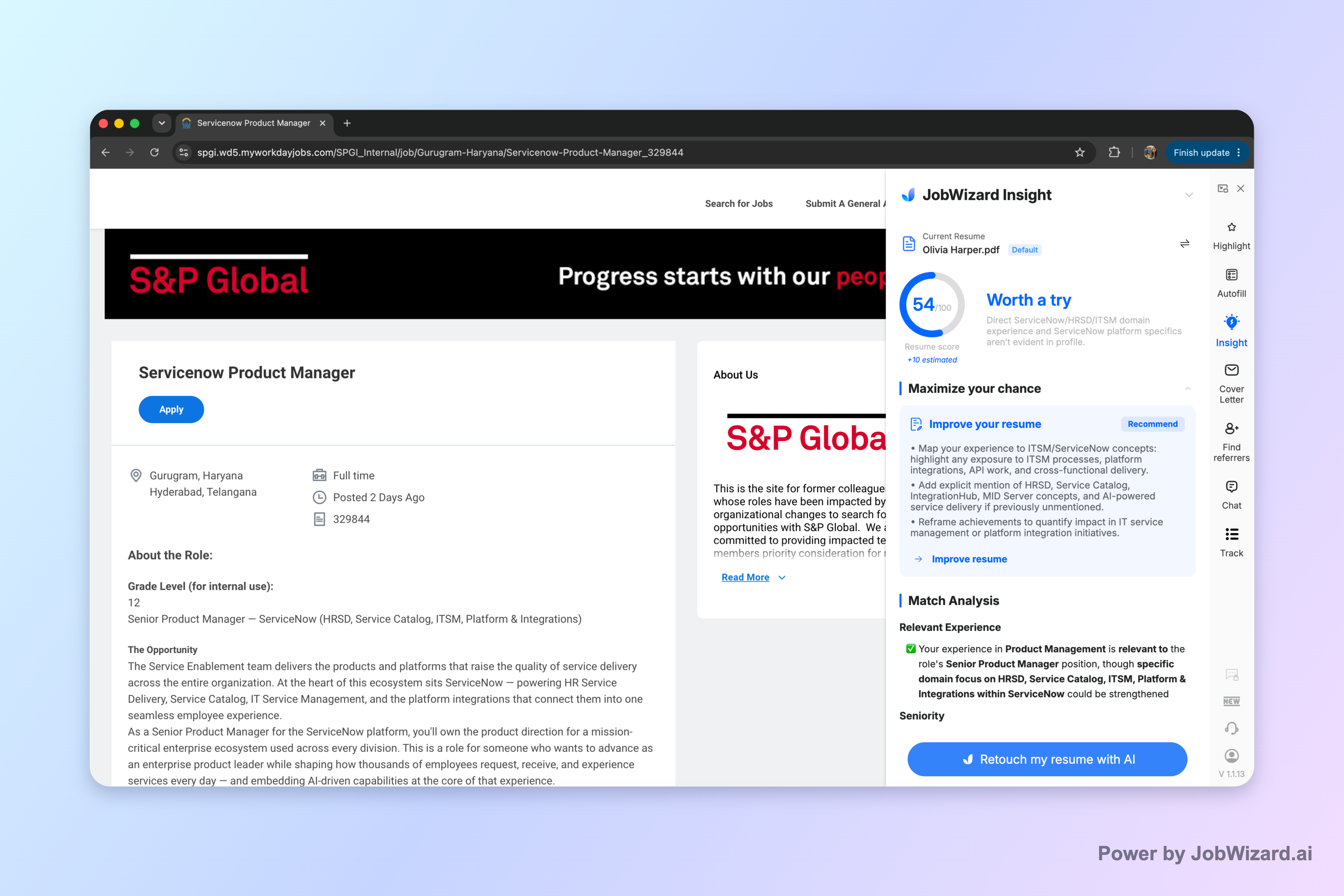
To make sure your availability reads the way the job expects, use JobWizard Insight to compare your resume to the specific job description and see where your wording creates gaps. It generates a match score plus an assessment and improvement suggestions you can review—then you decide what to keep based on accuracy.
Where does availability go on your resume (and why it matters)?
The best spot is usually near the top, labeled as “Availability,” so it’s visible and unambiguous before a recruiter dives into your work history. Availability is one of those details that can quickly move a candidate from “maybe” to “not a fit” if it’s missing or unclear.
For most US job seekers, that means adding a short line under your contact/header area or in a small “Availability” sub-section in the summary region. This keeps it easy to find while still treating it like a key qualifier, not a buried note.
Recommended resume placement options (choose one)
Pick the placement that matches your resume layout and keeps the information scannable—typically a labeled line near the header or summary. Below are the most reliable options, with what to write in each.
- Option A: Header/contact area → “Availability” line Put it right below your name, phone, email, and location. Example: “Availability: Start date (MM/YYYY).”
- Option B: Summary area → short “Availability” bullet If your summary is already doing qualification work, add a single bullet under it. Example: “Availability: Within 2–3 weeks (MM/DD/YYYY).”
- Option C: Dedicated “Availability” sub-section near the top If your resume is longer and you want it extra clear, add a small subheading called “Availability,” with 1–2 lines max.
What to avoid: burying availability inside experience. When it’s mixed into a past job entry (“I was available during X”), it becomes harder for recruiters to confirm your readiness, and it’s less likely to line up with what the job description is asking for.
How to list availability without sounding vague
Use labels and specific timing: recruiters want a clean yes/no on start timing and—if relevant—interview windows. Vague answers like “as soon as possible” can create uncertainty, especially when the role has an immediate need.
Start date vs. availability window
List one of the following, depending on what you can reliably commit to:
- Specific start date: “Availability: Start date (MM/YYYY).”
- Start window: “Availability: Start within X weeks (MM/YYYY estimate).”
- Conditional start (only if true): “Availability: Start after (event) on MM/DD/YYYY.”
Interview availability (if you need to include it)
If the employer asks about scheduling up front, you can include a second line that clarifies when interviews are feasible. Keep it short.
- Interview availability line: “Interview availability: Weekdays after 3pm ET.”
- Two-line format (ideal when relevant): “Interview availability: [times/days]. Start date: [date/window].”
If you’re not sure which one to include, default to start timing. Interview timing can be handled during scheduling, but start timing often determines whether you pass the first availability check.
Examples you can copy (and tailor)
Use concise, labeled statements that match how job postings are written. These examples are intentionally ATS-friendly because they’re short and structured.
| Scenario | Resume wording for availability | What it signals to recruiters |
|---|---|---|
| Applying to a role with a known start date | Availability: Start date (MM/YYYY). | You can commit to a specific timeline. |
| You need a short transition period | Availability: Start within 2–3 weeks (MM/YYYY estimate). | You’re flexible, but realistic about timing. |
| You can start immediately | Availability: Available to start immediately. | You’re ready now (only if accurate). |
| You also need to clarify interview windows | Interview availability: Weekdays after 3pm ET. Start date: MM/DD/YYYY. | Scheduling is easy, and start timing is confirmed. |
| You’re tailoring the resume for each job | Availability: Start window aligned to this role (X weeks). | Your resume reflects role-specific needs. |
When you tailor, the goal isn’t to “game” ATS—it’s to ensure your resume doesn’t create an avoidable mismatch. If your timeline is different for each role, keep availability truthful and consistent per version.
For deeper guidance on timing questions outside the resume, see How to Answer “What Is Your Availability to Interview” (Scripts That Get Replies).
Use match feedback to confirm your availability line fits the job
After you place your availability correctly, use JobWizard Insight to check whether the job description expects language your resume doesn’t currently show. That’s especially useful if the posting includes phrasing like “availability,” “start timeline,” “time to onboard,” or similar qualifiers.
JobWizard Insight compares your selected resume with the current job description and provides a match score, an overall assessment, and improvement suggestions. It can also diagnose resume expression gaps and turns them into an editable resume revision draft.
Important limitations to keep in mind: the score is not a hiring probability and does not guarantee ATS passage or an interview. You also must verify every suggested resume change and keep only accurate experience.
If your availability is a core qualifier for this application, double-check it before you submit. Then compare your version to the job description again—especially if you’re applying through systems that ask timing questions during the application flow.
Want additional context on availability phrasing and timeline trust? Explore Availability in Resume: How to Write It So Hiring Managers Trust Your Timeline and ensure your availability: the recruiter-ready availability script, tracker, and review-first workflow. For maintaining consistency across your application materials, use How to Answer Job Application Questions: A Field-Tested Method for Confident, Consistent Responses.
Do this automatically with JobWizard
Skip the manual work — JobWizard's Match Score handles this for you.
FAQ
Where does availability go on your resume if I’m applying to multiple roles at once?
Put it in a dedicated “Availability” line near the top (or in your header/contact area), then keep the date/range accurate. If different roles require different start timing, update that one line for each version rather than listing a one-size-fits-all answer.
Should I list “available immediately” or a specific start date?
If you know the date, list the specific start date (or a start window like “within 2–3 weeks”). “Available immediately” is fine when it’s truly accurate, but a precise date generally gives recruiters less back-and-forth.
How do I handle interview availability versus job start availability on my resume?
Use two separate signals when needed: “Interview availability” for when you can meet, and “Start date” (or “Start window”) for when you can begin working. Even if space is tight, keep both as short lines so your timeline is unambiguous.
Will listing availability hurt my resume if it doesn’t match every job description?
Availability doesn’t have to match every detail, but it must be truthful and consistent. If a job expects an earlier start than you can offer, tailor the availability line to what you can actually do for that specific role.
What wording should I use for availability on a resume so it reads clearly to ATS?
Keep it simple and label the line. Examples: “Availability: Start date (MM/YYYY)” or “Availability: Start window (within X weeks)” and, if relevant, “Interview availability: Days/times.” Use consistent date formats and avoid long sentences.
Next step: If you want to apply faster without losing accuracy, paste your resume and the target job description into JobWizard Insight. Compare the match feedback, review the suggested availability/timeline wording gaps, and make sure your availability line is both recruiter-friendly and truthful—then submit with confidence.
Frequently Asked Questions
Let AI answer these questions for you
JobWizard fills sponsorship, work-auth, and availability answers correctly on every application — free.