Availability in Resume: How to Write It So Hiring Managers Trust Your Timeline
Learn how to fill out availability in resume (and applications) with clear dates, constraints, and professional wording. Plus, how to tailor it using JobWizard Insight.

Free Chrome extension
Let AI answer these questions for you
JobWizard fills sponsorship, work-auth, and availability answers correctly on every application — free.
Availability in resume is the start-timeline detail that signals whether you’re a realistic fit
When you’re applying, availability in resume answers a simple question hiring teams can’t ignore: “Can we bring this person on soon enough?” If your timing is unclear—or contradicts your application answers—you may get filtered out even if your skills are strong.
In this guide, you’ll learn exactly what to include, how to phrase it professionally, and how to tailor it to the job description so your timeline reads as credible from the first screen. We’ll also show how JobWizard Insight can compare your resume with the posting and turn detected gaps into next-step edits you can review.
Write availability like a hiring constraint, not a vague promise
The best availability in resume statements are short, specific, and consistent. Instead of “available soon,” aim for the earliest date you can start and—if needed—a tight range that reflects real-world constraints.
Think of availability as a “timing contract.” Your resume is where that contract is most visible, but job applications often have dedicated fields for the same information—so mismatches can create doubt.
Choose the right format (date vs. range vs. window)
- Specific start date: Best when you have a clear end date for your current role, notice period, or transition period.
- Short range: Best when timing depends on scheduling, paperwork, or relocation logistics—use a narrow window.
- Immediate / ready to begin: Best when you can begin right away without violating obligations you must honor.
Where to put it on your resume
You don’t need a dedicated “Availability” section to make it easy to find. Common, reader-friendly placements include:
- Header area: Next to your contact info (works especially well for “available starting [date]”).
- Summary or professional profile: One line in your summary that confirms timing.
- Skills or experience page—only if relevant: Generally less effective than header/summary, but useful if the job description emphasizes onboarding speed.
Example wording you can adapt
Use wording that’s precise without sounding rigid or apologetic. Here are plug-and-play examples:
- Specific date: “Available to start: June 3, 2026.”
- Short range: “Available to start between Aug. 5–Aug. 12, 2026.”
- Notice period truth: “Current notice period ends July 1; available to start July 2.”
- Immediate readiness: “Available to start immediately (no relocation or scheduling constraints).”
- Relocation timing: “Relocation complete by Sept. 1; available to start Sept. 2.”
If you’re wondering how to phrase the same idea in application language, see How to Answer “What Is Your Availability?” on a Job Application.
Tailor availability to the job description so it supports your match score
Availability in resume isn’t just about dates—it’s also about how well your resume aligns with what the employer is actively hiring for. A posting that emphasizes quick ramp-up may be more sensitive to timing than one that’s building a pipeline.
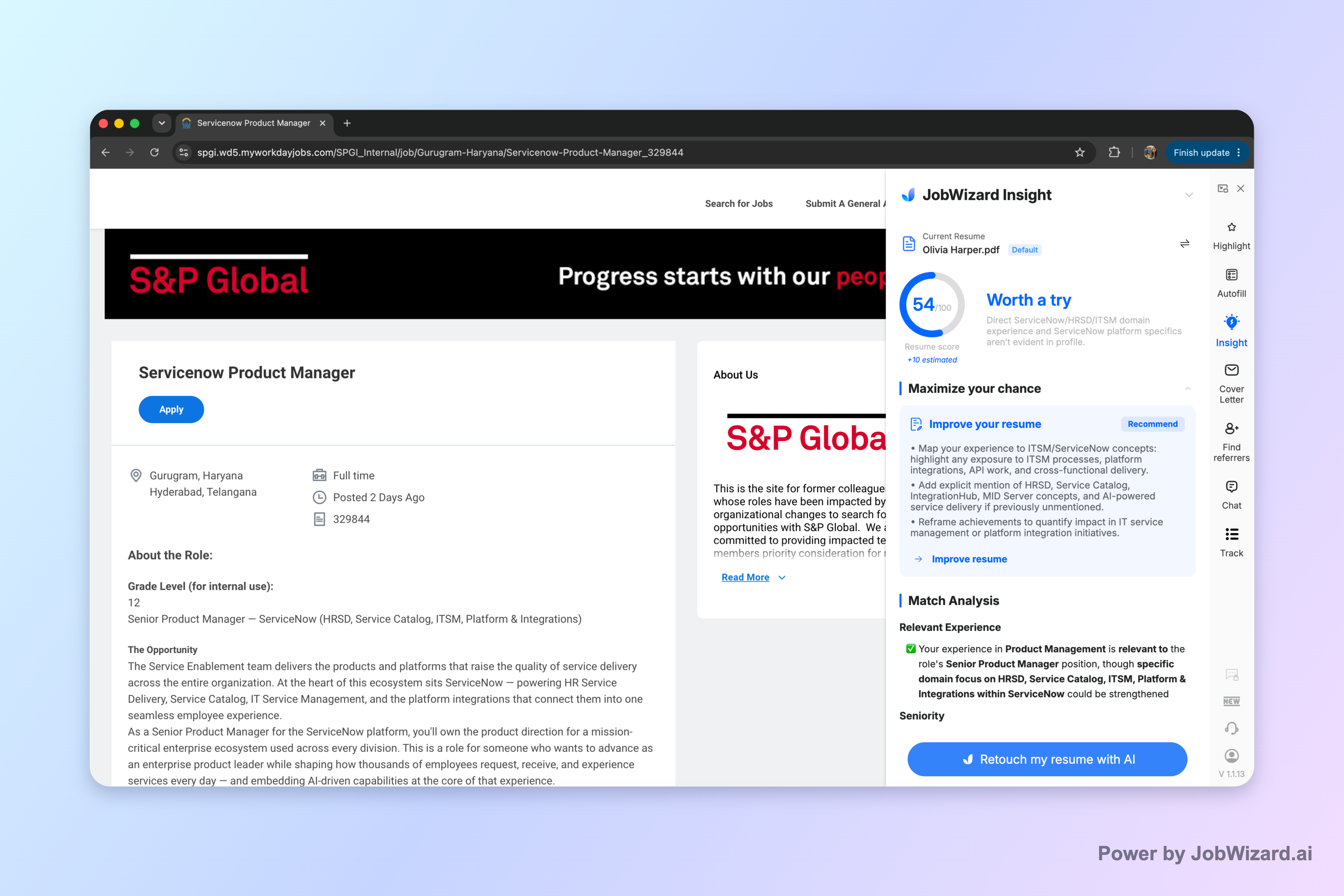
JobWizard Insight is built to help with this exact problem: it compares the selected resume with the current job description and presents a match score, an overall assessment, and improvement suggestions. It can also diagnose expression gaps and turn them into an editable resume revision draft.
Use the job description to “stress test” your timeline
Before you submit, scan the posting for timing signals and align your resume accordingly:
- Onboarding urgency: Look for phrases like “immediate need,” “fast ramp,” or “start date flexibility.”
- Interview cadence: If they mention quick interviews, your earliest start matters more.
- Relocation or travel constraints: If the role requires immediate presence, vague availability can hurt.
- Team start coordination: Some teams hire to fill specific kickoff windows.
Verify every edit—don’t overpromise
Even with AI-assisted tailoring, you must validate changes. JobWizard’s suggested adjustments are not a hiring probability and don’t guarantee ATS passage or an interview, and you must verify every suggested resume change and keep only accurate experience.
Rule of thumb: Tailor availability to the job posting, but only say what you can truly meet—your credibility matters.
Availability plus relocation: keep the story consistent
If relocation is part of your timeline, your availability statement should reflect both the “can start” date and the “can be onsite” (or travel-ready) date. You can make this smoother by planning your wording around relocation decisions.
For decision help and answer phrasing, read “Are You Willing to Relocate?”—How to Decide, Answer, and Stay Hireable.
Common availability mistakes that cost interviews (and how to fix them)
Many candidates lose momentum not because they can’t start, but because their availability in resume reads as uncertain, contradictory, or impractically vague.
1) “Soon” without an actual date or range
Vague wording forces recruiters to guess. If the form asks for a timeframe and your resume says “soon,” you’ve created an avoidable mismatch.
- Fix: Replace vague language with a specific date or tight range.
2) Different availability across resume vs. application
Your resume and your job application answers should align. If the application form requires a selectable option and your resume contains a different timeline, the recruiter may assume you don’t track details well—or that your timeline changed.
- Fix: Choose one earliest-start truth and mirror it everywhere.
3) Availability that ignores real constraints
If you can’t start by your stated date due to notice periods, relocation, or other obligations, your availability becomes a risk to the hiring plan. That can create delays even after you “pass” initial screens.
- Fix: If you’re waiting on something, reflect it as a range with realistic bounds.
4) Overly apologetic or hedged phrasing
“I’ll do my best to start quickly” doesn’t help decision-makers. Availability is a logistics signal, and your goal is clarity—not reassurance.
- Fix: Use confident, factual phrasing (dates, windows, or notice period ends).
Availability in resume vs. application fields: keep them in sync
Job applications often include explicit questions about timing, and your availability in resume should match those fields so the recruiter doesn’t have to reconcile differences.
Here’s a practical way to keep everything consistent across documents and forms—without rewriting your whole resume for every job.
Quick consistency checklist
- Pick your earliest start truth: Confirm the earliest date you can realistically begin.
- Decide date vs. range: Use a range only if constraints make a precise date unreliable.
- Mirror wording lightly: Match the timing, not necessarily the exact sentence.
- Confirm relocation/travel readiness: If relevant, ensure “available to start” matches onsite/travel readiness.
- Review before submitting: If anything changed since you last applied, update it.
Where JobWizard fits in your workflow
JobWizard is designed to support the tedious parts of resume-to-job matching: it helps fill repetitive fields quickly while you review before submitting, and it provides Insight to compare your resume with the job description and identify expression gaps that you can turn into editable revision drafts.
In practice, that means you’re not relying on blind auto-fill to carry your story—you’re using tools to speed up the mechanical parts while keeping your availability details accurate and intentional.
Do this automatically with JobWizard
Skip the manual work — JobWizard's Smart Autofill handles this for you.
FAQ: Availability in resume questions job seekers ask before they apply
What does “availability” mean on a resume?
On a resume, “availability” is your realistic start timeline—often phrased as a start date window (e.g., “available to start June 3”) or as a general readiness (e.g., “available immediately”). It’s meant to help the employer understand whether your timing matches their hiring schedule.
Should I put a specific start date or a range?
If you know your constraints (notice period, relocation timing, certifications, onboarding dates), use a specific date when possible. If you’re still coordinating, a short range is usually better than vague wording (for example, “available between Aug. 5–Aug. 12”). Keep it consistent across resume and application fields.
How do I answer availability questions on a job application?
Match your application answer to what’s on your resume and be specific about your earliest start date. If the form asks for options (immediately, within two weeks, etc.), choose the closest option you can truly meet, then confirm details in your resume or a brief note if there’s space.
What if my availability changes after I submit my resume?
If your availability changes, update your details as soon as you can—ideally before an interview when timing matters most. Avoid overpromising in your first submission; write availability in resume wording that reflects what you can reliably deliver.
Can JobWizard help me tailor my availability in resume to a job description?
Yes. JobWizard Insight compares your resume against the specific job description and produces a match score, plus improvement suggestions and an editable revision draft based on the gaps it finds. You still need to verify every change and keep only accurate experience before you submit.
Want to make your timing feel “plug-and-play” to the employer? Use JobWizard to compare your resume with the exact job description and then review the identified gaps so your availability in resume aligns with the posting—before you submit.
If you’re also uploading resumes into structured workflows, start with the matchup between platforms and document inputs: Greenhouse vs Workday for Job Seekers: Resume Upload, Custom Questions & Tracking.
Frequently Asked Questions
Let AI answer these questions for you
JobWizard fills sponsorship, work-auth, and availability answers correctly on every application — free.