How to Write Availability in Resume: A Recruiter-Trust Timeline Template
Learn how to write availability in resume using a clear start-date timeline and recruiter-ready wording. Match your answer to each job’s schedule and review before submitting.

Free Chrome extension
Let AI answer these questions for you
JobWizard fills sponsorship, work-auth, and availability answers correctly on every application — free.
Most resumes list skills—but how to write availability in resume is what helps employers quickly decide if you can actually start when the role needs you. The goal isn’t to “sound eager”; it’s to give a timeline they can trust, without trapping yourself.
In this guide, you’ll learn a simple availability format you can copy, plus examples for notice periods, interviews, and role-specific start dates. You’ll also see how JobWizard Insight helps you compare your resume with the specific job description and turn gaps into editable next steps.
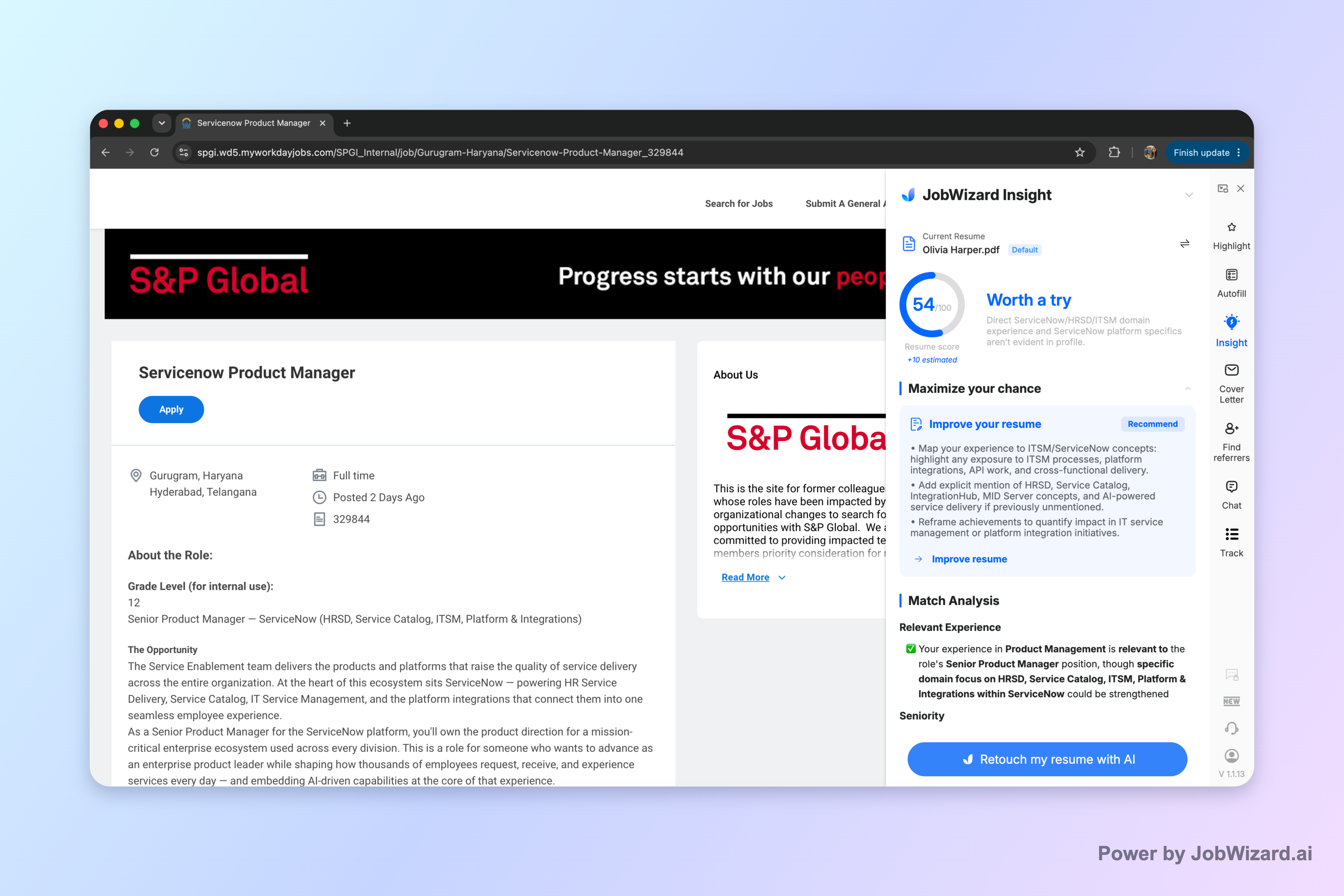
JobWizard Insight compares your selected resume with the job description and shows a match score, an overall assessment, and improvement suggestions—so you can review the differences before you submit.
Start with the recruiter’s timeline: write availability as an “earliest start”
Recruiters usually scan for one thing first: can you start when they need you? That’s why your availability line should be framed as your earliest realistic start date (or date range), not just a general feeling.
Think of availability as part of your application “fit,” similar to location and work authorization—except it’s often more time-sensitive. If your availability conflicts with the job’s requested start window, it can push you into a “maybe” pile.
Use this one-line structure
- Earliest start: [date] (optional: “Flexible by [X days/weeks]”)
- Notice period: [# weeks] (optional, only if relevant)
- Schedule readiness: [e.g., “On-site ready / remote onboarding ready”] (optional)
Keep it factual. Don’t promise a start date you can’t defend later.
Where to place it so ATS and humans both find it
For best visibility, put availability near the top, either as a dedicated “Availability” line under your contact info or inside your summary. Keep formatting simple and readable.
- Preferred: a short “Availability” line near the top of the resume.
- Acceptable: one line inside the summary (if your summary is short).
- Avoid: burying it in the work history where it’s easy to miss.
Choose the right availability wording (notice period, immediate, or date range)
To nail how to write availability in resume, select wording based on your real constraints—then use the same pattern across applications.
Template examples you can paste
- Immediate start (true): “Availability: Earliest start immediately / within 1–3 days.”
- Notice period: “Availability: Earliest start [date] (2-week notice period).”
- Date range: “Availability: Earliest start [date]; flexible within [range].”
- Training/onboarding ready earlier: “Availability: Can begin onboarding/training on [date]; earliest full-time start [date].”
- Interview availability (separate from start date): “Interview availability: [days/times].” (Keep interview scheduling info distinct from start dates.)
When “immediately” is risky
If you’re currently employed, “immediately” can become a mismatch. Even if you want to move quickly, the safe version is: earliest start + notice period. It reads confident and avoids back-and-forth.
Availability vs. interview availability (don’t mix them)
Availability for a role’s start date and availability to interview are related—but not the same. If the job asks “What is your availability to interview,” answer it separately and keep the resume start date clear.
If you want recruiter-ready wording for interview scheduling, see How to Answer “What Is Your Availability to Interview” (Scripts That Get Replies).
Tailor availability to each job description without rewriting your whole resume
Tailoring availability is one of the highest-impact resume tweaks because it’s directly connected to the role’s timeline. You don’t need to rewrite everything—just align your earliest start date (or range) to the job’s stated needs.
Quick tailoring checklist
- Find the start window in the job posting (as explicit as possible).
- Match your earliest start to that window first.
- Decide whether you need a notice line (usually yes if you’re employed).
- Confirm the wording stays truthful—your resume is a commitment.
How JobWizard Insight can help you qualify faster (with review-before-submit)
JobWizard Insight compares your resume with the current job description and surfaces a match score, overall assessment, and improvement suggestions. The key is that you still review every suggested change and keep only accurate experience—especially for time-sensitive fields like availability.
Availability should be checkable. Use your earliest realistic start date (and notice period when needed) so it stays consistent with what you’ll confirm later in recruiting.
If you’re working through multiple application questions, this related guide can help: How to Answer Job Application Questions: A Field-Tested Method for Confident, Consistent Responses.
Common availability mistakes to avoid (and what to do instead)
Even strong candidates lose momentum when their availability is vague or inconsistent. Here are the most common failure points and the fix.
Mistake #1: Vague wording (“soon,” “asap,” “ongoing”)
Recruiters can’t schedule around “soon.” Prefer earliest start: [date] or a short date range.
Mistake #2: Overpromising (“start Monday” without certainty)
If your notice period or approvals aren’t guaranteed, don’t commit. Use “earliest start” plus your notice period to stay credible.
Mistake #3: Listing interview availability as your start date
Interview availability helps scheduling but doesn’t answer the hiring question of when you can begin the job. Keep these in separate lines.
Mistake #4: Forgetting to update availability before submitting
Situations change. Before you apply, verify your availability line is current. If you update it later, keep messaging consistent across your resume and application responses.
Mistake #5: Using availability inconsistently across versions
If you apply to several roles, the availability line should match your reality every time. For guidance specifically focused on timing and recruiter trust, read Availability in Resume: How to Write It So Hiring Managers Trust Your Timeline.
Do this automatically with JobWizard
Skip the manual work — JobWizard's Smart Autofill handles this for you.
FAQ: how to write availability in resume
Where should availability go on my resume?
Put availability in a dedicated “Availability” line near the top of your resume (or under your summary) so it’s visible fast. If you use a one-line header for contact details, you can place it right after your location/phone—just make sure it doesn’t break ATS formatting.
What should I write for availability if I need notice at my current job?
State the earliest realistic start date and reference notice plainly (e.g., “Notice period: 2 weeks; earliest start: [date]”). If you can start earlier for onboarding tasks, internships, or training, mention that separately.
Is it better to say “immediately” or give a specific date?
A specific date or date range is usually safer because it’s checkable. Use “immediately” only when you truly can start right away; otherwise, replace it with an earliest-start date and (optionally) a flexible window.
How do I tailor availability to different job postings?
Read the job description’s stated start timeline, then align your availability line to it using the same time horizon (earliest start date first). If the posting asks for an exact start date, don’t leave it vague—give the earliest start you can commit to.
What if my availability changes after I apply?
Before you submit any application, review your resume’s availability line and update it if your situation changed. If a recruiter asks for details after you apply, reply with the updated earliest start date and keep any supporting context consistent.
Next step: compare your resume to the job description and finalize a trustable availability line
If you want your application to move faster, don’t treat availability as an afterthought. Compare your resume to the specific job description, then review the suggested edits—especially anything time-sensitive—before you submit.
Start by using JobWizard Insight to diagnose resume expression gaps against the job description, then tailor your availability with the templates above so it matches the role’s timeline.
Try JobWizard to compare your resume with the job description and review the identified gaps before you apply.
Frequently Asked Questions
Let AI answer these questions for you
JobWizard fills sponsorship, work-auth, and availability answers correctly on every application — free.