
How to Put Availability on Resume: ATS-Friendly Wording + Timeline Examples
Learn how to put availability on resume with clear, recruiter-friendly wording, ATS-safe formatting, and timeline examples for your next application.
Free Chrome extension
Let AI answer these questions for you
JobWizard fills sponsorship, work-auth, and availability answers correctly on every application — free.
How to Put Availability on Resume without confusing recruiters or ATS
If you’re trying to figure out how to put availability on resume, your goal is simple: state a start-ready timeline in a format recruiters can scan in seconds and ATS can extract reliably.
That means being clear about when you can start (date or window), and optionally explaining constraints like notice periods—without writing a paragraph that looks like a contract clause.
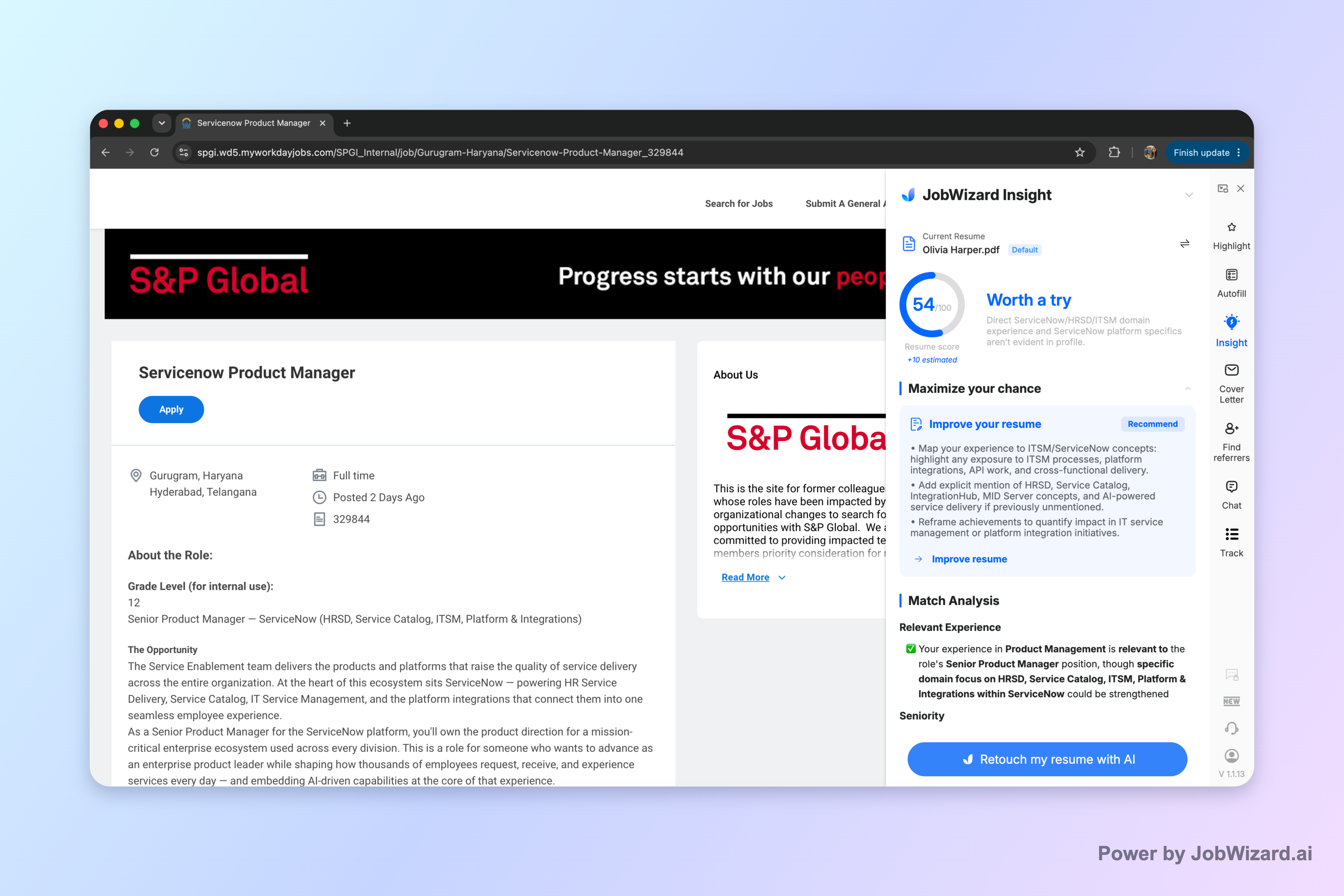
JobWizard’s Insight compares your resume to the job description and turns gaps into actionable next steps, which is especially useful when your availability wording doesn’t match the role’s timeline needs.
In practice, you’ll want to verify every suggestion so the availability details stay accurate and consistent across your resume and applications.
For deeper guidance on timeline phrasing and how hiring managers interpret it, use these companion reads: Availability in Resume: How to Write It So Hiring Managers Trust Your Timeline and What Is Your Availability Meaning? How Recruiters Read Your Schedule (and How to Reply).
Choose the right availability format (date, window, or “on/after” wording)
The format you choose determines whether your timeline feels certain or vague, so pick the option that matches your real-world constraints and comfort level.
Option A: A specific start date (best when you know it)
If you can name the exact day you’ll be available, write it directly. This is the most recruiter-friendly version because it reduces back-and-forth.
- Available to start: August 26, 2026
- Available to start: 09/01/2026
- Start date: Monday, Sept. 9
Keep it consistent with any application fields that ask “earliest start date” or “when can you begin.”
Option B: A window (best when you’re timing around approvals or notice)
Use a range when you can’t commit to one day but can commit to a period. Windows are common for notice periods, onboarding timelines, and relocation logistics.
- Available to start: September 1–15
- Available to start: Within 2 weeks
- Targeting a start date in early September
Option C: “On or after” (best when you must meet a constraint)
If you have a notice period or contractual requirement, “on or after” communicates constraint without sounding like you’re trying to negotiate later.
- Available to start on or after August 30, 2026
- Available to start on/after 08/30
- Available to start on or after the end of my notice period
What to avoid (common mistakes)
- A vague phrase like “as soon as possible” (it forces recruiters to ask follow-up questions)
- Overpromising with deadlines you may not control
- Mixing availability with unrelated details (like salary requests or long explanations)
If you need a job-application version of this, this step-by-step companion is built for the exact “what do I write” moment: How to List Availability on Application: Exact Steps, Smart Phrases, and Examples.
Put availability in the right place so it’s visible and ATS-readable
To successfully answer how to put availability on resume, you need placement that survives scanning and parsing.
Recruiters typically skim the top third first, so availability belongs where it can be found quickly.
Best placement choices (pick one primary spot)
- Under your name/contact header (a single line like “Available to start: …”)
- In a “Professional Summary” or “Summary” line (short and specific)
- In a labeled “Availability” line within the top section of your resume
Example: Summary placement
Professional Summary Project Coordinator with 5+ years supporting cross-functional teams. Available to start August 26, 2026.
Example: Header/contact placement
John Rivera | john.rivera@email.com | (555) 123-4567 | Available to start: August 26, 2026
If you use a skills section
You can add a short labeled line without turning your resume into a list of constraints.
- Availability: On or after September 15, 2026 (after notice period)
Don’t hide it in the footer
Even if the text is present, small footer formatting can reduce visibility for human scanning and create extraction problems for some ATS setups.
Write availability wording that matches recruiter expectations
The best availability statement is short, specific, and easy to verify—so it reads like a professional timeline, not a question.
Start-date lines you can copy (edit with your truth)
- Available to start: [Month Day, Year]
- Available to start within [X] weeks
- Available to start on or after [Month Day, Year]
- Targeting a start date of [Month/Year]
Availability when you’re giving notice
If your current role requires notice, mention it with a clear “after X” structure. This helps recruiters understand the practical timeline.
- Available to start: September 1, 2026 (after 2 weeks’ notice)
- Available to start on or after September 1, 2026 (subject to notice period)
Availability if you’re currently employed and can interview immediately
This is a great way to reduce friction: you’re not starting yet, but you’re available to move through the hiring process.
- Available to start: October 1, 2026 (interviews available immediately)
- Available for interviews this week; start date targeted for August 30
Availability if you’re between roles
Keep it confident without adding extra drama.
- Available to start immediately
- Available to start on [specific date]
- Currently available for interviews and onboarding
Availability for part-time, weekend, or schedule-based roles
Some jobs don’t just care about “when” you start—they care about “when” you can work. In those cases, label the schedule in addition to the start date.
- Availability: Start August 26; weekends only
- Available to start September 1; open to evening shifts
Availability + relocation or travel (keep it separate)
Don’t force other constraints into the same sentence as your start date. Recruiters may misinterpret them.
- Availability: Available to start on or after August 30, 2026
- Relocation/Travel: Open to relocation / Available for up to 3 business trips per month
Match your resume availability to the specific job description
Your “best” availability statement is the one that aligns with the hiring team’s timeline—so tailor it to the posting.
Use the job description as your checklist
Before you edit, scan the posting for timeline cues like:
- “Immediate need” or “start ASAP” language
- Mentions of onboarding dates or “must start by”
- Whether they talk about training schedules
Then adjust your resume with one rule
Keep the availability statement accurate, but tune the format to what they’re effectively asking for: date, window, or “on/after.”
For example, if the job emphasizes “start ASAP,” you’d rather write “Available to start immediately” or “Available this week” than “Within a few weeks,” even if that’s technically true.
Quick tailoring examples (from common scenarios)
| Your situation | Write this on your resume | Why it works |
|---|---|---|
| Currently employed; 2 weeks’ notice | Available to start: September 1, 2026 (after 2 weeks’ notice) | Direct date + reason without extra narrative |
| Between jobs; can start this week | Available to start this week | High clarity without over-explaining |
| Waiting on relocation paperwork | Available to start on or after October 1, 2026 | Constraint communicates uncertainty without sounding evasive |
| Flexible start date; prefer late month | Targeting a start date of September 20–30 | Gives a range that feels realistic and intentional |
Use JobWizard to tighten expression gaps
If you suspect your resume’s availability line doesn’t “match” the posting’s tone—too vague, too hidden, or formatted differently—JobWizard Insight can help by comparing your resume to the job description and highlighting where your expression doesn’t line up.
Just remember: you must verify every suggested change and keep only information that’s accurate for you.
Finally, if you want to broaden your timing answers beyond the resume (for example, when applications ask “What is your availability meaning?”), revisit What Is Your Availability Meaning? How Recruiters Read Your Schedule (and How to Reply).
Do this automatically with JobWizard
Skip the manual work — JobWizard's Match Score handles this for you.
FAQ about adding availability to your resume
Where on a resume should I put availability?
Most of the time, add availability in a dedicated line near your contact header (or in a “Summary”/“Professional Profile” section) so it’s visible even when ATS extracts your text. If the job is very timeline-driven, you can also mirror it in a “Relevant Skills” or “Availability” label within the summary.
How do I write availability if I need notice from my current job?
Use an exact, plain-language window: “Available to start: [date] (after 2 weeks’ notice).” If you’re not sure of the notice period yet, write the constraint without making it vague: “Available to start on or after [earliest date] (subject to notice).”
What’s the best wording for immediate availability?
Recruiters often scan for certainty. Good options include: “Available to start immediately,” “Available to start this week,” or “Available to start on [specific date].” If you’re truly ready now, pair it with a working-status note like “Currently available for interviews and onboarding.”
Should I list “open to relocating” or “travel availability” the same way?
Yes—but label it clearly and keep it separate from start-date availability. For example: “Availability: Available to start [date]” and “Relocation/Travel: Open to relocation / Available for up to [X] days per month of travel,” using whatever level you can stand behind. This prevents recruiters from assuming one commitment means the other.
Can my resume wording hurt my chances if I’m too specific?
Specificity helps when it’s accurate. Don’t overpromise—avoid deadlines you might miss. If you must qualify, use a soft but clear constraint like “Targeting a start date of [month/date]” or “Available to start after notice period ends.” Always keep your timeline consistent with any application answers you submit.
Ready to tighten your resume for each job? Start by comparing your resume to the specific posting, then make sure your availability line uses the right format (date, window, or on/after) and stays consistent with your application answers. If you’re using JobWizard, use Insight to find where your resume expression doesn’t match the job description, then revise with accurate details.
Want better consistency across all application prompts? Read How to Answer Job Application Questions: A Field-Tested Method for Confident, Consistent Responses.
Frequently Asked Questions
Let AI answer these questions for you
JobWizard fills sponsorship, work-auth, and availability answers correctly on every application — free.