Subject Line Follow Up Email That Gets Opened: 17 Fast Options + a Review-First Plan
Need a subject line follow up email that actually gets opened? Use these 17 options and a review-first follow-up plan based on your application activity and current status.

Free Chrome extension
Autofill your next job application
JobWizard is a free Chrome extension that fills applications, tracks statuses, and optimizes your resume.
Subject line follow up email: how to get replies without sounding generic
Your subject line follow up email is the difference between “maybe I’ll respond” and “did they follow up?” A strong subject line is specific, easy to skim, and aligned with your application status—so the recipient can understand your intent in a glance.
Most candidates write a good email body and then reuse a bland subject like “Checking in.” Instead, treat the subject line as your mini headline: include the role, reference the application, and hint at next steps.
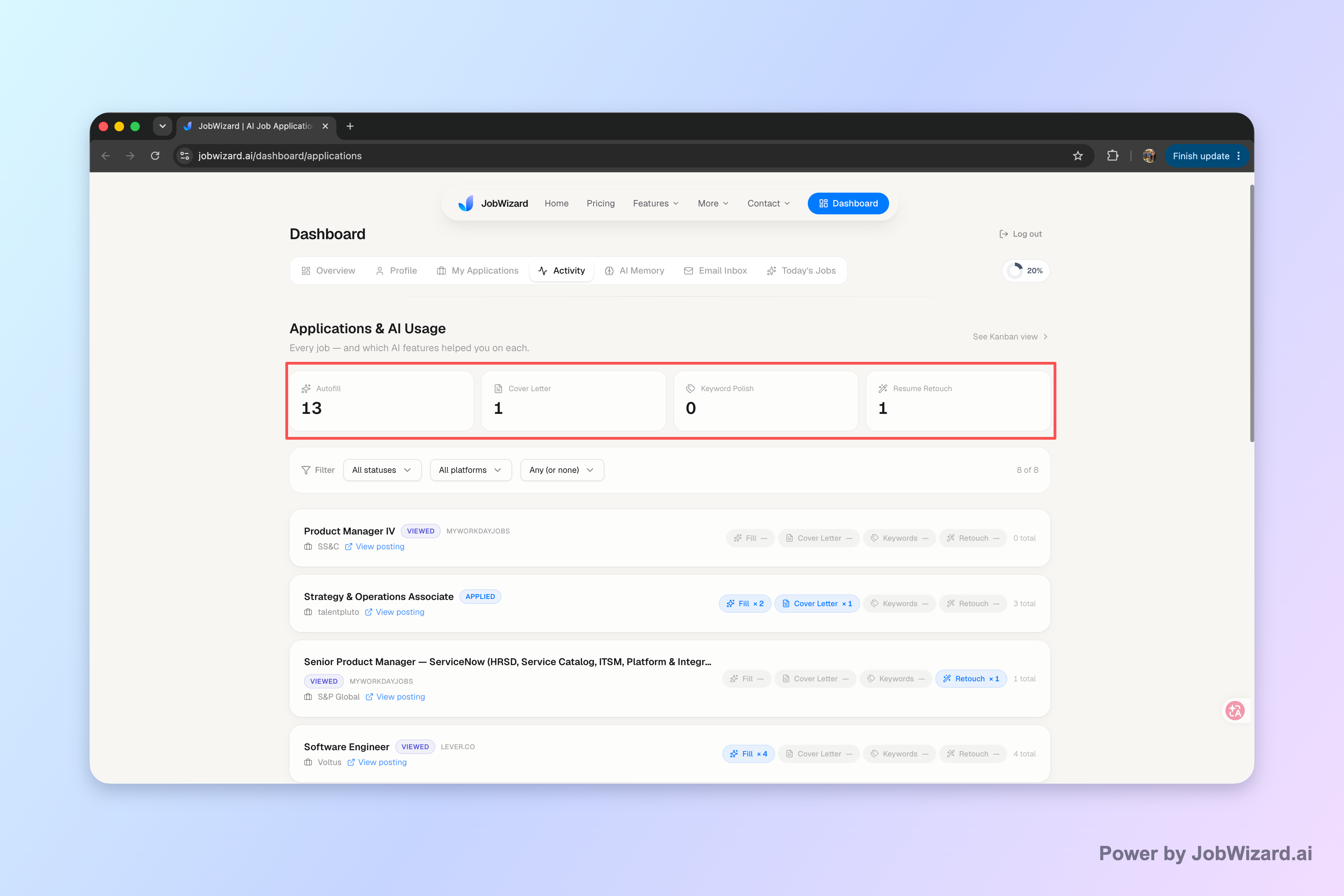
If you want the follow-up to feel timely (not random), tie it to what you know about the application—your role, your submission details, and the latest status you can confirm. An application activity view helps you see what stage each role is in and which tools were used for that application, so your wording can stay relevant.
17 subject line follow up email options you can copy today
Pick a subject line that matches your situation, then reuse the same email body structure with only the status line changed. Below are open-ready ideas designed for job applications and early follow-ups.
After you apply (general follow up)
- Following up on my application for [Role Title]
- Application follow-up: [Role Title]
- Next steps for the [Role Title] application
- Re: [Role Title] — application status
- Checking in: [Role Title] application
- Submitted application for [Role Title] — any update?
When the role is “under review / under consideration” (status-sensitive)
- Re: [Role Title] — still under consideration?
- Update on [Role Title] application (under review)
- Follow-up: [Role Title] — looking for next steps
- [Role Title] application — any updates from your team?
When you’re waiting on a decision (polite, not pushy)
- Following up on [Role Title] — thank you
- [Role Title] application — appreciation + next steps
- Quick follow-up: [Role Title] application
After an interview (different intent)
- Thank you — next steps for [Role Title]
- Following up after my interview for [Role Title]
- Re: Interview for [Role Title] — timing for next steps?
Tip: Keep your bracket text consistent with the job posting. If the title is slightly different on the posting versus your resume, use the posting’s wording so the recipient can instantly match you to the right job.
Write the follow-up email body so it’s easy to reply to
A great subject line follow up email gets opened. A great body earns the reply. Your goal is to make it effortless for the hiring manager or recruiter to say “yes, we’re moving forward” or “not for this role.”
Use a 4-part structure: identity, role reminder, purpose, and a low-effort call to action.
- Identity (1 sentence): “I’m [Name], and I applied for the [Role Title] on [Date].”
- Relevance (1 sentence): Mention one matching detail (skill, project, or domain) from your resume.
- Purpose (1 sentence): Ask about next steps or whether they need anything else.
- Close (1 sentence): “Thank you for your time—I'd appreciate any update when possible.”
Keep it short. If you need more space, add one sentence explaining why you’re a good fit—no paragraph essays. Also, remember the role: you’re following up on the application, not requesting a full history of their hiring process.
Two copy-and-paste message templates
Template A: after applying (general)
Hi [Name], I’m [Name]. I applied for the [Role Title] position on [Date]. I’m following up because I’m very interested in contributing to [team/company goal or product area]. If there are any next steps I should prepare for, I’d appreciate your guidance. Thank you for your time. Best regards, [Your Name]
Template B: status-sensitive (“under consideration”)
Hi [Name], I’m [Name], and I applied for the [Role Title] role on [Date]. I wanted to check whether the application is still under consideration and if there’s an expected timeline for next steps. If there’s any additional information that would be helpful, I’m happy to provide it. Thank you for your time and consideration. Best regards, [Your Name]
For more status-aligned phrasing, you can also use: What to Say in a Follow Up Email After Applying: 9 Lines for Every Status.
How to time a subject line follow up email (without over-communicating)
Timing matters because your follow-up should feel like a natural checkpoint, not a spam pattern. The safest approach is to follow up when you can reasonably expect review progress—and then stop at a respectful cadence.
Here’s a simple review-first workflow you can follow to decide when to send:
- Confirm the role + date applied: Use your own records so you don’t reference the wrong job or submission time.
- Check the current application status: If you track applications, use your application activity view to align your wording with the stage.
- Draft the email, then review personalization: Make sure the subject and first line match the posting.
- Send one concise follow-up: Aim for clarity—ask about next steps and provide a quick path to reply.
- Document the outcome: Keep your follow-up notes with the job so you don’t repeat yourself later.
Important: Tracking is for organization and clarity, not a guarantee. Your application activity view can show application status and which JobWizard tools were used for each role, but you shouldn’t assume you’ll catch every update or that tracking alone improves outcomes.
If you’re building a system for follow-ups across multiple roles, start with this: How to Track Job Applications: A Practical System (JobWizard + Beyond). It’s the easiest way to know what you’ve already sent and what step comes next.
Common follow-up mistakes (and better alternatives)
Even with the right subject line, a few mistakes can reduce response rates. Watch for these and swap in the fixes below.
1) Using “just checking in” as your subject
Why it fails: It doesn’t tell them what you want or what you’re referencing. Better: Include role and intent: “Following up on my application for [Role Title].”
2) Over-explaining in the first paragraph
Why it fails: Recruiters skim. Long intros slow down the reply decision. Better: First 1–2 sentences should identify the application and your purpose.
3) Not aligning with the current status
Why it fails: If you ask for “an update” but the role already moved forward, your email can feel off-target. Better: Use status-specific wording like “still under consideration?” or “next steps after review.”
4) Sending the same message to every role
Why it fails: The recipient can tell when an email isn’t tailored to the posting. Better: Keep the structure, but vary one line that references a match.
To make it easier to write quickly, use: An Email Template for Job Application That Gets Replies (with Subject Lines + Follow-Up Copy) and then customize the subject line using the options above.
Do this automatically with JobWizard
Skip the manual work — JobWizard's Application Tracker handles this for you.
FAQ: subject line follow up email questions job seekers actually ask
How long should I wait before sending a subject line follow up email?
Wait long enough that the hiring team has had time to review your application, then follow up once you have a clear reason to check status (e.g., it moved to “under consideration”). Avoid repeated pings—one well-timed follow-up beats multiple messages.
What should I write after the greeting in a subject line follow up email?
In the first 1–2 sentences, remind them who you are and the role you applied for, then state your purpose: you’re checking on the application’s status and asking about next steps. Keep it specific and short so it’s easy to reply.
Can I use the same subject line for every follow up email after applying?
You can reuse a template style, but don’t copy the exact same wording. Adjust the subject line to match the current situation (submission timing, interview status, or whether you’re following up after a recruiter screen) so your message feels relevant.
Should I mention I used an autofill tool or tracking software in my follow up email?
No—don’t mention autofill or internal tools in your email. The key is your professional request for next steps and your review of application details before you send.
How do I tailor my follow up email when I don’t know the application status?
Tailor the email around what you do know: confirm the role and date applied, ask politely whether they’re still considering your application, and offer a quick way to reach you. If you track applications, use your application activity view to align the follow-up wording with the latest status.
JobWizard CTA: If you’re sending follow-ups across multiple roles, keep each application and its next step in one place—use JobWizard’s Activity view to track application status and your tool usage, so every subject line follow up email you send stays aligned with where that application really stands.
Frequently Asked Questions
Autofill your next job application
JobWizard is a free Chrome extension that fills applications, tracks statuses, and optimizes your resume.