Student Cover Letter Sample That Gets Noticed: A Ready-to-Edit Template + Tips
Get a student cover letter sample you can tailor fast. Includes a plug-and-play structure, tone guidance, and a workflow to edit before you submit.
Free Chrome extension
Generate this cover letter automatically
JobWizard drafts a tailored letter from your resume and the job description in seconds — free.
Applying for internships, entry-level roles, or school-to-career opportunities can feel harder when you don’t have years of experience. That’s where a student cover letter sample helps: it gives you a proven structure you can customize, so you sound confident and relevant—not generic.
This guide gives you a ready-to-edit sample, plus a fast workflow to tailor it to each job posting (and keep it sounding like you). You’ll also see where to plug in your strongest examples—even if your “experience” is coursework, projects, or campus leadership.
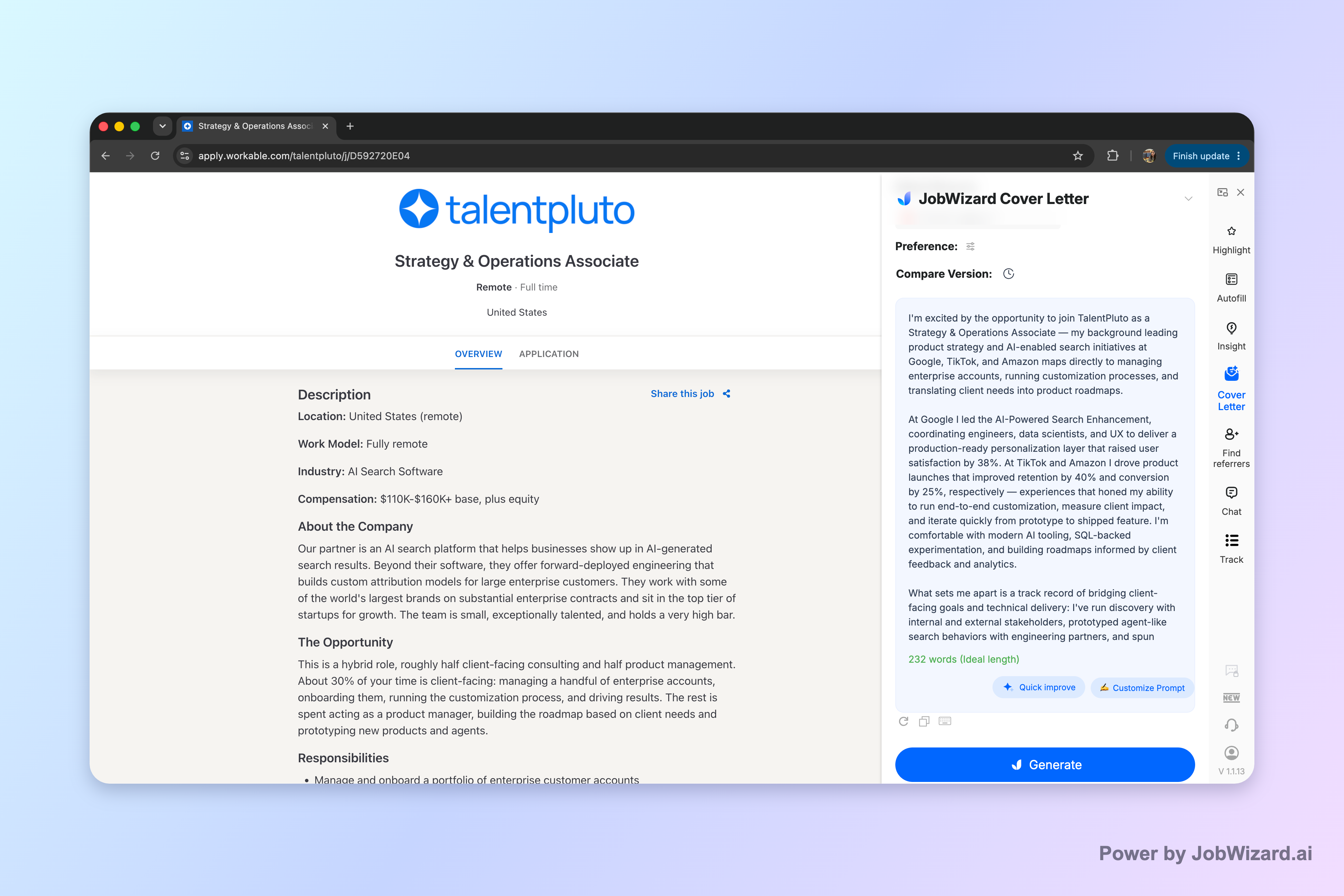
JobWizard can generate an editable cover letter draft using your selected resume and the current job description, and you can choose length, format, tone, style, and focus before you write. Then you click into the draft and edit it directly—so you’re not stuck with a one-size-fits-all letter.
Use this student cover letter sample structure (and know what to replace)
A strong student cover letter sample follows a predictable pattern: identify the role, prove fit with 2–3 relevant examples, and close with a clear call to action. Below is a template that works for internships, new grad applications, and entry-level positions.
Copy the structure first, then replace brackets with your specifics. If you’re applying to multiple jobs, keep a “bank” of your best project bullets (impact, tools, results, and what you learned) so tailoring is quick.
Student cover letter sample (ready to edit)
Header (standard): Your name | City, State | Phone | Email | LinkedIn/GitHub/Portfolio (optional)
Date: [Month Day, Year]
Hiring Manager: [Name if known], [Company]
Subject: [Role Title] — [Your Name]
Dear [Hiring Manager/Team],
Paragraph 1 (hook + fit): I’m excited to apply for the [Role Title] at [Company]. As a [student/year major] with experience in [relevant area], I’m especially interested in this role because [specific reason tied to the job posting—mission, product, team, or problem]. My background in [skill 1] and [skill 2] translates well to helping you [one sentence describing what the role needs].
Paragraph 2 (example #1 → job requirement): In my [course/project/internship/club], I [what you did]. For example, I [brief action] and delivered [measurable or concrete result if you have it—time saved, improved quality, completed deliverable, presentation outcome]. This matters because [connect to the requirement from the posting: e.g., “it mirrors the level of detail needed for…”].
Paragraph 3 (example #2 → job requirement): I also built experience with [second relevant area] through [another project/leadership/volunteer example]. Specifically, I [action] and [outcome]. I learned how to [tool/process/skill] and apply it in ways that support [company/team goal].
Paragraph 4 (example #3 optional + readiness): Beyond coursework, I bring [soft skill supported by evidence—ownership, collaboration, communication, customer focus] from [campus role/volunteer group/research]. I’m comfortable working with [relevant tools/methods] and I pay close attention to [quality bar the job cares about].
Closing paragraph (next step): Thank you for your time and consideration. I’d welcome the opportunity to discuss how my experience in [top 1–2 skills] can help [Company] succeed in the [role goal]. Sincerely, [Your Name]
If you want more real-world student scenarios, use Cover Letter Examples for Students: Templates That Sound Like You (Plus Real Student Scenarios) to see how students phrase similar experiences for different kinds of roles.
Tailor it fast: a student cover letter workflow that keeps you truthful
Most student cover letters fail for one reason: they don’t map to the job posting. Use this workflow to tailor quickly without exaggerating or inventing experience.
- Skim for the “requirements,” not the buzzwords: highlight 3–5 job needs from the posting (skills, responsibilities, and the kind of outcomes they care about).
- Pick 2–3 matching examples: choose projects, coursework, volunteering, leadership, or part-time work that prove each highlighted need.
- Write one sentence per connection: for each example, state what you did and why it matters to the requirement.
- Adjust tone to the company: if the posting is formal, keep your language polished; if it’s more energetic, keep it upbeat but still professional.
- Review for accuracy and personalization: verify facts and add genuine personal details before you submit. If you use an AI draft, you still own the final content.
Want a deeper AI-safe process you can trust? Read How to Write a Cover Letter with AI (Step-by-Step That Still Sounds Like You) for a checklist-based approach.
What to say when you “don’t have experience”
Instead of writing what you lack, translate what you did. Replace “I have no experience” with “I practiced this skill through…” and then point to a credible learning proof.
- Coursework: use a project title + method + result (even if the result is “completed a capstone prototype” or “ranked in the top X for the final presentation”).
- Club/leadership: describe ownership (“led a weekly workflow,” “coordinated timelines,” “created training materials”).
- Volunteer/work: focus on customer communication, reliability, and problem-solving.
- Independent projects: include tools used, constraints, and what you improved after feedback.
One practical paragraph example you can borrow
Example (tailored to a typical “data + communication” internship): Through a course project, I analyzed [dataset/topic] using [tool] to identify [insight]. I presented the findings in a concise report and walkthrough, and I incorporated feedback to improve clarity and accuracy—work that aligns with the role’s focus on turning information into decisions.
Choose the right length and formatting for your student cover letter sample
Your format should make it easy to skim and easy to trust. The best this application workflow is readable, not long.
In general, aim for a tight letter with short paragraphs and a clear structure. If the posting or your situation prompts extra detail, use that extra space to add relevance—not repetition.
How long is “too long” for a student cover letter?
A typical student cover letter fits on about half to one page. If you’re considering a longer version, keep it specific and relevant.
For guidance on extending without losing impact, see Can a Cover Letter Be Two Pages? When to Go Longer (and How to Keep It Strong).
Formatting checklist (quick)
- Use the same header style: consistent name, contact info, and professional email.
- Keep paragraphs 2–4 lines: use whitespace so the reader can scan.
- Write a clean subject line: include the role title and your name.
- Close with one clear next step: interview request or brief availability statement.
Make it sound like you: tone fixes that improve a this application workflow
Tone is where a this application workflow becomes believable. Use professional language, but avoid “template voice.”
As you edit, look for phrases that sound impressive but don’t prove anything. Replace them with evidence from your resume, projects, or school work.
Replace common weak phrases with evidence
| Weak/Generic Phrase | Stronger, Evidence-Based Replace |
|---|---|
| “Hard-working and motivated.” | “I managed weekly deliverables for [project/role] and met deadlines by building a simple workflow and tracking progress.” |
| “Team player.” | “I collaborated with [group/teammates] to [task], and incorporated feedback to improve [quality/outcome].” |
| “Skilled in communication.” | “I wrote [report/brief] and presented it to [class/team], then used feedback to clarify [what changed].” |
| “I’m passionate about this field.” | “I’m interested in [company/mission] because [specific reason], and my work on [project] helped me practice [relevant skill].” |
Use AI responsibly (so your letter stays real)
If you generate a draft, you should treat it like a starting point—not your final submission. JobWizard can create an editable first draft from your resume and the current job description, but you must review the content and add genuine personal details before using it.
If you’re applying to a role with a specific focus (like analytics), you can still start from a tailored template. For example, see Cover Letter Template Data Analyst: a plug-and-play draft you can customize fast (and still sound like you)—then swap in your student-level examples.
this application workflow FAQs (quick answers before you submit)
Here are fast, high-impact answers to common this application workflow questions.
Where do I start with a this application workflow if I have limited experience?
Start with impact over employment history: pick 2–3 school, project, volunteer, or leadership examples that match the job’s needs. In your first paragraph, name the role and why you’re a fit; in the body, connect each example to a requirement, and end with a clear next step (interview request).
How long should a student cover letter be?
Most student cover letters fit on about half to one page. If you’re tempted to go longer, keep it tight: cover only the most relevant experiences, use short paragraphs, and avoid repeating your resume. If the posting calls for specifics, address them directly rather than adding filler.
What tone should I use in a student cover letter?
Professional, specific, and confident without exaggeration. Use plain language, avoid generic phrases like “hard-working” without evidence, and mirror the job’s seriousness. If you’re using an AI draft, review every claim and add genuine details before submitting.
Should I use AI to write my this application workflow?
Yes—if you use it to create an editable first draft, then you fully review and personalize it. JobWizard can generate a draft using your selected resume and the current job description, and you can edit it directly; the key is to verify facts and add your real personal details (sponsorship, salary, EEO, and custom questions must be answered by you before submitting).
Can a student cover letter be two pages?
It usually isn’t necessary, but two pages can be appropriate when the posting requests detailed context or you have strongly relevant, tightly written experience. If you go longer, prioritize relevance, keep paragraphs short, and ensure every section supports the role—not your full history.
Next step: Generate your own draft for the current job description, then edit it to include your real student examples—so your this application workflow is tailored, accurate, and ready to submit with confidence.
Try JobWizard to create an editable cover letter draft (using your resume + the job posting), then personalize it before you apply.
Frequently Asked Questions
Generate this cover letter automatically
JobWizard drafts a tailored letter from your resume and the job description in seconds — free.