Cover Letter Examples for Students: Templates That Sound Like You (Plus Real Student Scenarios)
Get cover letter examples for students with approachable templates for internships, first jobs, and career changers—plus a workflow for turning rough notes into a polished draft you can personalize.
Free Chrome extension
Generate this cover letter automatically
JobWizard drafts a tailored letter from your resume and the job description in seconds — free.
Cover letter examples for students work best when they show proof, not just promises.
If you’re searching for cover letter examples for students, you’re probably not struggling with “how to sound nice”—you’re struggling with what to say when you don’t have years of experience yet. The good news: you can write a strong cover letter by treating your education, projects, and activities as your early “experience” and connecting them directly to what the role needs.
This guide gives you student-ready templates for common situations (internships, first job, career change, and remote applications), plus a simple drafting workflow you can reuse. You’ll also learn how to turn rough notes into an editable draft—without letting it sound robotic.
Start with the right cover letter format for students (so examples don’t feel off).
Before you copy any of these cover letter examples for students, use a predictable structure. When the hiring manager can scan your letter quickly, your lack of “traditional job titles” matters less.
Use this standard flow:
- Header + greeting (Hiring Team / “Dear Hiring Manager”)
- Opening (role name + why you’re a fit)
- Body Paragraph 1 (education + relevant coursework or training)
- Body Paragraph 2 (project, club, volunteer, or part-time responsibility—what you did)
- Optional Body Paragraph 3 (or bullets) (tools, teamwork, outcomes, or leadership)
- Closing (your interest + invite next steps)
Keep the tone confident and specific. If you’re tempted to write, “I am a hardworking student,” replace it with something observable: a project you built, a process you improved, or a team role you handled.
Cover letter examples for students: ready-to-edit templates for real scenarios.
Below are cover letter examples for students you can personalize quickly. For each one, swap in the bracketed details and replace generic claims with evidence you can point to.
1) Internship cover letter example (student with coursework + a relevant project)
Template
Dear Hiring Team,
I’m writing to apply for the [Internship Title] position at [Company Name]. As a [Year in School / Major] focused on [Relevant Area], I’m excited to contribute my strengths in [Skill 1] and [Skill 2] while learning from your team.
In my [Course / Program Name], I worked on [Project or Assignment] where I [Action] and achieved [Result—quantify if possible, otherwise describe]. This experience strengthened my ability to [Relevant Job Requirement], especially when balancing time and feedback.
Outside the classroom, I contributed through [Club/Volunteering/Part-time Role] by [What you did]. I enjoyed collaborating with others, communicating progress clearly, and improving my work based on what the team needed.
I’d welcome the opportunity to discuss how my background in [Area] can support [Company Goal/Team Focus]. Thank you for your time and consideration.
Sincerely, [Your Name]
2) First job cover letter example (student with transferable skills)
Template
Dear Hiring Team,
I’m applying for the [Job Title] role. Although I’m early in my career, I’ve built hands-on experience through [Relevant Experience: part-time job, internship, volunteering, campus role] and I’m ready to bring that same reliability to [Company Name].
In my role at [Organization], I [Action] and supported [Team/Customers] by [Process or Responsibility]. I learned how to prioritize competing tasks, follow procedures carefully, and communicate updates in a way that keeps others moving forward.
Academically, I’ve developed [Technical/Domain Skill] through [Coursework/Project]. For example, in [Project Name], I [Outcome]. That blend of practical responsibility and learning-focused effort is why I’m excited about this opportunity.
Thank you for considering my application. I look forward to discussing how I can contribute to [Team/Role Objective].
Sincerely, [Your Name]
3) Career change cover letter example (student pivoting from one major to another)
Template
Dear Hiring Team,
I’m writing to apply for the [Job Title] role. My academic background is in [Previous Major], but I’ve intentionally built experience in [Target Field] through [Coursework/Projects/Certifications]. I’m drawn to this position because it aligns with my strengths in [Skill you bring] and my interest in [What the job does].
Through [Program/Project], I practiced [Target Skill] by [How you did it]. I’m especially proud of [Specific deliverable or result], because it reflects how I learn: I identify gaps, apply feedback, and improve.
Beyond that, I bring a collaborative work style from [Club/team/role]. I’ve learned to communicate tradeoffs clearly and keep projects moving even when priorities shift.
I’d love to discuss how my training and project experience can support your team at [Company Name]. Thank you for your time.
Sincerely, [Your Name]
4) Remote internship or remote-first jobs example (student emphasizes collaboration)
Template
Dear Hiring Team,
I’m excited to apply for the [Job Title] opportunity. I’m a [Year/Major] student with experience in [Relevant Skills], and I’m particularly interested in this role because it supports [Remote/team outcome from job posting].
During [Project/Experience], I collaborated with [classmates/team/mentor] to [Action]. Because the work was remote, I practiced clear written communication: I shared updates, documented decisions, and used feedback loops to keep quality high.
I’m confident I can contribute to your goals at [Company Name] by applying my skills in [Tool/Process]. I’m organized, responsive, and motivated by work that benefits from thoughtful iteration.
Thank you for considering my application. I’d welcome the chance to discuss how I can support your team.
Sincerely, [Your Name]
How to customize student cover letters fast (without making them sound fake).
The fastest way to improve cover letter examples for students is to customize at the “evidence level,” not just the “word level.” That means matching the job’s priorities with proof from your projects, coursework, or responsibilities.
Use this repeatable checklist while you edit:
- Circle 3 requirements from the job description and choose one piece of evidence for each.
- Replace generic verbs (“helped,” “worked on”) with actions (“built,” “analyzed,” “presented,” “managed,” “implemented”).
- Add one concrete detail per paragraph: a course name, project deliverable, team role, tool, or process.
- Mirror the job’s language carefully (use the same concept, not the same sentence).
- Write a closing that matches the role: why you want this team and what you’ll bring in the first weeks.
Turn your notes into a polished first draft with AI (then personalize).
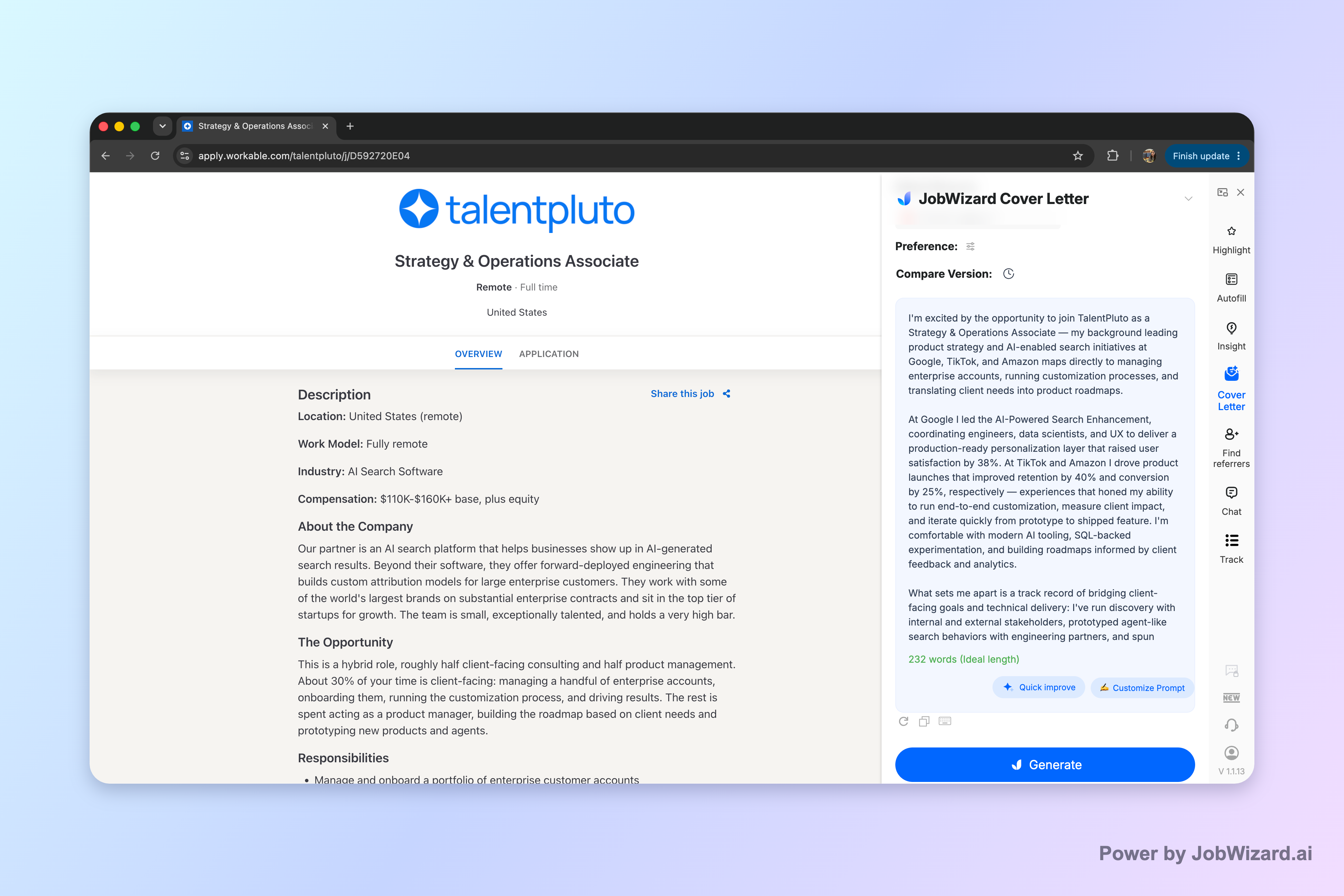
If you’re starting from a blank page, AI can help you generate an editable draft you can revise. JobWizard uses the selected resume and the current job description to generate an editable cover letter draft, and you can choose length, format, tone, style, and focus before generating it.
Remember: you should review the draft and add genuine personal details (like your project specifics or the exact experience you truly have) before submitting. That’s how you keep the letter sounding like you—not like a template.
Want student-focused examples for a specific situation? See:
- AI Cover Letter Examples for Recent Graduates
- AI Cover Letter Examples for Remote Jobs
- How to Write a Cover Letter with AI (Step-by-Step That Still Sounds Like You)
- What Is a Cover Letter for Employment? Purpose, Format, and What to Write
Common student cover letter mistakes (and what to do instead).
Even strong cover letter examples for students can fail if they repeat the same beginner errors. Avoid these pitfalls to make your letter feel credible and tailored.
1) Too much “about me,” not enough “evidence”
If every paragraph could apply to any student, the hiring manager won’t learn anything new. Use 1–2 sentences per paragraph to prove relevance: what you did and what it demonstrates about how you’ll perform in the role.
2) Vague achievements
Instead of “I worked hard,” write “I built X,” “I analyzed Y,” or “I presented Z.” If you can’t quantify, describe scope and method: timeline, deliverable, audience, or constraints you handled.
3) Ignoring the job posting’s priorities
Customize the letter to the posting. If the role emphasizes customer communication, leadership, or accuracy, make sure at least one paragraph connects your experience directly to that.
4) Over-formal or robotic tone
Good student cover letters sound like thoughtful professionals, not essays. Read your letter aloud and look for sentences that feel unnatural—then rewrite them with simpler phrasing while keeping the meaning.
5) Skipping the “why this role” closing
A strong closing ties your interest to the company’s work and signals readiness. Close with one sentence about what you can contribute and one sentence inviting next steps.
Do this automatically with JobWizard
Skip the manual work — JobWizard's AI Cover Letters handles this for you.
FAQ: Cover letter examples for students (quick answers you can use today).
What should a student include in a cover letter if they have no experience?
Focus on transferable skills and evidence: coursework projects, club leadership, volunteer work, part-time responsibilities, internships you’ve pursued, and specific tools you used. Then connect each item to what the role needs, and end with a clear “why this role” paragraph.
How long should cover letters be for students applying to internships or entry-level jobs?
Aim for about one page. Keep it scannable: 3–4 short paragraphs (or 2–3 plus bullets), one specific accomplishment or project per paragraph, and a closing that matches the job’s priorities.
Do cover letter examples for students need to be customized for each application?
Yes—use the example as a structure, then customize the details. Swap in the role-specific requirements, mirror key themes from the job posting, and add genuine personal details before submitting (e.g., dates, tools, projects, or outcomes you can stand behind).
How can AI help me write a cover letter as a student without sounding generic?
Use AI to generate an editable first draft from your selected resume and the current job description, then revise the tone and facts so they reflect your real story. Before using the draft, choose length, format, tone, style, and focus—and review every detail to ensure it’s accurate and truly yours.
What’s the best cover letter format for students?
Use a standard format: header, hiring manager or “Hiring Team” line, a strong opening that names the role, 2–3 body paragraphs that connect your education/projects to the job, and a concise closing with a call to action. Keep spacing clean and avoid dense paragraphs—use bullets when you need to show evidence fast.
Ready to draft your next student cover letter faster? Use JobWizard to generate an editable first draft for the current job description from your selected resume—choose the length, format, tone, style, and focus you want, then review and personalize it before submitting.
Frequently Asked Questions
Generate this cover letter automatically
JobWizard drafts a tailored letter from your resume and the job description in seconds — free.