Resume Worded vs Teal: Which Job-Description Match Gives You Cleaner ATS Language?
If you’re deciding between resume worded vs teal, focus on what they do with your job description and ATS keyword gaps—then verify every suggested edit before you submit.
Free Chrome extension
See your resume's match score for any job
JobWizard compares your resume to each job description and shows the exact keywords to add — free.
Resume worded vs teal: use the JD match score to find resume expression gaps
If you’re stuck on resume worded vs teal, start by asking a sharper question than “which is better?”: does the tool compare your resume to the specific job description, then show you what’s missing in your resume language?
That’s the core value behind most resume matcher workflows: they take the job description as the reference point, scan for overlap, and highlight where your resume doesn’t express the right skills the posting expects (often framed as ATS keyword gaps or qualify-style match indicators). Then you apply the suggested edits—only after you verify they’re accurate to your experience.
What to look for in a resume matcher (and why “match score” needs context)
A resume matcher is most useful when it gives you a job-description-based diagnosis and turns gaps into improvement suggestions you can actually edit.
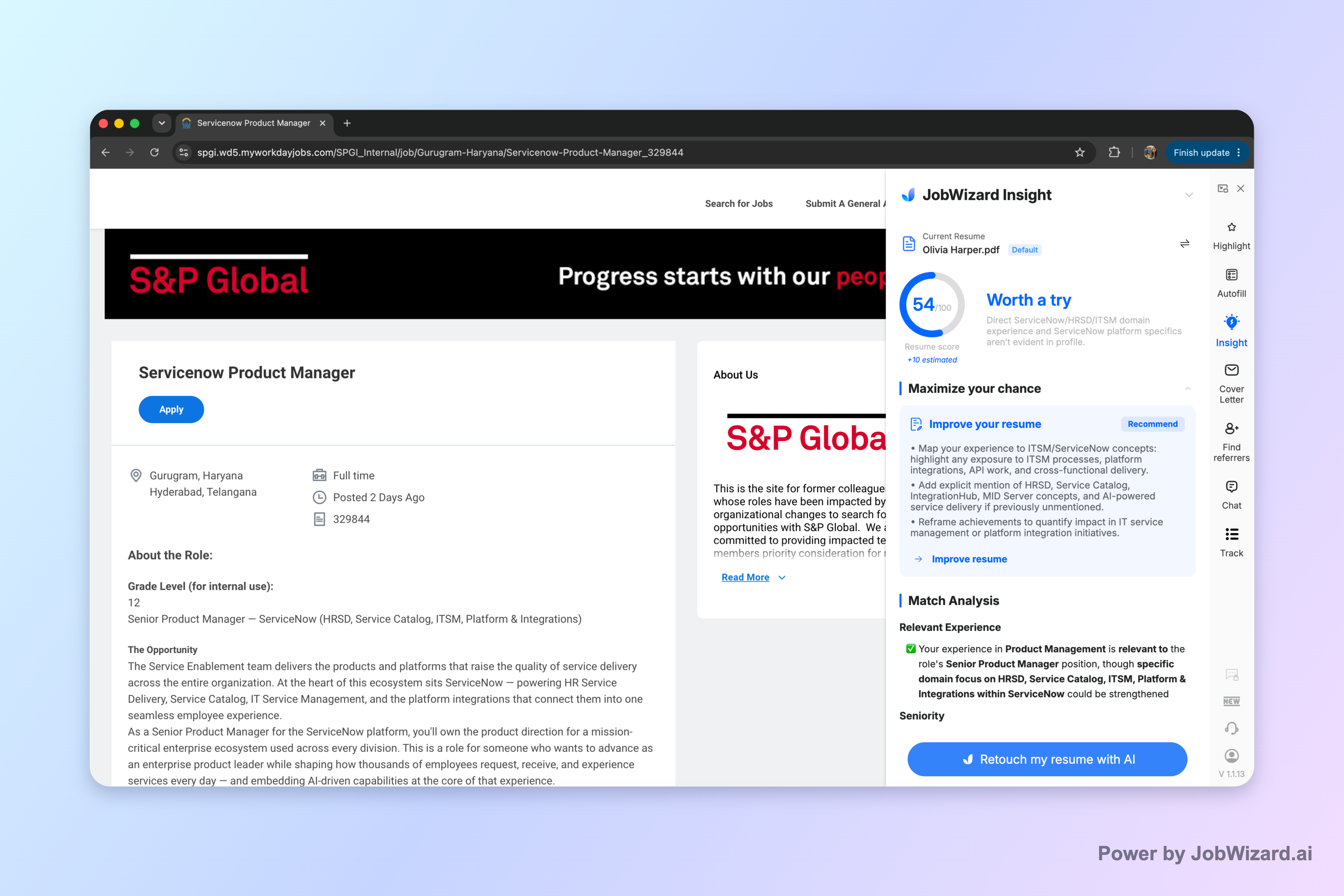
With JobWizard Insight’s match-score workflow, the system compares the selected resume with the current job description and presents an overall assessment plus improvement suggestions. The goal is to close “expression gaps”—where your experience may be relevant, but your resume wording doesn’t match what the job is asking for.
Turn “score” into editable, verified changes
The most productive way to use match-score outputs is to treat them as a review checklist, not a final verdict. JobWizard Insight’s JD-based diagnosis can identify resume expression gaps and turn them into an editable resume revision draft—so you’re not just guessing what to change.
- Expression gaps → editable revisions: Use the suggestions as draft language, then confirm every claim matches your real experience.
- JD language → ATS keyword coverage: Focus on the job’s skill phrasing and requirements, not on generic “more keywords” advice.
- Overall assessment → iteration loop: Re-check after edits so the resume and job description align more closely.
Match score limitations you should keep front-of-mind
Even the best JD comparison tool can’t promise outcomes. The match score is not a hiring probability and doesn’t guarantee ATS passage or an interview. You must verify every suggested resume change and keep only accurate experience.
Rule of thumb: use the match score to locate gaps, not to assume results.
How to compare resume worded vs teal without getting lost in buzzwords
To compare resume worded vs teal, don’t evaluate them only by marketing claims—evaluate them by their “job description → actionable edits” loop.
Here’s a practical comparison framework you can apply to any resume matcher, including ones marketed under different names:
| What you’re really checking | Why it matters for ATS keyword alignment | How to verify it in the product |
|---|---|---|
| JD-based comparison (resume vs the specific posting) | Aligning to the exact job description improves relevance—rather than chasing one-size-fits-all keywords. | Look for workflows that ingest the job description and analyze your resume against it (not just general score labels). |
| Match score interpretation | A score helps you prioritize what to fix, but it won’t predict interviews. | Confirm whether the tool clearly frames the score as an indicator/assessment and includes guidance on what to do next. |
| Gap → suggestion → editable draft | The fastest path to a stronger resume is turning gaps into language you can edit and verify. | Check whether it outputs improvement suggestions you can incorporate directly, and whether it supports revision drafts. |
| User control and accuracy | Even “smart” edits must reflect your real background to avoid overstating experience. | Ensure there’s a review step where you validate changes before you submit anything. |
A “right tool” decision rule (fast and honest)
Pick the tool that helps you produce the best tailored draft with the least confusion. If one platform makes it harder to see what’s missing and why, it will cost you time in rework.
- Run the job description match check: Use the posting you actually plan to apply to.
- Review flagged skills and phrasing: Identify what’s missing or under-expressed.
- Edit only what’s accurate: Keep your experience truthful and specific.
- Re-check relevance: Repeat the match check after major edits.
Use the match-score workflow for cleaner tailoring—especially for Workday-style applications
Even when you’re using different resume matcher tools, the workflow that wins is the same: tailor from the job description, then review before you apply.
JobWizard’s database shows many job applications and sessions where the process emphasizes autofill plus review-before-submit—filling repetitive fields quickly while you handle the sponsorship/salary/EEO/custom questions and anything that requires judgment.
Verified scale context: JobWizard has supported 720,000+ applications and 600,000+ autofill sessions, with an average of ~18 repetitive fields auto-filled per application (typically 11–23). About 65% of those applications are on Workday.
That matters because “fast application” only helps if the resume you attach is coherent and aligned. A JD-based matcher helps you reduce mismatch between the resume language and what the job posting expects—so you can apply faster without sending a resume that’s out of sync.
How to apply the resume matcher output (without over-optimizing)
When the tool flags gaps, translate them into resume bullets that sound like you. Avoid padding with buzzwords you can’t defend in an interview.
- Rewrite, don’t impersonate: Match the posting’s skills, but keep your voice and proof points.
- Prioritize requirements: Fix gaps that connect directly to the role’s core responsibilities.
- Be explicit with outcomes: If the job asks for impact, ensure your resume bullets reflect that—truthfully.
Finally, remember the key limitation: any match score is not a hiring probability. Your best strategy is to use it to guide editing, then submit only after you’ve verified accuracy.
Do this automatically with JobWizard
Skip the manual work — JobWizard's Match Score handles this for you. On these platforms: JobWizard vs Teal.
FAQ: resume worded vs teal match score and tailoring questions
Is a higher match score from tools like resume worded vs teal a guarantee of an interview?
No. A match score is an estimate based on how your resume aligns with the job description, and it does not guarantee interview outcomes or ATS passage.
What should I do with the gaps a resume matcher flags (like missing ATS keyword phrases)?
Use the gaps as a starting point, then verify each change against your real experience. Keep only accurate updates, because you’re responsible for submitting a truthful resume.
How do JD-based resume tools help you tailor faster than manual edits?
They compare your resume to the current job description and identify expression gaps—then turn those findings into improvement suggestions you can revise into an editable draft.
Will resume worded vs teal save time, and should I still review before I apply?
They can speed up the tailoring pass by highlighting where your resume language doesn’t line up with the job description, but you should always review and edit suggestions before applying.
Frequently Asked Questions
See your resume's match score for any job
JobWizard compares your resume to each job description and shows the exact keywords to add — free.