Jobscan vs Teal: How to Use Match Scores and Skills-Gap Suggestions Without Guessing
Wondering “jobscan vs teal”? Learn how match scores and resume-to-JD insights should be used to close your skills gap—then verify every suggested change before you apply.
Free Chrome extension
Autofill your next job application
JobWizard is a free Chrome extension that fills applications, tracks statuses, and optimizes your resume.
If you’re stuck comparing jobscan vs teal, the real question isn’t which app “wins”—it’s how to use their match-score and resume-to-job-description insights correctly so you improve your odds without turning your resume into guesswork.
In this guide, you’ll learn what match scores can tell you (and what they can’t), how skills-gap suggestions should be handled, and a simple decision workflow you can use for your next targeted resume. You’ll also see where JobWizard’s resume/JD insight approach fits if you want clearer next steps.
What “jobscan vs teal” usually comes down to: match scores and resume/JD comparison
Most comparisons between jobscan vs teal start with the same core idea: your resume is compared against a job description, then the tool surfaces an insight / match score signal plus improvement suggestions.
With JobWizard’s resume/JD diagnosis, the Insight feature compares the selected resume with the current job description and provides a match score, an overall assessment, and improvement suggestions. It’s designed to help you pinpoint resume expression gaps—then turn those gaps into an editable resume revision draft you can work from.
When you see “match score” language in jobscan vs teal discussions, interpret it as a triage tool: it helps you locate where your resume may not be expressing the right concepts yet, not as a guarantee that you’ll automatically be seen as a perfect fit.
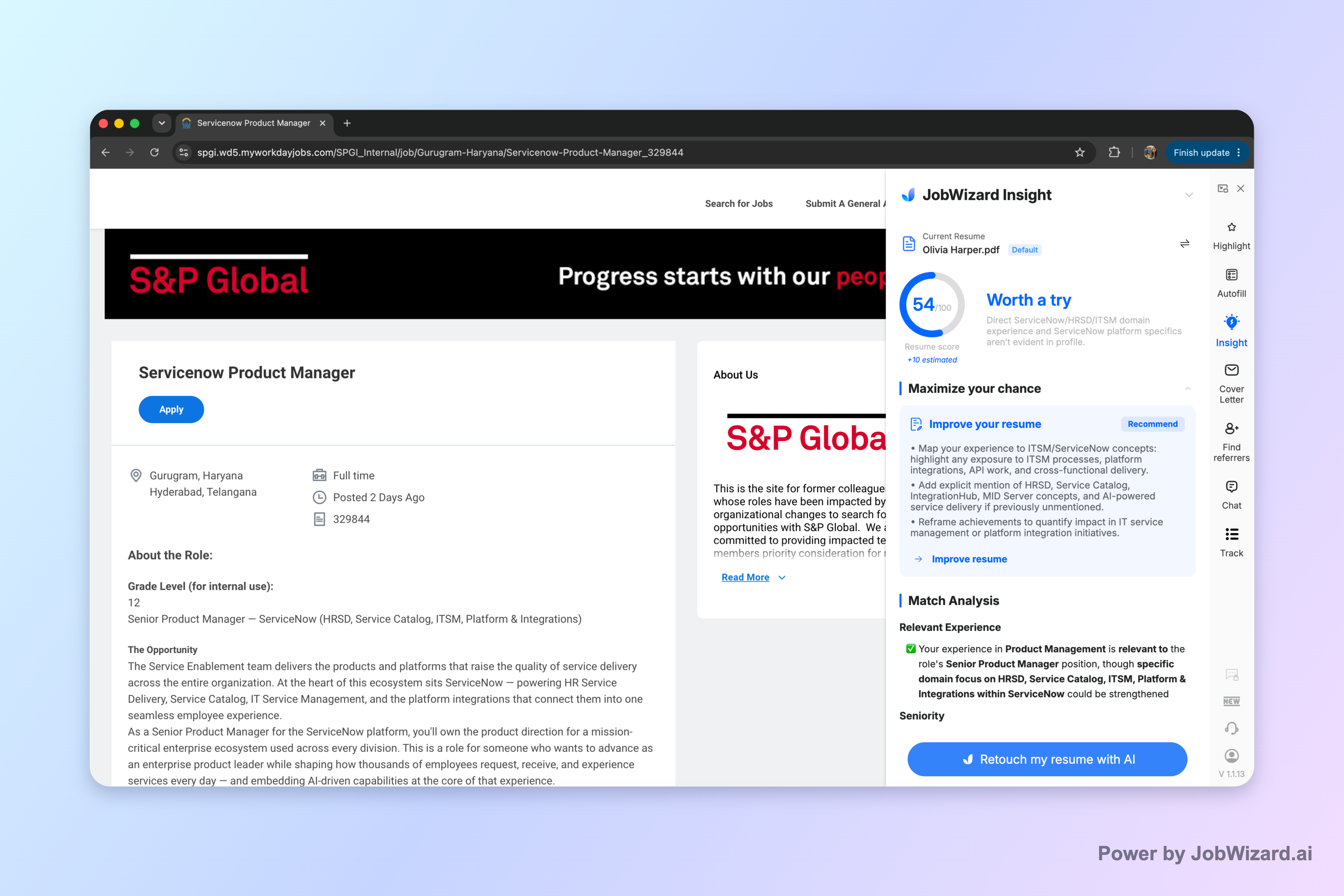
Use the screenshot-style workflow as a checklist: compare your resume to the job description, then treat the match score and suggestions as prompts for the review step—not as instructions to submit.
Match scores can guide you—only if you verify every suggested change
One of the biggest mistakes people make when they compare jobscan vs teal is treating the match score like a hiring signal. In reality, a match score is not a hiring probability and does not guarantee ATS passage or an interview.
JobWizard’s limitations are clear for this type of tool: you must verify every suggested resume change and keep only accurate experience. That matters because a score can move based on wording, formatting, or keyword expression—even when the underlying claims don’t accurately reflect your background.
- Don’t treat the score as truth: use it to identify likely resume gaps you should inspect.
- Verify accuracy first: if a suggestion implies experience you don’t have, remove or rewrite it.
- Keep your voice consistent: edits should still reflect your actual expertise, not just “ATS-friendly” phrasing.
If you’re tailoring, the goal is alignment with the role you want—not gaming a metric. A skills-gap list is helpful, but your resume still needs to be honest, complete, and specific.
How to handle “skills gap” improvement suggestions without overfitting
When jobseekers ask about jobscan vs teal, they’re often really asking how to close the skills gap. The practical answer: turn suggestions into a draft, then review for correctness and relevance.
JobWizard’s approach is designed for that workflow. The JD-based diagnosis can identify resume expression gaps and turn them into an editable resume revision draft. But the limitation is just as important: you must verify every suggested resume change and keep only accurate experience.
Here’s a concrete, low-risk way to work through suggestions:
- Map the suggestion to your real experience: if you can’t point to a specific project, tool, or result you actually did, revise or drop it.
- Rewrite for clarity, not exaggeration: use the suggested concept as a prompt, then express it in your own words.
- Replace vague claims with specifics: add concrete scope, artifacts, and responsibilities you truly performed.
- Retest with the same job description: once you update wording, run the comparison again to confirm the gap is actually addressed.
This keeps you from “spraying keywords.” You’re using the diagnosis to improve accuracy and readability—not to invent capabilities you can’t back up in an interview.
Which tool fits you best: choose a workflow, not a winner
The fairest way to compare jobscan vs teal is to look at your workflow. The best tool is the one that helps you compare your resume to the job description you’re targeting and translate the output into edits you can trust.
JobWizard’s resume/JD insight angle is particularly useful when you want explicit guidance about expression gaps and editable next steps—paired with a reminder to verify every suggested resume change and keep only accurate experience.
Here’s a simple “fit” test you can run in 15 minutes:
- Start with one job description: use a real posting you plan to apply to.
- Run your resume through the comparison: focus on what the tool calls out as missing or weak.
- Audit the suggestions: can you verify each change as true to your background?
- Pick the tool that makes reviewing easiest: the best one is the one that turns diagnosis into edits you’ll actually apply.
Bottom line: In jobscan vs teal, prioritize accurate, job-specific alignment. Treat match scores as a directional checklist, and always verify suggested resume changes before you submit.
Ready to tighten your resume using the job description you care about? Compare your resume to a specific posting, review the identified gaps, and turn them into an editable revision draft with JobWizard’s Insight—then apply with confidence that your updates are accurate.
Do this automatically with JobWizard
Skip the manual work — JobWizard's Smart Autofill handles this for you. On these platforms: JobWizard vs Teal, JobWizard vs Jobscan.
FAQ about jobscan vs teal
Is a match score from jobscan or Teal the same thing as a guaranteed ATS pass or interview?
No. A match score is not a hiring probability and doesn’t guarantee ATS passage or an interview—treat it as a directional signal and verify what you change in your resume.
What should I do with the skills-gap or “improvement suggestions” I get from resume/JD comparisons?
Use them to identify resume expression gaps, then review and keep only accurate experience. The suggestions can be turned into an editable resume revision draft, but you must verify every suggested resume change.
How do I avoid over-optimizing my resume just to raise a score?
Focus on real, honest alignment: prioritize changes that reflect your actual experience and skills, and keep placeholders out of your resume. Review the proposed edits carefully and remove anything that isn’t true to your background.
If I’m comparing jobscan vs teal, what’s the most practical way to decide which tool fits my workflow?
Pick the tool that helps you best compare your resume to the specific job description you’re targeting, then use its diagnosis as a checklist—not as a substitute for review-before-application.
Frequently Asked Questions
Autofill your next job application
JobWizard is a free Chrome extension that fills applications, tracks statuses, and optimizes your resume.