Resume Worded vs Jobscan: Which “Match Score” Helps You Tailor Faster (Without Guessing)
Resume Worded vs Jobscan comes down to how each tool diagnoses your resume against a job description. Here’s how to use the match score and improvement suggestions effectively.
Free Chrome extension
See your resume's match score for any job
JobWizard compares your resume to each job description and shows the exact keywords to add — free.
If you’re comparing resume worded vs jobscan, the biggest question usually isn’t “which one is better”—it’s which one helps you tailor your resume using the job description, without turning the process into guesswork.
Most ATS-focused tools use a similar idea: compare your resume to the role’s requirements and highlight gaps. Where they differ is how clearly they show those gaps and what they do next (for example, suggestions you can edit, or a score you can use to decide whether to apply).
What a match score really tells you (and what it doesn’t)
Match scores are a resume-vs-job-description diagnostic, not a hiring probability—and you should treat them that way every time.
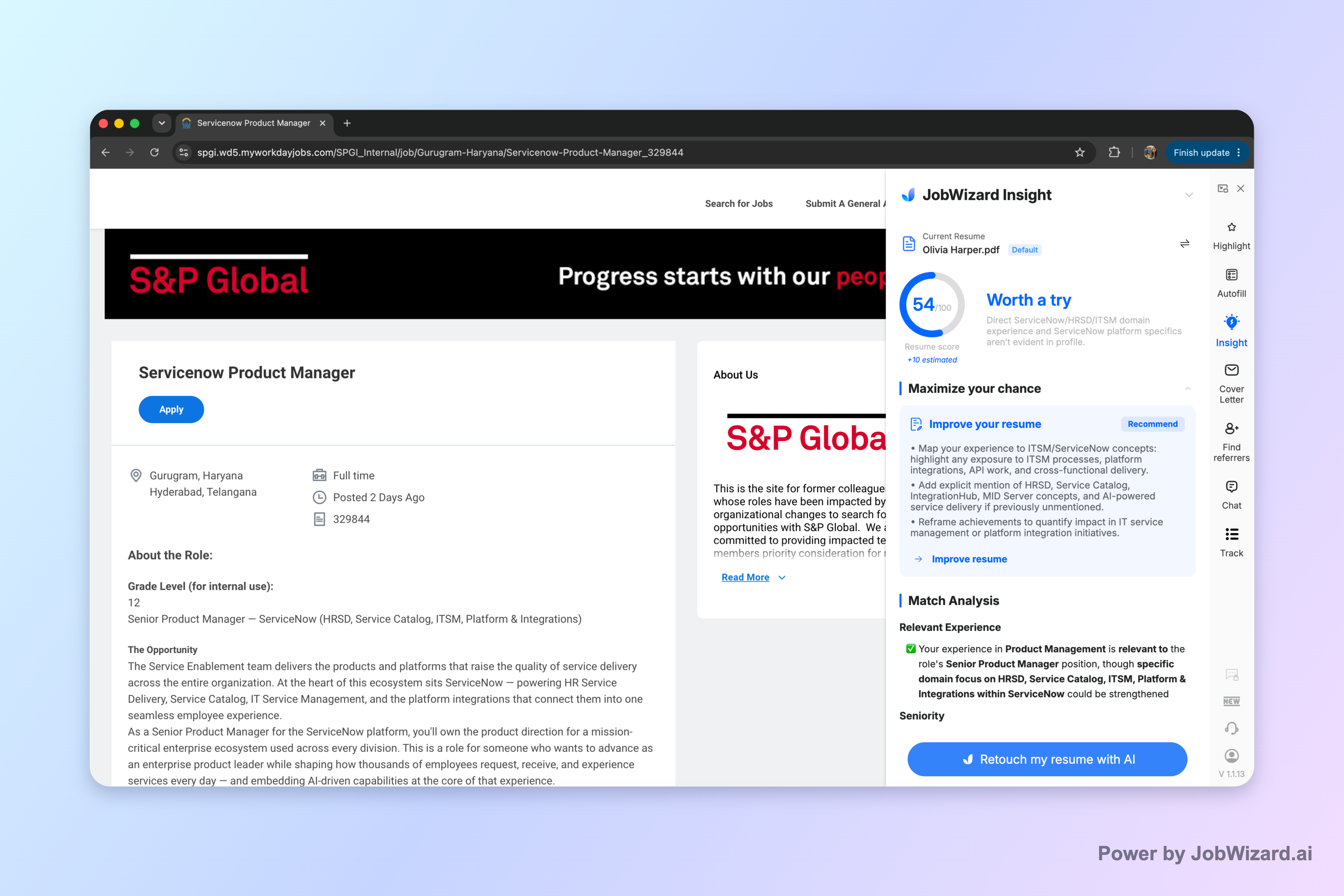
In JobWizard’s Insight flow, the tool compares your selected resume with the current job description and presents an overall assessment, a match score, and improvement suggestions. It can also diagnose expression gaps and turn them into an editable resume revision draft—so you’re not left staring at a vague warning.
However, the limitation is just as important: the score is not a guarantee that you’ll pass ATS screening or earn an interview. Even if the score looks strong, your experience, accuracy, and role fit still matter. And if a suggestion conflicts with what’s true about your background, you’ll want to ignore it.
Key takeaway: Use the match score as a “skills gap” finder, then review every change before submitting anything.
Resume Worded vs Jobscan: decide based on your workflow
Choose the tool that matches how you actually tailor resumes: diagnose, rewrite, review, and then apply.
Both the “resume worded” and “jobscan” style of products typically revolve around evaluating your resume against a job description and indicating whether key keywords/skills are missing. Where you can differentiate for your own workflow is in how the tool helps you close gaps.
When diagnosis-first is your priority
If your main pain point is not knowing why you’re not getting callbacks, a diagnosis-first workflow can help. JobWizard Insight compares your resume to the job description and surfaces expression gaps, then provides improvement suggestions that you can review and use as next steps.
When you’re optimizing for “apply readiness”
If you want a quick signal before you invest time applying, a match score and overall assessment can be a practical starting point. But remember: the match score doesn’t guarantee ATS passage. The right move is to use the diagnosis to decide whether your resume aligns with the role—and then do the final review yourself.
How to review suggestions without accidentally rewriting your story
Any tool can identify what appears missing from the job description. Your responsibility is to keep your resume accurate. In JobWizard’s case, the intended use is still review-before-submit: fill repetitive gaps quickly, then verify sponsorship / salary / EEO / custom questions and every suggested resume change so your final submission reflects your real experience.
This is where “fit” becomes more than a score. If a suggested change asks you to claim experience you don’t have, you should remove it and adjust your bullets to reflect what you actually did.
How to use a job description match score to tailor in minutes
Start with the job description, then use the gaps to drive targeted rewrites—not blanket edits.
Here’s a simple process that keeps you moving while staying accurate:
- Pick one job description you genuinely want to pursue so your tailoring stays relevant.
- Run the resume comparison to get the match score, overall assessment, and improvement suggestions.
- Scan the “skills gap” areas and identify which gaps you can truthfully address.
- Update wording, not your history—rewrite bullets to reflect your actual accomplishments in a clearer way.
- Review every change so you keep only accurate experience before applying.
If your resume is close but not quite aligned, the fastest wins usually come from fixing how your skills are expressed (for example, aligning the language of your bullet points to the job description’s required capabilities). If your resume is far off, treat the output as a roadmap for building closer alignment—then submit only when you’ve verified the updates.
When you’re doing this repeatedly across multiple roles, it also helps to remember that the tool is assisting with diagnosis and suggestions, while you control what gets submitted.
Do this automatically with JobWizard
Skip the manual work — JobWizard's Match Score handles this for you. On these platforms: JobWizard vs Jobscan.
FAQ: resume worded vs jobscan
These answers will help you interpret the results without over-trusting the score.
Is a match score the same thing as “getting through ATS”?
No. An Insight/Match Score is a resume-vs-job-description comparison, not a guarantee of ATS passage or an interview. Treat it as a gap-finder and still verify every suggested change against your real experience.
What should I do after a tool flags “skills gaps” in my resume?
Review the suggested improvement points, then keep only changes you can support with accurate, current experience. If a gap is real, update your resume in your own words; if it isn’t, ignore that specific suggestion.
Can either tool help me decide whether I should apply to a job?
They can help you decide whether your resume currently aligns with a job description by showing an overall assessment and improvement suggestions. But you still need to review the diagnosis and decide based on fit—not on the score alone.
How do I use “job description” keywords without keyword stuffing?
Use the job description as a checklist for relevant skills, then rewrite your resume bullets to reflect your actual accomplishments. The goal is accuracy plus clarity, not repeating keywords you can’t back up.
Ready to compare your resume against a real job posting? Use JobWizard’s Insight to see where your resume expression doesn’t match the job description, review the improvement suggestions, and tailor with confidence before you apply.
Frequently Asked Questions
See your resume's match score for any job
JobWizard compares your resume to each job description and shows the exact keywords to add — free.