Job Matching Tool That Shows Your Skills Gap: How to Use Match Score Without Guessing
A job matching tool should help you compare your resume to a specific job description, spot expression gaps, and draft edits you can verify. Here’s how to use JobWizard’s Insight (match score + suggestions) responsibly.

Free Chrome extension
Autofill your next job application
JobWizard is a free Chrome extension that fills applications, tracks statuses, and optimizes your resume.
What a job matching tool should do (and what to expect from a match score)
If you’re using a job matching tool to tailor faster, the goal isn’t “a magic score”—it’s a clear comparison between your resume and the specific job description you’re targeting. A good match score helps you understand where your resume’s wording and skills signals don’t line up yet, so you can fix the gaps with intentional edits.
JobWizard’s Insight is built around that exact workflow: it compares the selected resume with the current job description and then provides a match score plus an overall assessment. It also highlights what to change next so your resume reads like it belongs to the role you’re applying for.
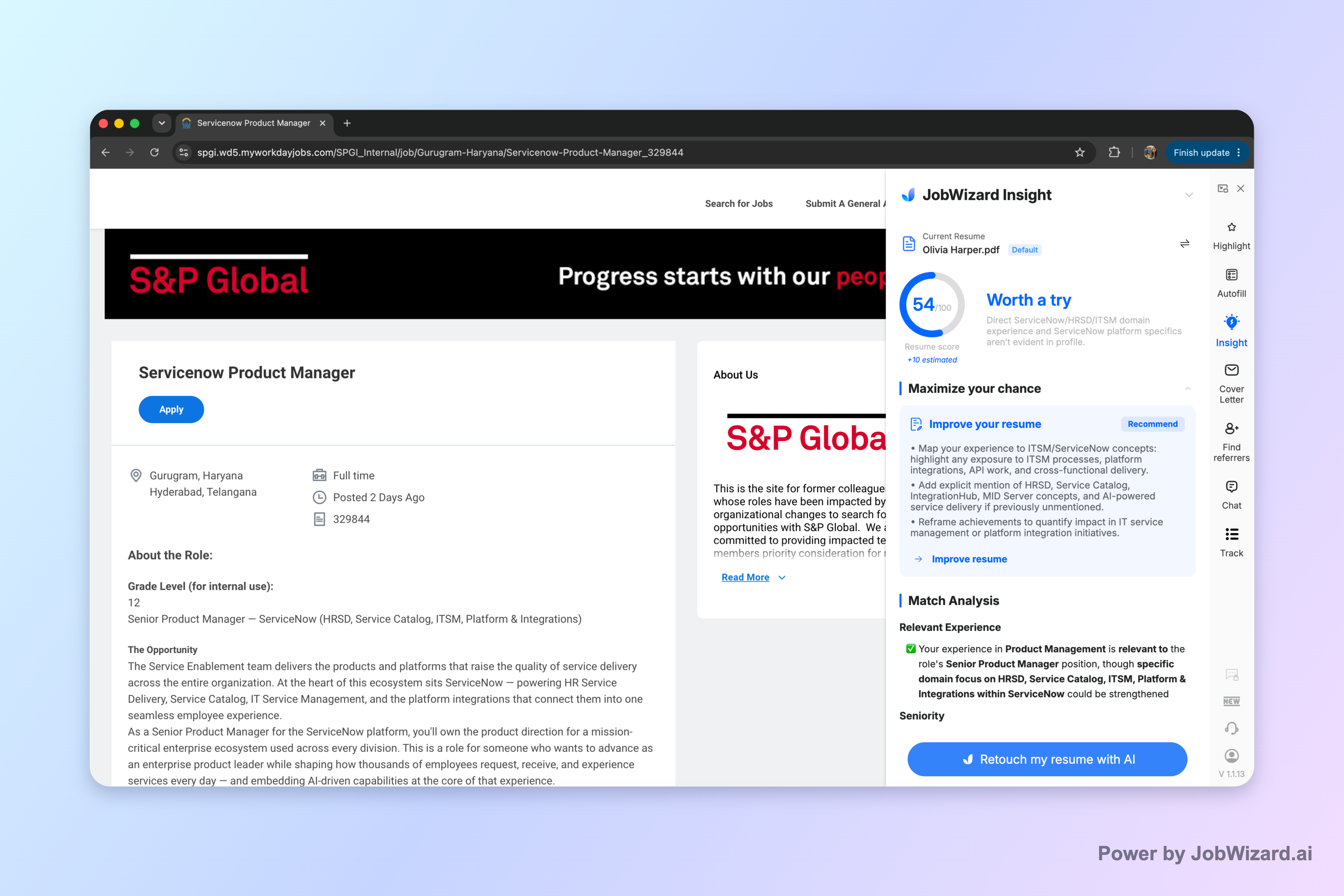
With Insight, you can review the comparison results and use the identified gaps to guide your next resume revisions—before you submit anything.
How to use a job matching tool to find your skills gap in plain English
A match score becomes useful when you treat it like a diagnostic, not a verdict. Insight compares your resume with the job description and can identify “expression gaps”—the places where your resume may have relevant experience but doesn’t describe it in the way the job posting signals it wants.
In practice, that means you’re not just checking whether you “feel qualified.” You’re looking at what the job description is asking for, then seeing where your resume might need clearer alignment.
- Choose the resume you plan to submit so the comparison reflects the actual document you’ll be tailoring.
- Paste or select the current job description (JD) you’re targeting, because the analysis is JD-specific.
- Review the match score and overall assessment to understand how well your resume currently aligns.
- Open the improvement suggestions to identify resume expression gaps you can fix.
- Turn gaps into an editable revision draft and then verify every change for accuracy.
This is also where you keep control. The match score is meant to support tailoring, not replace your judgment—especially when it comes to your real experience.
Turn suggestions into edits you can verify (resume revision draft + human check)
One of the most practical reasons to use a job matching tool is that it can convert a JD-based diagnosis into an editable resume revision draft. Instead of staring at a vague “not a match,” you get specific next steps to incorporate.
However, the product’s limitations matter: the score is not a hiring probability and does not guarantee ATS passage or an interview. And you must verify every suggested resume change—keeping only information that’s accurate to your background.
Here’s a safe, fast way to apply the suggestions without accidentally inventing or overstating anything:
- Confirm each suggested change against your experience (projects, responsibilities, metrics, timing).
- Keep language honest—if a phrasing tweak doesn’t change meaning, it’s easier to validate.
- Use the draft as a rewrite prompt, not as a copy/paste final version.
- Review “skills” alignment carefully so you only claim what you can support.
Key takeaway: Insight can help you revise, but you’re still responsible for accuracy. The match score supports tailoring—not blind acceptance.
Job matching tool vs. “apply everywhere” bots: how to stay competitive without losing control
Many applicants start with a volume mindset—apply more, tweak later. But a job matching tool works best when you focus on fit for each role, because the comparison is specifically tied to the job description you analyze.
That’s why the best use of a job matching tool looks more like “compare, edit, review-before-submit” than “auto-submit and hope.” JobWizard’s workflow is designed for this balance: it fills and suggests repetitive parts quickly, while leaving sponsorship/salary/EEO/custom questions and any changes that require your judgment for you to review before you submit.
If you’re curious about how frequently the market actually runs through autofill + review-before-submit workflows, our database shows:
Verified usage snapshot: JobWizard has supported 720,000+ applications submitted and 600,000+ autofill sessions run through the platform. On average, autofill handles ~18 repetitive fields per application (typically 11–23), and the largest share of applications are on Workday (~65%).
Even with automation in the mix, you still get the most leverage by tailoring the resume to the JD—this is exactly what Insight’s JD-based comparison is meant to support.
Do this automatically with JobWizard
Skip the manual work — JobWizard's Smart Autofill handles this for you.
FAQ: job matching tool basics (match score, resume edits, and accuracy)
Is a job matching tool’s match score the same thing as a hiring probability?
No. The score is an assessment to help you compare your resume (CV) to a job description, but it does not guarantee ATS passage or an interview, and it’s not a hiring probability.
What does JobWizard Insight compare to produce its match score?
Insight compares the selected resume with the current job description and presents a match score, an overall assessment, and improvement suggestions based on gaps it finds in your resume’s expressions and skills coverage.
Can a job matching tool draft resume edits for me?
Yes. For the gaps it identifies, the JD-based diagnosis can turn them into an editable resume revision draft—but you must verify every suggested change and keep only accurate experience.
How should I use match score suggestions so I don’t create inaccuracies?
Treat suggestions as a starting point: verify each suggested resume change, remove anything that isn’t accurate to your background, and decide what to keep before you submit applications yourself.
Ready to tailor with confidence? Use JobWizard Insight to compare your resume with the specific job description you’re applying to, review the match score and improvement suggestions, and then update your resume gaps with edits you can verify before submitting.
Frequently Asked Questions
Autofill your next job application
JobWizard is a free Chrome extension that fills applications, tracks statuses, and optimizes your resume.