Keywords for HR Recruiter Roles: The Hiring Signals to Pull From Every Job Post
Learn the best keywords for HR recruiter roles and how to extract them from job descriptions—so your resume and applications match what recruiters actually screen for.
Free Chrome extension
See your resume's match score for any job
JobWizard compares your resume to each job description and shows the exact keywords to add — free.
Keywords for HR recruiter roles: the fast path from job post to tailored application
If you’re searching for keywords for hr recruiter roles, you’ve probably noticed a frustrating pattern: two job postings can look similar at first glance, yet hiring managers and recruiters emphasize very different skills. The difference is usually in the language of the job description—what they call out in responsibilities, qualifications, and recurring requirements.
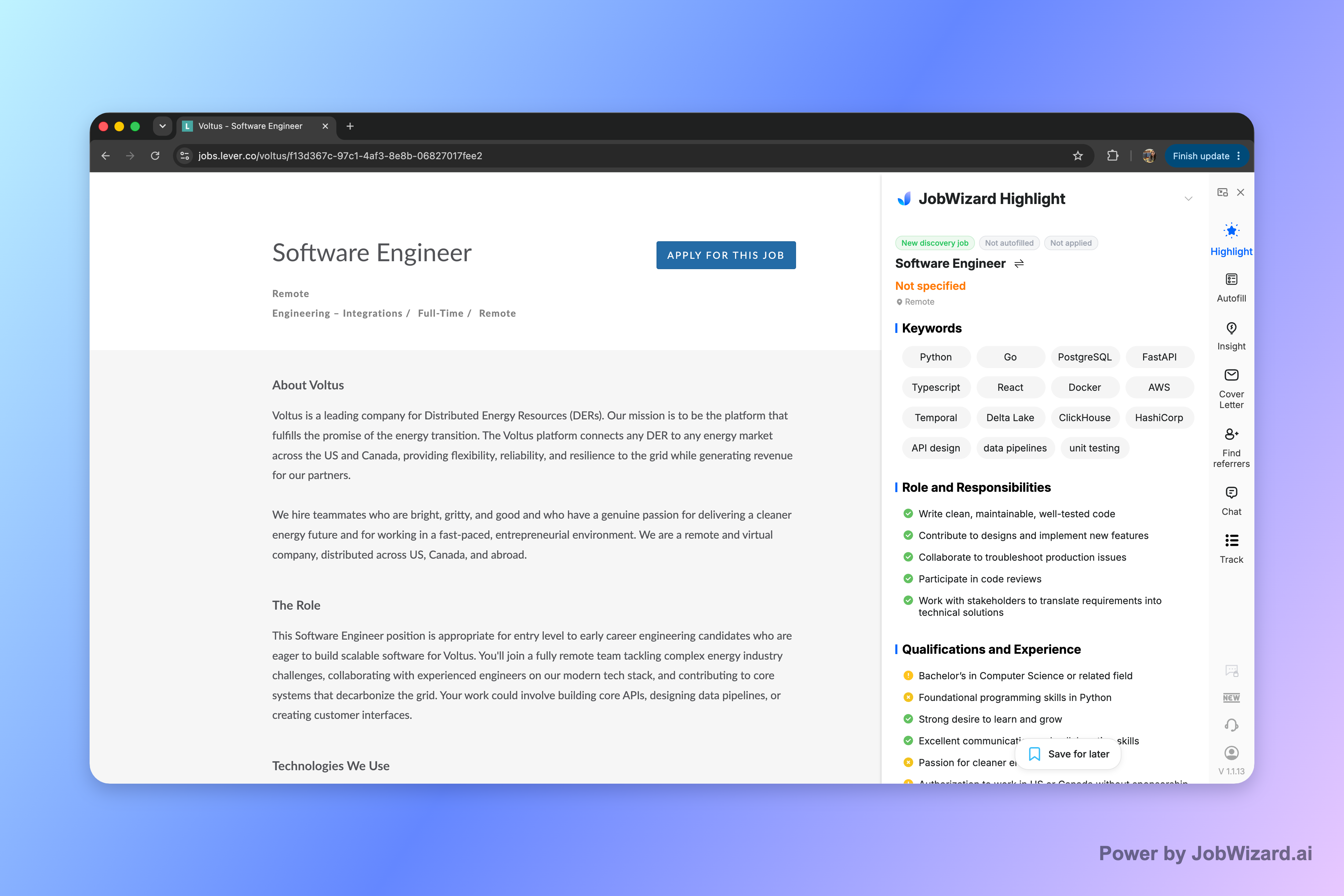
JobWizard’s JD Highlights can organize a job description into keywords, role responsibilities, and qualifications so you can review the requirements more systematically before applying.
Why “HR recruiter keywords” aren’t one-size-fits-all
“Recruiter” can mean different things depending on company size, hiring volume, and team structure. Some HR recruiter roles are focused on high-volume sourcing, while others emphasize relationship building, process compliance, or coordinating interviews across stakeholders. When you tailor your resume and application, you’re not just using trendy terms—you’re aligning your evidence with the role’s specific priorities.
The key idea: use keywords as hiring signals
Think of keywords for hr recruiter as signals that tell a recruiter what you’re expected to do. Your job is to extract those signals and then show proof in your own wording—through resume bullets, examples, and (where applicable) application answers you control before submission.
JobWizard helps you review requirements systematically by turning long job descriptions into a structured view of key requirements—without pretending those keywords predict an ATS decision or hiring outcome.
How to extract the right keywords from every HR recruiter job description
The best keyword list is the one that comes directly from the job posting you’re applying to. Here’s how to build it quickly and accurately.
Step 1: Break the JD into three buckets
Use the structure of the posting itself. Most HR recruiter job descriptions implicitly fall into three buckets:
- Keywords: terms that show up repeatedly across the posting (skills, tools, practices, competency names).
- Role responsibilities: what you’d actually be doing day-to-day (workflow tasks and coordination responsibilities).
- Qualifications: what they require or strongly prefer (experience, education, certifications, years in recruiting or HR operations).
This approach keeps you from grabbing random “ATS keywords” that don’t reflect the role. It also helps you avoid overfitting: you can identify what matters most, then build a small set of tailored bullets around it.
Step 2: Turn keyword phrases into “proof-ready” themes
Instead of listing 30 disconnected keywords, group them into themes you can support with examples. For example:
- Sourcing & pipeline building: sourcing channels, Boolean search, candidate outreach, pipelining.
- Screening & selection: structured interviews, competency-based screening, evaluating fit.
- Scheduling & coordination: calendars, interview coordination, candidate communication, stakeholder alignment.
- Systems & process: ATS management, requisitions, updates, data hygiene, documentation.
- Compliance & fairness: EEO/AA awareness, documentation practices, policy adherence.
- Stakeholder management: partnering with hiring managers, translating needs into job requirements.
Step 3: Write bullets that match the JD’s language (without keyword stuffing)
When you see a keyword in the JD—say, “stakeholder management”—don’t just add that phrase. Replace generic bullets with bullets that show how you did stakeholder management. Good bullets tend to include:
- Action (what you did)
- Scope (who/what you managed)
- Method (how you did it)
- Outcome (what improved, if you can support it honestly)
You can often match the JD’s terms by using the same category label, then supporting it with your specific behavior.
Top keyword categories for HR recruiter resumes (with examples you can reuse)
Below are keyword categories that frequently appear in HR recruiter postings. Use them as a checklist while you extract the actual terms from your target job description. Add only what you can support with your experience.
1) Sourcing & candidate outreach keywords
- Sourcing (e.g., candidate sourcing, pipeline building)
- Outbound outreach (e.g., recruiting emails, candidate engagement)
- Boolean search (if it’s in the JD and it’s true for you)
- Talent communities
- Market mapping (if applicable)
Example resume bullet starter: “Conducted candidate sourcing and outreach using [channels/tools from the JD] to build a qualified pipeline for [role types].”
2) Screening, interviews, and evaluation keywords
- Resume screening
- Structured interviews
- Competency-based evaluation
- Selection criteria
- Interview coordination
Example resume bullet starter: “Screened applicants against job requirements and led structured evaluations aligned to [competencies/criteria named in the JD].”
3) Scheduling, communication, and coordination keywords
- Scheduling
- Candidate communication
- Interview logistics
- Stakeholder coordination
Example resume bullet starter: “Coordinated interview schedules and communicated next steps to candidates and internal stakeholders, ensuring timely progress for [team/roles].”
4) ATS & HR systems keywords (match what the JD mentions)
- ATS management
- Requisitions support
- Candidate record updates
- Data accuracy / documentation
- Workflow coordination
Example resume bullet starter: “Maintained candidate records in the ATS, updating stages and documentation to ensure [data/process requirements] were met.”
5) Compliance, EEO, and fair hiring keywords
- EEO/Equal Opportunity awareness
- Compliance with hiring policies
- Documentation expectations
- Fair hiring practices
Example resume bullet starter: “Supported compliant recruiting processes by following documented policies and ensuring consistent candidate handling aligned with [policy/standard named in the JD].”
Note: keep this specific and truthful—only include compliance-related language if you actually handled it.
6) Qualifications keywords (make your resume match the level)
- Years of recruiting experience (or related)
- HR background / HR operations exposure
- Education and certifications (if listed)
- Role-specific experience (e.g., volume recruiting, technical recruiting, campus recruiting)
Example resume bullet starter: “Leveraged [X years / specific experience] in recruiting to support hiring needs across [role types].”
How to tailor keywords for hr recruiter applications (a workflow you can repeat)
Tailoring works best when you use the same workflow every time—especially when you’re applying to multiple HR recruiter roles.
Workflow (15–25 minutes per role)
- Open the target job posting and identify the keyword themes in the JD.
- Extract JD Highlights: review keywords, responsibilities, and qualifications as a structured set.
- Select 8–15 “core keywords” that you can support with experience (don’t include everything).
- Map each keyword to one proof point (one resume bullet, one sentence in your experience section, or a short example in your summary).
- Update your resume summary to reflect the role’s recruiting style (e.g., high-volume pipeline, stakeholder-heavy coordination, compliance-forward process).
- Rewrite 2–4 bullets in your most relevant experience section so the action and method mirror the JD.
- Review application questions and customize anything that’s not “resume-based,” using your own words.
- Submit yourself after you verify that your content matches the role’s requirements.
Make it concrete: sample “keyword-to-bullet” mapping
| Keyword theme from the JD | What you add to your resume | Example bullet language (starter) |
|---|---|---|
| Sourcing & outreach | A bullet describing channels and pipeline building | “Sourced candidates and ran targeted outreach to build a pipeline for [role types] using [channels/tools].” |
| Structured screening | A bullet describing screening method and evaluation criteria | “Performed structured screening using [criteria/competencies] and coordinated decisions with stakeholders.” |
| ATS & candidate records | A bullet describing ATS upkeep and stage documentation | “Updated candidate status and documentation in the ATS to support consistent workflow and data accuracy.” |
| Stakeholder coordination | A bullet describing how you partnered with hiring managers and interviewers | “Partnered with hiring managers to align requirements, coordinate interviews, and keep candidates informed through the process.” |
| Compliance/fair hiring | A bullet describing your process alignment with policies | “Supported compliant, consistent candidate handling by following hiring policies and documentation expectations.” |
Where tools help (and where they shouldn’t)
Keyword extraction and organization can save time, especially when job descriptions are long. However, remember the limitation: highlighted keywords are for reviewing requirements more systematically, not for predicting outcomes or automating the hiring decision. Your final responsibility is to ensure your resume and application honestly reflect your experience.
HR recruiter keyword examples for common job-post “signals”
Here are keyword “signals” you can watch for in HR recruiter job postings, plus practical ways to respond in your resume.
Signal A: “Partner with hiring managers”
What it means: You must translate needs into requirements and coordinate feedback.
Add to resume: bullets about intake, aligning role requirements, and managing iteration between stakeholders.
Signal B: “Manage requisitions in the ATS”
What it means: They care about system hygiene and workflow consistency.
Add to resume: a systems-focused bullet describing what you updated, how you tracked status, and what “accurate records” meant in your context.
Signal C: “Ensure compliance with EEO/AA practices”
What it means: The team expects process adherence.
Add to resume: a compliance/process bullet that’s specific to how you followed policies (documentation, consistent handling, or training/awareness you used on the job).
Signal D: “High-volume recruiting”
What it means: Speed and organization matter, along with pipeline discipline.
Add to resume: examples of how you managed multiple roles, prioritized tasks, and kept candidate communication on track.
Signal E: “Schedule and coordinate interviews across teams”
What it means: The coordinator role is central to success.
Add to resume: bullets about scheduling logistics, stakeholder availability management, and keeping candidates informed.
Do this automatically with JobWizard
Skip the manual work — JobWizard's Match Score handles this for you.
FAQ: keywords for hr recruiter hiring signals
What are keywords for hr recruiter roles?
Keywords for hr recruiter roles are the specific skills, tools, responsibilities, and qualification phrases that appear repeatedly in HR recruiter job descriptions—such as sourcing, screening, scheduling, ATS administration, compliance, and stakeholder management.
How do I find the right keywords for an HR recruiter job posting?
Start by scanning the job description for recurring terms in the responsibilities and qualification sections, then group them into themes (sourcing, interviewing, compliance, systems/operations). Tools like JobWizard’s JD Highlights can organize the description so you can review requirements more systematically before applying.
Should I copy job posting keywords word-for-word into my resume?
You can mirror phrasing when it genuinely matches your experience, but the goal is alignment—not stuffing. Use the keywords to shape bullets that describe what you did (and how), then keep your resume readable for humans.
Do recruiter keywords guarantee I’ll get an interview?
No. Keywords help improve relevance, but they don’t predict an ATS decision or hiring outcome. Treat them as signals for tailoring, not guarantees.
What’s a practical workflow to tailor keywords for hr recruiter roles?
Use a repeatable process: (1) extract keywords from the JD, (2) map each keyword to one proof point (a bullet or example), (3) update your summary and experience bullets, (4) review any application questions, and (5) submit yourself after confirming your fit.
Ready to apply with sharper alignment? Open the HR recruiter job you want, use JobWizard JD Highlights to extract the job’s keywords, responsibilities, and qualifications, and then tailor your resume and application answers so your experience matches what the role actually asks for.
Frequently Asked Questions
See your resume's match score for any job
JobWizard compares your resume to each job description and shows the exact keywords to add — free.