Job Application Automator? Here’s What Bots Get Wrong (and the Fast Human Check that Works)
A “job application automator” sounds like speed, but bot submissions can fill the wrong answers, trigger spam filters, and damage your reputation. JobWizard’s Smart Autofill fills repetitive fields so you can review and submit yourself.
Free Chrome extension
Autofill your next job application
JobWizard is a free Chrome extension that fills applications, tracks statuses, and optimizes your resume.
“Job application automator” sounds like instant hiring momentum—until a bot submits the wrong answers, mismatched materials, or triggers employer spam filters. The result can be anything from a declined application to long-term friction with a company you actually want.
JobWizard’s approach is different: it uses Smart Autofill to fill repetitive fields for the application you’re already on, then you review and submit yourself.
What a “job application automator” usually gets wrong (and why it matters)
Most job application automators optimize for submission volume—not application accuracy. When that happens, the quality of answers depends on how well the tool guesses your situation and the form’s logic.
Here are the most common failure modes when a bot “does it for you,” and why each one can hurt your chances.
- Wrong answers to screening questions: Screening questions often require context (dates, preferences, eligibility, specific experiences). A bot may fill something adjacent or generic rather than your true response.
- Mismatch between the role and your materials: Many postings expect information that’s specific to the job (tools used, scope of work, domain). If the wrong resume or details land in the wrong spots, your application reads inconsistent.
- Employer-side spam or quality filtering: If multiple applications look templated or repetitive, systems may flag them for review. Even if your information is decent, bot-like patterns can be a liability.
- Damaged reputation with companies you want: Submitting inaccurate or low-quality responses to a target employer can create a negative impression that persists beyond one application.
Bottom line: the risk isn’t theoretical. Bots can turn “apply faster” into “apply carelessly,” and hiring teams notice when answers don’t feel human or job-specific.
Why bot submissions trigger the exact problems hiring teams reject
Screening is where small errors have big consequences. Automated approaches typically treat forms like static inputs, but job applications are more like structured interviews with hidden rules.
Two things tend to break with automation: (1) required fields and (2) the meaning behind answers.
1) Required fields aren’t always “typeable” without judgment
Some required fields still need your decision. For example, a form may ask for a specific certification, a work authorization nuance, or a “yes/no + short explanation” where the “right” response depends on your real history.
2) Bots can’t reliably map your experience to a question’s intent
Even if a field is filled, intent can be off. A bot might select a degree that’s technically present, but the question may be asking for a particular type or timeline. That’s enough to cause a mismatch between what the employer expects and what you submit.
3) Template-like answers can look suspicious to automated review
Quality filters often react to patterns. If many applications share near-identical language or contain repeated placeholders, review systems may down-rank them—or push them into a manual review queue with skepticism.
None of this means every applicant tool is “bad.” It means the more a tool behaves like a blind sender, the more it risks violating the key expectation: your application must match your actual profile and the job’s requirements.
How JobWizard’s Smart Autofill helps you apply faster without risking a bot mindset
JobWizard fills, but it doesn’t submit for you. That single constraint changes everything about accuracy and control.
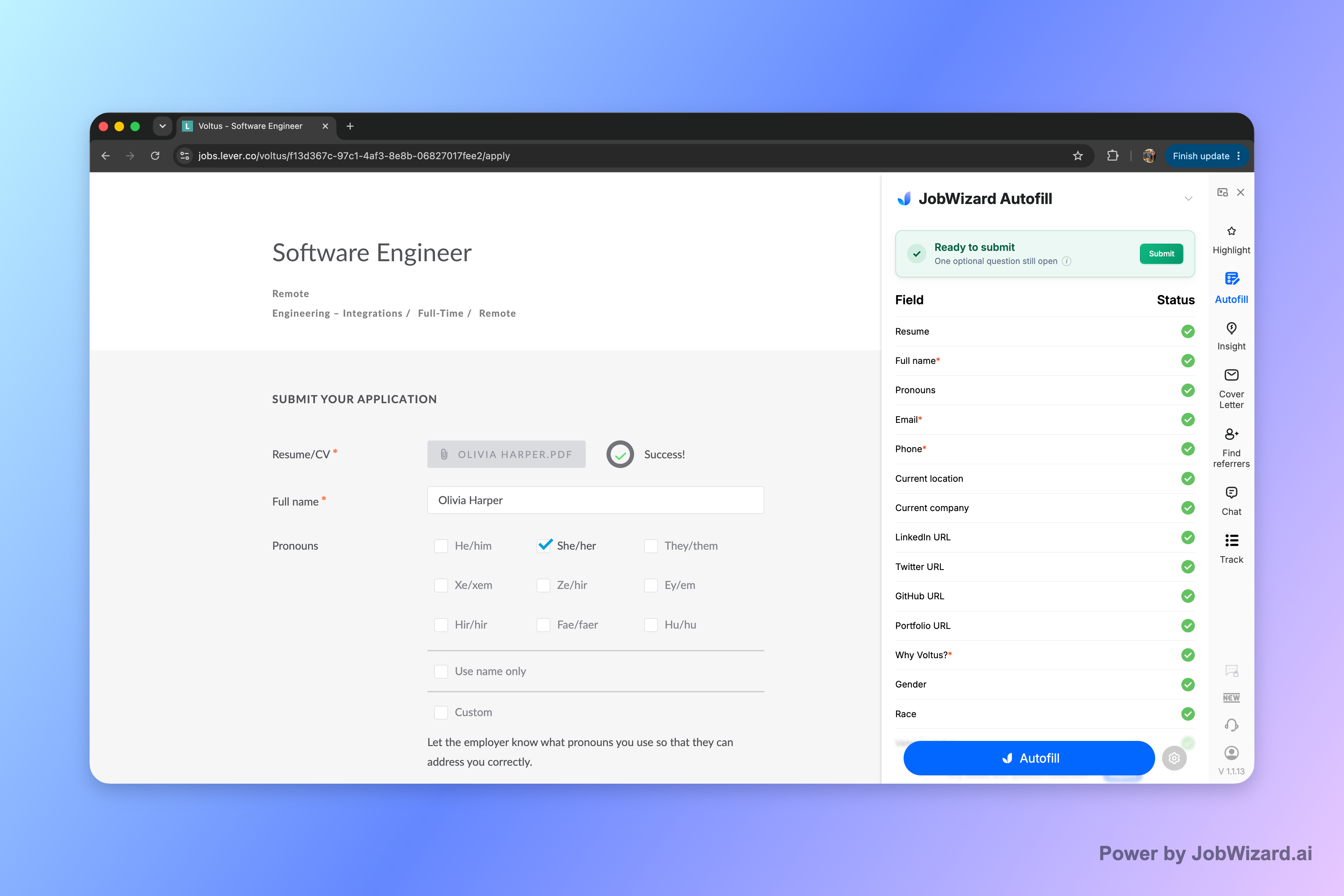
Smart Autofill uses saved profile and resume data to fill detected fields on supported application pages. After the fields are populated, you review every answer and submit the application yourself.
When a required field still needs attention, JobWizard can identify it and let you jump to the matching question—so you can verify what the form is asking and respond correctly.
What “autofill + review-before-submit” means in practice
- Repetitive fields get handled first: Think contact info and standard profile inputs that don’t require personal judgment each time.
- Sensitive parts get your final check: Screening questions and any required fields still need your human confirmation.
- You stay in control of fit: If the job calls for a specific skill or timeline, you make sure your answer matches the role.
Why this approach reduces the risks bots create
It prevents “wrong answer, wrong place” from going live. The autofill step speeds up the mechanical part, while your review step protects the parts most likely to affect outcomes: screening answers, job fit, and consistency.
Job application automator vs Smart Autofill: a practical comparison
Choose tools that help you fill quickly, not tools that remove your review. Here’s a straightforward way to compare the “job application automator” idea versus JobWizard’s workflow.
| Consideration | Bot-style “automator” concept | JobWizard Smart Autofill |
|---|---|---|
| Who submits? | Often positioned as auto-submitting behavior | You review and submit the application |
| Screening question accuracy | May guess or reuse answers without full context | You review populated answers before submitting; required fields needing attention can be identified |
| Resume/detail alignment | Can mismatch job expectations if materials don’t map to the form | You confirm what’s correct for the specific application during review |
| Spam/quality filter risk | Higher risk if applications look templated or mismatch user intent | Review-before-submit reduces the chance of bot-like errors landing as final answers |
| Control and accountability | Less control once automation runs | You remain accountable for every submitted response |
If your goal is real speed, the best trade-off is simple: autofill to reduce typing, then you decide what to submit.
Build a safer “apply faster” workflow you can actually trust
You can apply faster without turning your applications into templates. Use a repeatable checklist so every submission is accurate and job-aligned.
- Start the application on the job posting: This keeps everything anchored to the exact form and role requirements.
- Use Smart Autofill to complete repetitive fields: Let it populate detected fields using your saved profile/resume data.
- Do a focused review pass: Verify screening answers, work eligibility details, and any required short responses.
- Confirm resume/details match the job: Make sure your experience narrative fits what the employer is asking for.
- Submit yourself: Don’t skip the last check—this is where bot-style errors get prevented.
If you’re trying to scale your applications, it helps to understand the broader usage pattern: JobWizard has supported 720,000+ applications submitted and 600,000+ autofill sessions, with an average of about ~18 repetitive fields filled per application. The key is that it’s autofill + review-before-submit, so you’re not outsourcing the final accountability to a bot.
Invite the reader next step: Try Smart Autofill on your next application, then review each populated answer before you submit.
Do this automatically with JobWizard
Skip the manual work — JobWizard's Smart Autofill handles this for you.
FAQ: job application automator questions
Is a job application automator the same as auto-submitting for you?
No. JobWizard autofills fields on the application you’re already viewing, and you review the populated answers before submitting. It does not submit automatically.
What can go wrong when a bot submits my application?
Bots can pick the wrong values for screening questions, mismatch your resume with the role, and cause employer-side spam or quality filters to flag your application—especially if responses don’t truly reflect you.
How does Smart Autofill help without taking control away from me?
Smart Autofill uses saved profile and resume data to fill detected fields on supported application pages. If a required field still needs attention, it can identify it so you can jump to the matching question and verify your answers before submitting.
Will Smart Autofill fill every field perfectly and instantly?
No. You should still review every populated answer before submitting, and required or sensitive questions may need your attention.
What’s a safe workflow if I want to apply faster?
Use Smart Autofill to complete repetitive fields quickly, then do a focused final pass: verify screening answers, confirm the correct resume/details for the specific job, and submit yourself after your checks.
Ready to apply faster the safe way? Use JobWizard’s Smart Autofill for your next application, then review every answer before submitting so you stay accurate—and in control.
Frequently Asked Questions
Autofill your next job application
JobWizard is a free Chrome extension that fills applications, tracks statuses, and optimizes your resume.