Is Autofill With Resume Bad? A Review-First Answer for Real Applications
Is autofill with resume bad? It depends on whether you’re using it to review-before-submit or letting a tool fire off answers without checking. Here’s the safe workflow—and what to watch for.
Free Chrome extension
See your resume's match score for any job
JobWizard compares your resume to each job description and shows the exact keywords to add — free.
Trying to apply faster is normal—but is autofill with resume bad is the right question to ask before you hit “Submit.” If autofill turns into “set it and forget it,” you can end up with mismatched details, missing required answers, or resumes that don’t actually reflect the job description.
That’s why the difference comes down to process: review-before-submit vs. blind auto-apply. JobWizard is built for review-first autofill, where repetitive fields get populated quickly and you still control what’s final.
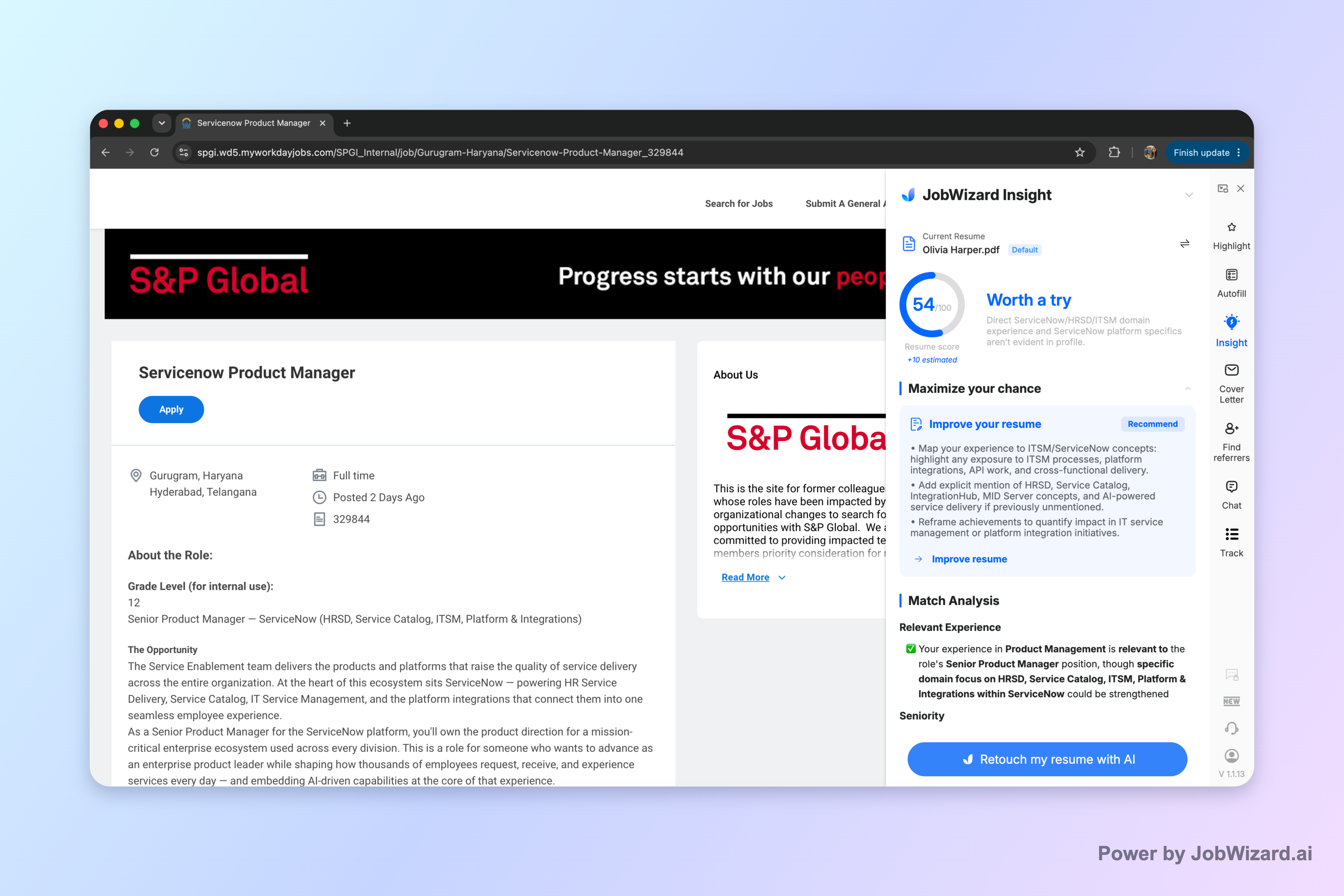
One way to reduce mismatch risk is to check whether your resume is actually aligned to the specific job description before you rely on autofill. JobWizard’s Insight compares your resume with the job description, shows a match score, and turns gaps into specific next steps you can edit and verify.
What “autofill with resume” really means—and where it can go wrong
Autofill with resume typically means a tool uses saved profile and resume data to fill detected fields on an application page. That can be a time-saver, but it can hurt you when you don’t verify what the tool filled in.
Here are the most common ways it goes wrong:
- Accuracy problems: dates, titles, locations, or employment details get filled incorrectly (even if they look plausible).
- Required-field gaps: some forms leave specific fields blank or need attention because the question is custom to that role.
- Resume-to-JD mismatch: you may submit a resume that has an “experience gap” in the way the job description is expressed (ATS keyword alignment is one symptom of this).
- Unreviewed custom questions: EEO/eligibility items and job-specific prompts can’t be safely trusted without reading them.
The key limitation: match or autofill can’t guarantee outcomes. JobWizard’s Insight is designed to help you diagnose fit, not to act as a hiring probability or an automatic guarantee of ATS passage.
Is autofill with resume bad? The real risk is skipping your review
Is autofill with resume bad as a concept? No—autofill isn’t inherently bad. The risk appears when autofill becomes a shortcut that replaces your judgment.
Think of it this way: repetitive fields can be filled quickly, but the “last mile” is where applications succeed or fail. That’s where you confirm sensitive details, ensure you’re answering custom questions correctly, and make sure your resume content actually matches the job description you’re applying to.
Bottom line: Use autofill + review-before-submit, not blind auto-apply/auto-submit.
JobWizard’s smart autofill is built around that review-first workflow: it fills detected fields using saved profile and resume data, but you review the populated fields and submit the application yourself.
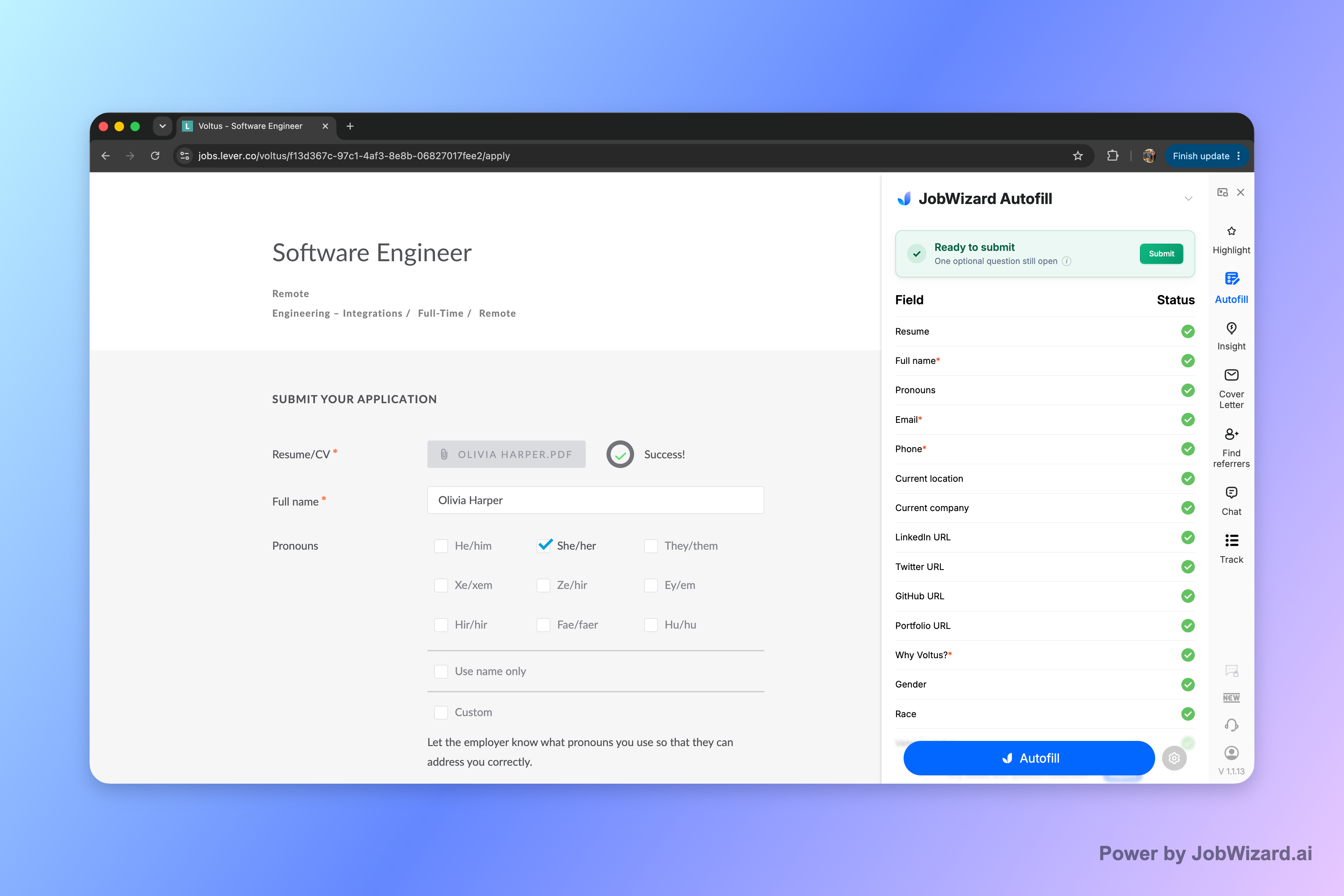
For example, JobWizard fills the repetitive fields on a Lever application while keeping the final review and submission in the job seeker’s hands.
How to use resume-based autofill safely (a practical review-first checklist)
Safe autofill is mostly a checklist problem: what must be verified, what can be filled faster, and how you handle gaps. Use this workflow on your next application.
- Start with the exact job description so your answers match the role you’re applying to.
- Run smart autofill for detected repetitive fields to reduce manual typing (addresses, contact info, standard work history fields).
- Scan custom/sensitive questions before you submit—don’t skip anything you haven’t read.
- Verify numbers and specifics (employment dates, job titles, tools used, education details) so your autofill is accurate.
- Handle required fields deliberately: if something still needs attention, jump to that question and answer it with the correct information.
- Only submit when everything is true—even if the form “looks complete.”
If you want a second layer of protection, add a resume-to-JD check before you finalize answers. That’s where JobWizard’s Insight can help: it compares your resume with the job description, shows a match score (not a hiring probability), and provides improvement suggestions based on the job description.
Match score limitation to remember: it doesn’t guarantee ATS passage or an interview. You still have to verify every suggested resume change and keep only accurate experience.
Autofill vs. tailoring: where “ATS-ready” actually fits in
Autofill can’t replace tailoring—but it can complement it. Autofill handles data entry speed; tailoring handles alignment between what the job asks for and what your resume says.
Here’s what to do when you feel torn between “apply faster” and “submit a strong application.”
- If the application form is repetitive, autofill helps you complete it without retyping the same data.
- If the job description uses particular skills/phrasing, tailor your resume so those expressions accurately reflect your experience.
- If you’re worried about “skills gap,” use a JD-based diagnosis to identify the gaps and generate editable revision drafts you can verify.
JobWizard’s Insight is designed for this diagnose-and-fix flow: it compares your selected resume to the current job description and turns expression gaps into specific next steps. Then you decide what’s accurate enough to keep.
This is also why autofill with resume doesn’t have to be “bad”—it can be part of a quality loop: diagnose gaps, autofill repetitive fields, and review custom answers.
Do this automatically with JobWizard
Skip the manual work — JobWizard's Smart Autofill handles this for you.
FAQ: Is autofill with resume bad?
Short answers first—then the practical rules you can follow to reduce risk.
Is autofill with resume bad if I’m trying to apply faster?
It isn’t automatically bad—but it becomes risky if you treat it like auto-submit. The safer approach is review-before-submit: let autofill complete the repetitive fields, then you verify everything (especially skills, dates, and any custom questions) before submitting.
What are the biggest reasons autofill with resume can hurt your chances?
The main issues are inaccurate or missing information, resume-to-JD mismatch (ATS keyword gaps or phrasing that doesn’t align), and required-field problems. Autofill can only go so far—so you still need to check every populated answer and keep only what’s true.
How do I know whether the resume I’m using matches the job description?
Use a JD-based diagnosis like JobWizard’s Insight: it compares your selected resume to the current job description, shows a match score (not a hiring probability), and generates improvement suggestions. Then you verify any proposed edits and keep only accurate experience.
Should I avoid autofill on Workday, Greenhouse, or similar platforms?
You don’t have to avoid it. JobWizard’s smart autofill fills detected fields using saved profile and resume data, and it won’t automatically submit—your review is the final step. If a required field still needs attention, JobWizard helps you jump to the matching question so you can correct it.
What’s the fastest safe workflow for using resume autofill?
Use a review-first workflow: (1) start the application, (2) run smart autofill to populate detected repetitive fields, (3) scan custom/sensitive items and required fields, (4) use Insight to spot resume-to-JD expression gaps, and (5) submit only after you confirm every answer is accurate.
Next steps: try review-first autofill with JobWizard (and verify the gaps)
If your goal is more submissions without more mistakes, start with review-before-submit. JobWizard helps you fill repetitive application fields fast while keeping your final review in your control.
Want the full step-by-step process? Start with How to Autofill Job Applications (Step-by-Step with JobWizard), then tailor your approach for specific platforms like Greenhouse Application Autofill: Custom Questions, Resume Upload, and Review Before Submit (Without Missing Required Fields).
If you’re trying to improve resume alignment without losing momentum, read Autofill Resume Extension: How JobWizard Helps You Tailor Fast Without Skipping Review. And if you’re deciding between automation and manual input, compare workflows here: Autofill with Resume or Apply Manually: The Fastest, Safest Job Application Workflow.
Try it on your next application: run smart autofill to populate detected fields, use Insight to spot job-description gaps, then submit only after you confirm every answer is accurate.
Frequently Asked Questions
See your resume's match score for any job
JobWizard compares your resume to each job description and shows the exact keywords to add — free.