Autofill Job Forms Without Losing Control: The Fast, Review-Before-Submit Workflow
Learn how to autofill job forms faster with JobWizard’s Smart Autofill, then review what matters before submitting. A practical, control-first workflow.

Free Chrome extension
Autofill your next job application
JobWizard is a free Chrome extension that fills applications, tracks statuses, and optimizes your resume.
Autofill job forms can feel like the difference between applying today and forgetting to apply—until you realize a wrong answer can waste the opportunity. The goal isn’t blind automation. It’s speed plus control: fill the repetitive fields fast, then review every answer that could affect your fit or eligibility before you submit.
That’s exactly why JobWizard focuses on a “fill, then review” workflow with Smart Autofill—powered by a Chrome extension that uses your saved profile/resume data to fill detected fields on supported application pages.
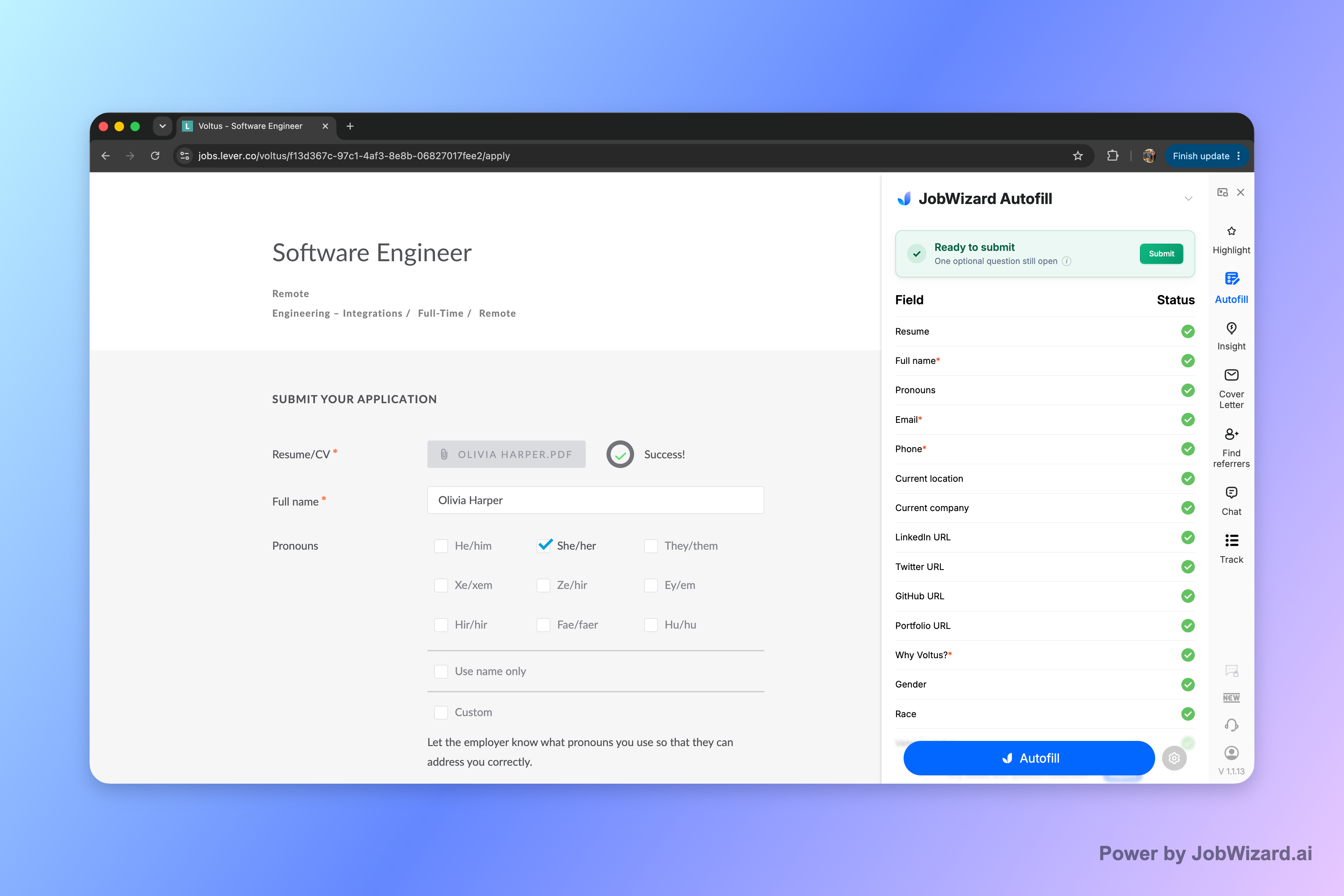
In a typical flow, JobWizard populates the repetitive parts first, and you keep the final review and submission in your hands. If anything required needs attention, you can jump to the matching question and correct it before submitting.
What “autofill job forms” should do (and what it should not)
Good autofill job forms reduce typing—not decision-making. Here’s the control-first standard you can use to evaluate any autofill workflow.
What it should do well: detect fields on the application page and populate repetitive fields from your saved profile/resume data.
What it should never promise: instant completion, perfect accuracy, or universal support across every website and every question. Even the best form filler can’t know what a specific employer wants from a custom question, and it can’t replace your judgment on eligibility details.
Control-first checklist (use after every autofill)
- Custom questions: Rewrite to match the posting (role-specific requirements, tools, scope, and impact).
- Eligibility details: Work authorization, sponsorship, and EEO-related responses where the employer expects exact truth for the candidate.
- Role-specific fields: Salary expectations, location constraints, notice period, and any “must-have” selections.
- Formatting and identity: Names, dates, addresses, and any fields that look “correct” but may be in the wrong format.
The Smart Autofill workflow: fill fast, review-before-submit
Smart Autofill is designed to help you move quickly through the repetitive parts of an application while keeping you in charge of the final answers.
At a high level, Smart Autofill uses your saved profile and resume data to fill detected fields on supported application pages through a Chrome extension. Then you review what’s been populated and submit yourself.
Here’s the workflow you can reuse on nearly every application type:
- Detect & populate: Smart Autofill fills the repetitive fields it recognizes on the form.
- Scan for exceptions: Look for required fields or questions that commonly differ by job or candidate circumstances.
- Jump to the missing/required item: If a required field still needs attention, JobWizard can identify it and let you jump to the matching question.
- Review before submit: Confirm each populated answer is correct and aligned to the job posting.
- Submit manually: You hit submit after review—autofill supports speed, not blind auto-submission.
Why this “review-before-submit” matters
The fastest application workflow is the one you can trust. Autofill job forms go wrong most often in the parts that require context: sponsorship and eligibility, custom responses, and any question with unique phrasing.
By keeping submission in your hands, you reduce the most damaging failure mode: “it filled something” but you didn’t notice it filled the wrong meaning for your situation or the wrong specifics for that job.
Real-world examples: what to trust autofill with vs. what to customize
Use autofill job forms for the parts that should be consistent—and customize the parts that prove fit.
Example 1: The “easy win” sections
- Contact basics: Name, phone, email, and address information (as long as it’s current).
- Work history structure: Company, title, dates, and location fields—especially when your resume is accurate and up to date.
- Education entries: Degree type, institution, and graduation date formatting (verify the format matches what the site expects).
Example 2: The “never skip review” sections
- Sponsorship / work authorization: These fields are high-impact and must reflect your real status.
- Salary expectations: Values can differ by role and timing—confirm what you intend to communicate.
- EEO-related and compliance questions: Ensure responses match your situation and the employer’s required options.
- Custom questions: Any free-text prompts require your voice and job-matching details.
Where people get tripped up
Even when autofill is correct, people forget to verify that the form accepted what it “recognized.” Quick review for dates, formatting, and any drop-down selections prevents subtle mistakes that don’t look wrong at a glance.
If you want a deeper control-first approach, read Is Better Apply Legit? How to Use Autofill Without Losing Control on Real Job Forms and use its “control” lens across any tool you try.
Which ATS forms are most common—and how to plan your review
Knowing where you’ll see autofill job forms helps you plan what to review most carefully.
JobWizard usage shows most autofill activity is on Workday, with additional volume on Greenhouse, Ashby, and Lever. Workday is where JobWizard can save the most time due to how many repetitive fields appear across those forms.
Usage context: JobWizard has processed 720,000+ applications and 600,000+ autofill sessions. Autofill fills an average of ~18 repetitive fields per application (typically 11–23), and about ~65% of submitted applications are on Workday.
Even with ATS familiarity, the “review-before-submit” step is still essential. Different jobs can change eligibility, role-specific questions, and custom responses—and autofill can’t replace your tailored context.
ATS-specific planning tips (practical and fast)
- Workday: Expect many repeatable fields—use autofill to reduce typing, then focus on eligibility, salary, and any role-specific selections.
- Greenhouse: Scan carefully for custom questions and selection options that may vary by team or hiring stage.
- Ashby/Lever: Still review required fields and any free-text prompts, even when most entries are consistent with your resume.
If you want ATS guidance beyond general tips, use these targeted resources: The Complete Guide to Greenhouse Autofill: JobWizard Supports 22+ ATS Platforms and Jobright AI Reviews: How JobWizard Autofills Forms (and How to Review Before You Submit).
Do this automatically with JobWizard
Skip the manual work — JobWizard's Smart Autofill handles this for you.
FAQ: Autofill job forms (control-first answers)
Is autofill the same as auto-submit or bot applying?
No. With JobWizard Smart Autofill, the tool fills detected fields using your saved profile/resume data, and you review the populated answers before you submit.
How do I handle required fields that still need attention after autofill?
If a required field needs attention, JobWizard can identify it and help you jump to the matching question so you can review and enter the correct info.
What should I review carefully after autofill job forms are populated?
Review anything that changes by role or eligibility: work authorization/EEO fields, salary or sponsorship details, and custom questions. Also confirm formatting for dates, addresses, and names.
Which ATS platforms does autofill work well with?
JobWizard usage shows most autofill is on Workday, with additional volume on Greenhouse, Ashby, and Lever. You should still review each populated field because not every field behaves identically across every form.
How can I reduce mistakes when autofill job forms asks for custom answers?
Keep a short “custom answers” note per job family (role summary, leadership keywords, and any unique experience). After autofill, edit those custom responses to match the posting before submitting.
Try Smart Autofill on your next application (and review every answer)
Autofill job forms should feel like typing on fast mode—not like giving up control. Start with Smart Autofill to populate repetitive fields quickly, then review required and custom questions before you submit.
For a step-by-step walkthrough, begin here: How to Autofill Job Applications (Step-by-Step with JobWizard). Then apply on your next role using the fill-fast, review-before-submit checklist.
Frequently Asked Questions
Autofill your next job application
JobWizard is a free Chrome extension that fills applications, tracks statuses, and optimizes your resume.