How to Answer When May Your Present Employer Be Contacted: A Confident Script + Email-Prep Tips
Learn how to answer when may your present employer be contacted with recruiter-ready wording, a calm risk plan, and a quick email you can send before you apply.
Free Chrome extension
Let AI answer these questions for you
JobWizard fills sponsorship, work-auth, and availability answers correctly on every application — free.
If an application asks, how to answer when may your present employer be contacted, it’s not just a checkbox—it’s a confidentiality decision. The best responses balance professionalism with discretion so you don’t jeopardize your current job while still keeping the process moving.
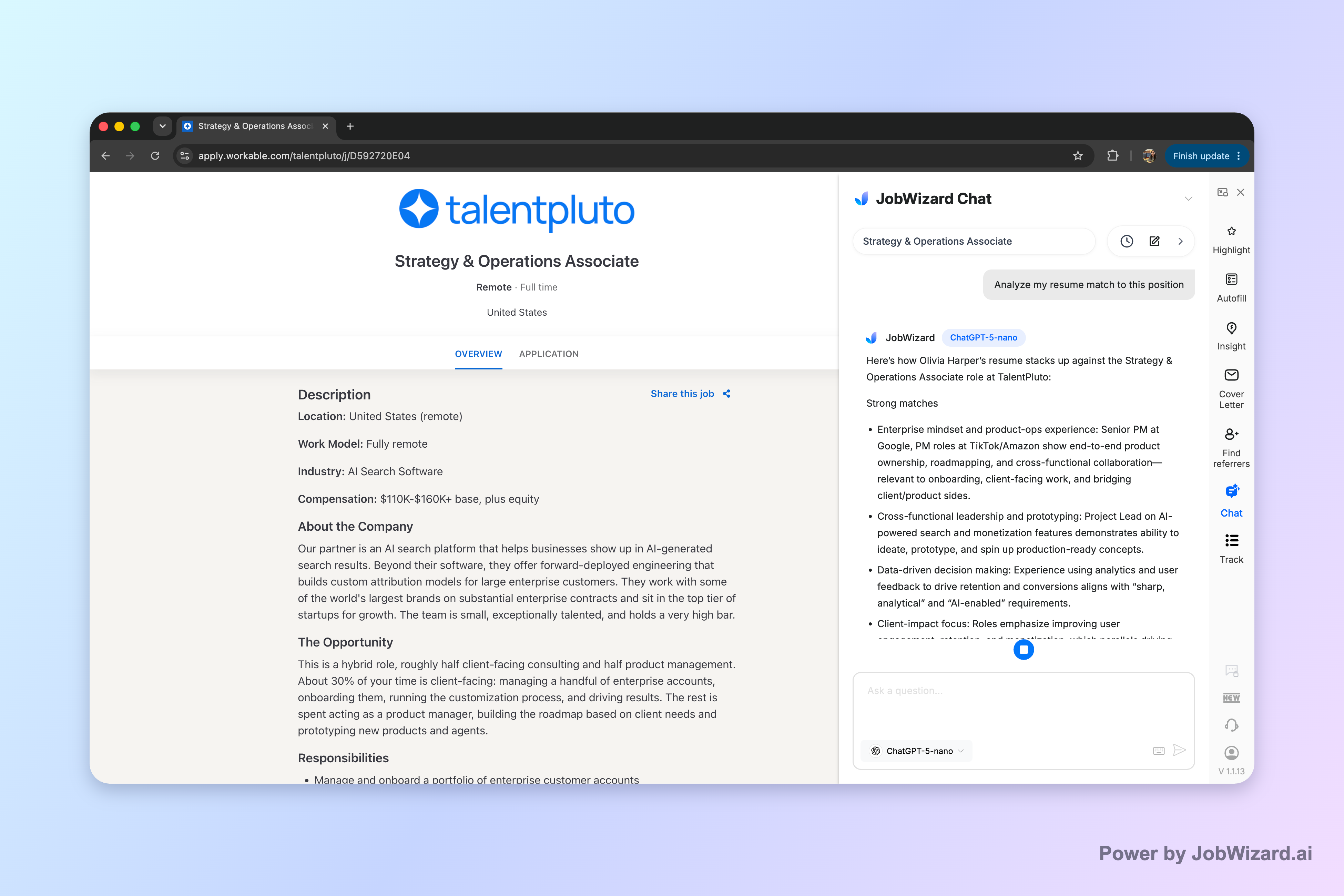
Before you submit, use JobWizard Career Chat to keep the current role in context—so you can ask follow-up questions about what the employer is likely trying to verify (without pasting the whole job description again).
What the question really means (and what recruiters are trying to verify)
“May your present employer be contacted?” usually signals whether the recruiter needs confirmation from your current workplace—often for role verification, performance signals, or timeline clarity.
Most of the time, they’re not trying to surprise your manager; they’re trying to reduce hiring risk. But from your side, contacting your employer too early can create real problems: internal awareness, rumor risk, or pressure to disclose job-search activities.
Because it’s an early-stage question, the most effective strategy is to control timing: you’re not saying “never,” you’re saying “not yet,” and you’re offering a workable alternative.
How to answer when you want discretion (yes, not yet, or with approval)
You can answer confidently even if you don’t want your employer contacted right away—by using wording that’s respectful, specific, and easy to process.
Option A: “Not yet” (recommended for many active job seekers)
Use this if you’re worried your current workplace will find out before you’re ready. It keeps you aligned with the recruiter’s need to verify—just later.
Application box script: “I’m currently employed and would prefer discretion. You may contact my current employer after the interview stage and with my approval. In the meantime, I’m happy to provide references from prior roles.”
Option B: “Only after I receive an offer” (for maximum protection)
This option is appropriate if your job-search could be sensitive (regulated environments, client-facing roles, or any situation where disclosure could cause complications).
Application box script: “I’d prefer that my current employer not be contacted until later in the process. Please contact me for an approval step after an offer is extended. If needed, I can provide references from previous employers in the meantime.”
Option C: “Yes, but only briefly / only to confirm role details” (if you can handle limited outreach)
If your workplace is understanding or you’ve already signaled your exit internally, you can reduce risk by narrowing what outreach is for.
Application box script: “You may contact my current employer, but please limit outreach to role verification (title/dates). I appreciate discretion during the early stages of the hiring process.”
Best practices: say less stress, offer a cleaner alternative, and keep it consistent
The winning approach is to reduce the recruiter’s friction: make it easy for them to proceed without contacting your employer immediately.
- Offer alternatives: references from prior roles, HR verification for employment dates only, or a short call from the recruiter that doesn’t mention your current job.
- Keep the tone professional: you’re managing confidentiality, not accusing anyone of wrongdoing.
- Match your choice to your behavior: if you select “with approval later,” be ready to respond quickly when the recruiter reaches that stage.
- Use consistent language across application fields (in forms, emails, and interview follow-ups) so there’s no confusion later.
Concrete example: a “not yet” answer that still moves fast
Imagine you’re applying to a role on a tight timeline. You choose “not yet,” but you don’t leave the recruiter hanging. In the application you write:
Script: “I’m currently employed and prefer discretion. Please contact my current employer only after initial interviews and with my approval. In the meantime, I can provide references from two recent prior roles.”
That does two things: it respects your confidentiality and gives the recruiter an obvious path forward.
Concrete example: when you pick “only after offer,” but want to stay credible
If the role requires strong verification, you can preempt delays by stating what you’ll do next:
Script: “I’m happy to discuss references now. I prefer that my current employer not be contacted until an offer decision is made. Once we reach that stage, I’ll provide my approval promptly.”
What to say if they push back: negotiation language that protects you
If they insist on contacting your manager immediately, respond with clarity and a workable compromise instead of a hard refusal.
Ask what they need and why (you control the terms)
Push back politely by getting specifics. Recruiters are often fine with adjusting timing once they understand your constraints.
Email-style line: “Understood. What exactly would you like to confirm with my current employer (title/dates only, or performance specifics)? If it’s just verification, I’m able to provide that later in the process after our first interview.”
Offer “approval workflow” language
This keeps you from being boxed into an all-or-nothing decision.
Email-style line: “I’m comfortable with outreach after I’ve had the chance to review the message and approve the timing. Please share the intended outreach details so I can coordinate discreetly.”
Propose a staged verification plan
For many employers, staged verification is acceptable because it still reduces uncertainty—without creating job-search risk on your side.
- Stage 1: use prior references while interviews proceed.
- Stage 2: after initial interviews, request approval for role verification contact.
- Stage 3: if needed, expand to deeper questions only when you’re ready.
Do this automatically with JobWizard
Skip the manual work — JobWizard's Smart Autofill handles this for you.
FAQ: how to answer when may your present employer be contacted
These recruiter-ready answers help you choose discretion without slowing your application.
Should I say yes or no when an application asks, “May your present employer be contacted?”
If confidentiality matters, it’s usually safest to say “not yet” (or “only after I’ve received an offer”) and offer an alternative, like references from prior roles or a brief initial phone screen that doesn’t involve your employer.
What’s a strong script to use in the application box?
Try: “I’m currently employed and would prefer discretion. You may contact my current employer after the interview stage and with my approval. In the meantime, I’m happy to provide references from prior roles.”
How do I handle it if the employer insists on contacting my current manager?
A good compromise is to ask for what they need and when: “Understood. What exactly would you like to confirm, and could we do this after my first interview? I can provide my manager’s name and your outreach subject to keep it brief and job-related.”
If I choose “later/with my approval,” what should I do next to stay credible?
Follow up quickly and proactively. Send a short email offering a timeline (e.g., after your first interview) and confirm you’ll approve outreach when you’re ready. Also keep references and contact details updated so there’s no delay once you give the go-ahead.
CTA: Want help wording this precisely for your target role? Use JobWizard Career Chat to ask a focused follow-up question about the current position, then verify your answer aligns with the job description before you submit.
For related question styles, you may also find these guides helpful: How to Answer “May We Contact Your Current Employer” on a Job Application (Script + Tips), How to Answer Job Application Questions: A Field-Tested Method for Confident, Consistent Responses, Behavioral Interview Questions That Actually Predict Your Performance—And How to Craft Strong Answers, and How to Answer Interview Questions Like a Pro: Your Repeatable Framework for Clear, Confident Replies.
Frequently Asked Questions
Let AI answer these questions for you
JobWizard fills sponsorship, work-auth, and availability answers correctly on every application — free.