How to Answer This: Use Career Chat Context to Respond Without Rambling
If you’re stuck on how to answer this follow-up or “tell me more” question, use Career Chat to keep the role in context and craft a clear response you can review before you share.

Free Chrome extension
Let AI answer these questions for you
JobWizard fills sponsorship, work-auth, and availability answers correctly on every application — free.
If you keep getting follow-up questions that start with “so… how would you handle…” or “tell me more,” you’re not alone—knowing how to answer this in a way that sounds confident (not rambling) is a real skill. The hard part isn’t finding words; it’s keeping your answer tied to the exact role and the evidence you actually have.
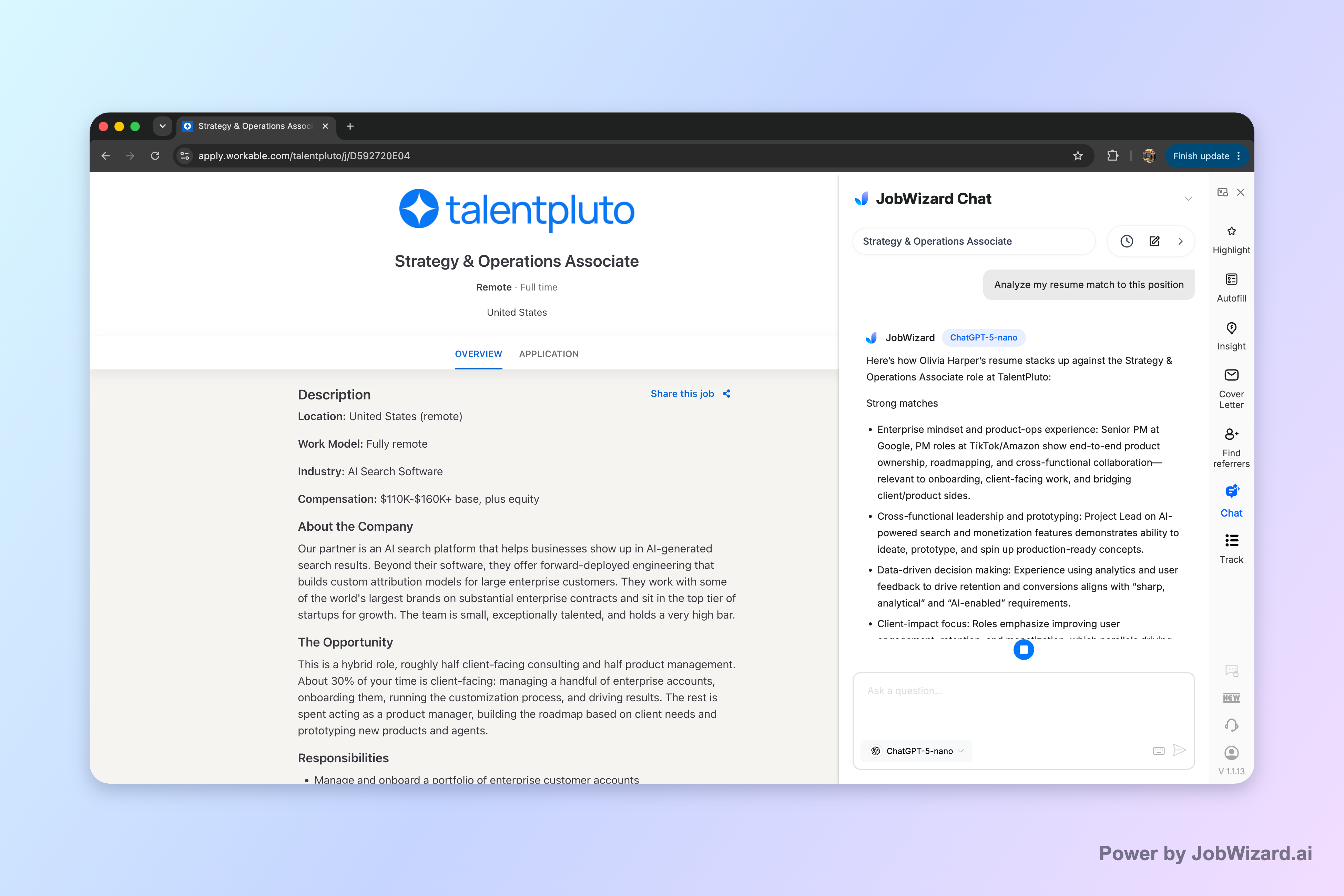
With JobWizard’s Career Chat, you can ask questions about your resume fit and application strategy while the current role stays in context, so you don’t have to paste the job description again. Then you review the draft and submit—or use it to guide your interview answer—your way.
Turn “how to answer this” into a clear, role-specific response
Make the question actionable first, then build the answer around what the role actually needs.
When a recruiter or hiring manager asks a follow-up, it usually means one of three things: they want a concrete example, they want clarity on your fit, or they want to understand how you think. A generic answer sounds safe, but it often reads as low-effort because it doesn’t land the point.
Instead of starting with your life story, start with the “so what” of the question. For example:
- If they ask “tell me more,” they want an example that proves the claim you already implied.
- If they ask “how would you…,” they’re testing your approach, tradeoffs, and decision-making.
- If they ask “should I apply,” they want a fit check—what you can do that matches the role’s priorities.
Use a fast answer map (2 minutes) before you write
Decide what they’re testing, then choose the smallest structure that proves it.
Here’s a simple pre-writing map that works for most follow-ups:
- Restate the goal: “It sounds like you’re looking for…”
- Choose one proof: a project, achievement, or behavior that directly connects.
- Add one decision detail: how you prioritized, negotiated, debugged, or collaborated.
- Land with an outcome: what changed because of your actions.
If you can’t pick one proof yet, that’s your cue to gather it—don’t guess. A clear “I can do X” without evidence becomes a ramble when they ask follow-ups.
Use Career Chat to keep the role in context while you draft
Draft faster by answering from context, not from memory.
One reason people struggle with “how to answer this” is that they answer from general experience instead of role-specific needs. Career Chat is built to help you avoid that by keeping the current role in context so you can ask follow-up questions about resume fit and application strategy without re-pasting the job description.
That matters because interviewers and hiring managers don’t just want your best story—they want the story that matches the role’s priorities.
Examples of follow-up prompts you can ask Career Chat
Use prompts that ask for an answer draft and an outline, then you refine.
- “Based on this role, what’s the strongest way to answer this follow-up: ‘Why should we hire you?’ Give me a tight 3-sentence version.”
- “If I say I’ve done X, what follow-up question might they ask next—and what should my answer include?”
- “Should I apply to this role given my background? If yes, which parts of my experience should I emphasize?”
- “What resume section or bullet should I connect to this question so my answer doesn’t sound generic?”
Important limitation: don’t treat the output as a recruiter decision or a guarantee that you qualify. Use it to shape your draft and check alignment with the job posting before you use your response in an interview or application.
How to review the draft before you speak or submit
Verify alignment with the job posting, then polish for your voice.
Before you use any draft answer, do a quick consistency check:
- Keywords as evidence: the job’s language should map to your evidence—not replace it.
- No missing details: if the job mentions a specific responsibility, your answer should reference how you’ve handled it (at least at a high level).
- Human delivery: read it out loud. If it sounds like an essay, shorten and add one concrete example.
This “autofill-and-review” mindset applies to writing your answers too: get a strong first draft quickly, then own the final version.
Answer templates for common “how to answer this” moments
Templates keep you focused when you’re under time pressure.
Below are practical templates for some of the most frequent follow-ups. You can adapt them whether you’re preparing for an interview, responding to a recruiter email, or answering an application question.
When they ask for an example: “Tell me more about that”
Follow the evidence-first pattern—claim, example, result.
Use this structure:
- Claim: “The reason I’m confident is that I’ve done this kind of work before.”
- Example: “In my last project, I…”
- Decision detail: “The key tradeoff was…”
- Outcome: “As a result…”
If you only provide an example without a decision detail, you can sound like you got lucky. Add one sentence on how you chose what to do.
When they ask about fit: “Should I apply?” or “Why this role?”
Answer as a fit check, not a sales pitch.
Try this approach:
- One-sentence fit: “I’m a good match because I’ve repeatedly handled…”
- Two evidence points: “First, I’ve done… Second, I’ve….”
- Role connection: “What I’m excited to apply is…”
- Close with readiness: “If you’re optimizing for X, I can contribute by…”
This is also where Career Chat can help you turn your background into role-aligned emphasis. Just remember the limitation: it’s not a guarantee—your job is to confirm what the role is asking for.
When they ask “how would you handle…”
Show your thinking in steps, not a vague promise.
Use an approach like:
- Clarify constraints: what you know vs. what you need.
- Propose a plan: what you’d do first, second, third.
- Explain tradeoffs: speed vs. quality, risk vs. scope.
- Communicate: who you’d align with and how often.
- Confirm success: what “done” looks like.
This turns “how to answer this” from a personality test into a process you can actually defend.
Avoid the #1 failure mode: answers that drift off the role
Don’t let your answer become a replay of your resume.
When you’re unsure, it’s tempting to narrate everything you’ve done. That often triggers follow-ups because the interviewer can’t see the match. The goal is not to cover your whole history—it’s to prove you can do the next thing the role needs.
Here’s how to keep your answers anchored:
- One question = one target: if they ask about collaboration, don’t pivot into unrelated technical work.
- Prioritize relevance: pick the example that mirrors the role’s responsibility most closely.
- Limit scope: if your example takes 2 minutes to explain, compress it and keep the “decision” part.
- Use language they recognize: borrow the job’s phrasing sparingly—but don’t copy it verbatim.
If you want a broader method for different application questions, start with How to Answer Job Application Questions: A Field-Tested Method for Confident, Consistent Responses.
Quick practice: rewrite your next answer in 10 minutes
Use a short practice loop so “how to answer this” feels second nature.
Set a timer for 10 minutes and do this:
- Pick the real question: copy the exact wording of the follow-up.
- Write a one-sentence goal: “They want to know if I can…”
- Draft a 4-bullet answer: claim, example, decision detail, outcome.
- Ask Career Chat for a tighter version: request a concise outline you can personalize.
- Read it out loud: cut filler until it sounds like you.
If your follow-up is about positioning—like “Why are you interested in this position”—use the strategy in How to Answer “Why Are You Interested in This Position” Without Sounding Generic so your answer connects your motivations to the actual role.
And if you’re answering recruiter or interview questions about timing or sourcing, don’t skip the framing. For “How did you hear about us,” see How Did You Hear About Us Interview Question? Use This Answer Framework to Sound Intentional.
If your follow-up is specifically about sponsorship, use How to Answer Visa Sponsorship Question Without Sounding Unprepared (Use This Script + Follow-Ups) to stay clear and confident.
CTA: Next time you hit “how to answer this,” open JobWizard and ask a focused follow-up in Career Chat about the current role—then review the draft against the job description and use the final version in your interview or application.
Do this automatically with JobWizard
Skip the manual work — JobWizard's Smart Autofill handles this for you.
FAQ
What should I do when I don’t understand the follow-up question?
Ask a quick clarifier and mirror what you think they mean, then answer the closest part first. If it’s about fit (“why this role”), reference the specific responsibility from the role and connect it to your evidence (project, metric, or behavior).
How do I avoid sounding generic when the question is vague (like “Tell me about yourself” or “Why should we hire you”)?
Use a tight structure: 1) the role you’re targeting in one sentence, 2) one or two proof points from your background, 3) the specific outcome you’re aiming for in this company/role. Keep it concrete and avoid repeating the job posting word-for-word.
Can Career Chat help me answer “should I apply” or job-fit questions?
Yes—Career Chat is designed to keep the current role in context so you can ask follow-up questions about resume fit and application strategy without re-pasting the job description. Use the answer as a draft, then verify it against what the job posting actually asks.
Is it okay to ask for clarification during an interview or after receiving an application follow-up?
Yes. A short clarification shows professionalism and helps you answer precisely. You can say: “To make sure I address this well—are you asking about X or Y?” Then answer the option that best matches the role’s stated needs.
Frequently Asked Questions
Let AI answer these questions for you
JobWizard fills sponsorship, work-auth, and availability answers correctly on every application — free.