How Long After an Interview Should You Follow Up? A Timing Plan That Fits Real Hiring Cycles
Wondering how long after an interview should you follow up? Use a simple timeline, message templates, and an application activity tracker workflow to stay organized.
Free Chrome extension
Autofill your next job application
JobWizard is a free Chrome extension that fills applications, tracks statuses, and optimizes your resume.
Answer: how long after an interview should you follow up?
How long after an interview should you follow up is mainly about respecting the hiring team’s timeline while still staying top-of-mind. In practice, that means sending your first follow-up within 24–48 hours, then checking back again after about a week if you haven’t heard anything.
Because each role moves differently—especially once interviews end and teams debrief—your goal isn’t to “catch” the recruiter mid-decision. Your goal is to send a clear, professional message at a point where a response is plausible, while you keep your process organized.
Use this follow-up timeline: dates that feel appropriate
How long after an interview should you follow up becomes easier when you use a repeatable timeline. Here’s a structure you can adapt whether you interviewed with a recruiter, a hiring manager, or a panel.
- 24–48 hours: send a thank-you + brief reiteration of fit (and mention a detail from the conversation).
- ~7 days: follow up if you haven’t heard back. Keep it short and focused on next steps.
- ~14 days: send a confident check-in—still polite, but you should clearly show you’re actively following the process.
- After that: reduce frequency. If you send more messages, make each one add value (a new relevant update, or a final “close-the-loop” note).
The exact day matters less than the pacing. If your first message is too fast, it can feel rushed; too late, and you may miss the team’s internal decision window.
Match your follow-up message to the “why” behind it
Your follow-up should correspond to your intent—thanks, next steps, or a gentle status check. If you align the tone with the purpose, you’ll reduce the chance that your email sounds like you’re pushing for a result instead of requesting information.
1) First follow-up (24–48 hours): gratitude + fit
In your first note, aim for three beats: thanks, a concrete link to what you discussed, and a closing that invites next steps.
- Thank them for the conversation and time.
- Reference one specific topic: a project, requirement, or decision-making style you discussed.
- End with a simple question: when might you expect to hear about next steps?
2) One-week follow-up: next steps without pressure
At the one-week mark, you’re not just reminding them you exist—you’re asking for guidance on what happens next. Keep it direct and respectful.
- Remind them of the role title.
- Briefly reiterate interest (one sentence max).
- Ask about the timeline or whether additional materials are helpful.
3) Two-week check-in: concise, confident, and organized
By two weeks, your email should be easy to skim. You want a recruiter or interviewer to read it and immediately understand: who you are, what you want, and why now.
- Use a subject line that signals “check-in,” not “urgent.”
- Keep the ask minimal: “Are there updates on next steps?”
- If you have new relevant info (a certification, a completed project), mention it—otherwise, don’t pad.
Stay organized with application activity (so follow-ups aren’t guesswork)
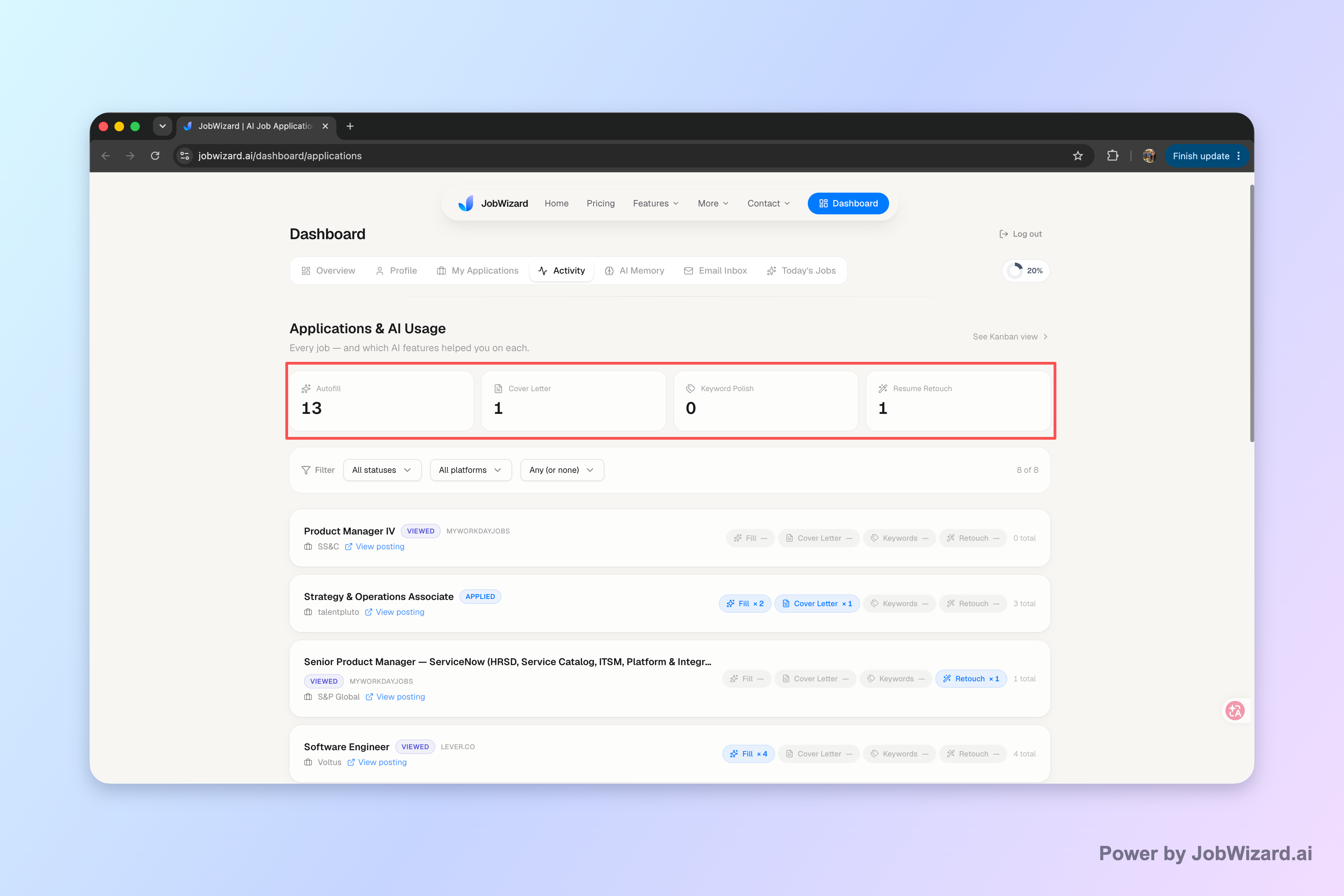
Following up goes smoother when you know what’s happening with each application and which part of your workflow is connected to it. JobWizard’s Activity view shows application status and which JobWizard tools were used for each role—so your follow-ups are grounded in reality.
That matters because “no response” can mean a lot of things: the team may be reviewing, waiting on approvals, or simply slower than you’d like. With a tracking-first mindset, you can keep a consistent routine across multiple roles without losing track.
JobWizard usage context: JobWizard is used heavily for applications—720,000+ applications submitted and 600,000+ autofill sessions run through JobWizard—so keeping your process tidy and review-focused helps you manage follow-ups across many roles.
Important limitation: tracking shouldn’t be treated as guaranteed detection of every update or as a guaranteed improvement in hiring outcomes. Instead, use it as a better way to manage your own workflow: what you submitted, what you reviewed, and what the system indicates is happening right now.
How to connect “application status” to “when to follow up”
- If a role is marked as under review or similar, your check-in can stay on your timeline (24–48 hours, ~7 days, ~14 days) rather than becoming reactive.
- If the role is moved to a stage that implies the team is waiting on internal steps, you can reduce urgency while still staying present.
- If you’re unsure, track your messages anyway—your next follow-up should reference prior outreach and keep asking for next steps.
If you want a deeper system for this piece, start with How to Track Job Applications: A Practical System (JobWizard + Beyond).
Follow-up message examples you can copy (and personalize fast)
You don’t need long emails—you need clarity. Use these patterns as drafts, then customize with one detail from your interview so it reads like it came from you, not a template factory.
Example: first follow-up (thank you + next steps)
Subject: Thank you — [Role Title]
Hello [Name], Thank you for taking the time to speak with me about the [Role Title] role on [day/time]. I especially appreciated our conversation about [specific topic you discussed]. I remain very interested in the opportunity and would welcome any update on next steps when available. Best regards, [Your Name]
For a version that’s written specifically for longer gaps, you can also adapt ideas from Interview Follow-Up Email After 2 Weeks: A Confident Check-In That Gets Replies.
Example: one-week check-in (short and neutral)
Subject: Quick follow-up — [Role Title]
Hello [Name], I hope you’re doing well. I wanted to follow up on my interview for the [Role Title] position on [day]. I’m still very interested in the role and would appreciate any insight into the timeline for next steps. Thank you, [Your Name]
Example: two-week check-in (confident, respectful)
Subject: Check-in — [Role Title]
Hello [Name], I’m checking in regarding the [Role Title] role after our interview on [day]. I remain enthusiastic about the position and would love to know if there are updates on next steps. If you need any additional information from me, I’m happy to provide it. Best, [Your Name]
Use a tracking-first workflow to decide what to send next
If you want a repeatable “what happens when” plan, use How to Follow Up After an Interview (Timing, Messages, and a Tracking Plan) and Interview Follow Up Email: A Tracking-First System That Gets You Seen (and Responded To).
Do this automatically with JobWizard
Skip the manual work — JobWizard's Application Tracker handles this for you.
FAQ: how long after an interview should you follow up?
How long after an interview should you follow up the first time?
A good rule is to follow up about 24 to 48 hours after your interview—especially if you have interviewers’ contact info and can personalize your note with something you discussed.
Is it okay to follow up a week after an interview?
Yes. If you haven’t heard back, a follow-up about one week after is often appropriate, particularly when hiring teams typically need time to debrief and move candidates to the next step.
What should you do if you still don’t hear back after two weeks?
Send a concise check-in that references your interview and reiterates interest, then switch to lighter-touch follow-ups (and stop after you’ve given a few clear attempts). At the same time, track every application step so you know which roles are pending or under review.
Should you check your application status before following up?
If you can do it quickly and it’s relevant (for example, the company uses a system where status can be viewed), check it first so your message reflects reality. Otherwise, it’s still fine to follow up on a timeline without knowing the exact status, as long as you keep the email respectful and specific.
How can an application tracker help after an interview?
An application tracker (like JobWizard’s Activity view) keeps your application status and which JobWizard tools were used for each role in one place—so you can follow up based on where the application actually is, not what you hope is happening.
Ready to make follow-ups simpler? Keep every application—and its next-step context—in one place with JobWizard’s application tracking workflow, then follow the timeline above so your emails land at the right moment.
Frequently Asked Questions
Autofill your next job application
JobWizard is a free Chrome extension that fills applications, tracks statuses, and optimizes your resume.