Follow-Up Email Examples After an Interview for Every Waiting-Game Moment
Use these follow-up email examples after an interview to thank your interviewer, check on a decision, or reconnect after a delay. Each template is designed to sound clear, specific, and professional.

Free Chrome extension
Autofill your next job application
JobWizard is a free Chrome extension that fills applications, tracks statuses, and optimizes your resume.
Choose the right follow-up for the moment
The best follow-up email depends on whether you are thanking the interviewer, checking on a decision, or responding to a delay. A timely, tailored note shows professional interest without asking the employer to move faster than promised.
Use these follow-up email examples after an interview as adaptable templates, not scripts. Replace the bracketed details with accurate information, and keep your message focused on one purpose.
For a broader overview of timing and message choices, start with this guide to sending a follow-up email after an interview. The templates below offer wording for common situations.
- Within 24 hours: Send a thank-you note after the conversation.
- After the stated decision date: Send a short check-in if you have not received an update.
- After a longer silence: Reconnect politely, then decide how to manage your search if there is still no reply.
Follow-up email examples after an interview for a thank-you note
Send a thank-you email within 24 hours and make it specific to the conversation. Mention one topic you discussed, restate your interest, and keep the note short enough to read quickly.
Standard thank-you email
Subject: Thank you for discussing the [Job Title] role
Hi [Interviewer Name],
Thank you for taking the time to speak with me about the [Job Title] position. I enjoyed learning more about [specific project, team priority, or responsibility we discussed].
Our conversation strengthened my interest in the role, especially the opportunity to [relevant contribution]. I appreciate your consideration and look forward to hearing about next steps.
Best,[Your Name]
Thank-you note after a panel or multiple interviews
Subject: Thank you for the conversation about [Job Title]
Hi [Interviewer Name],
Thank you for meeting with me as part of the [Job Title] interview process. I appreciated hearing your perspective on [specific topic] and learning how the team approaches [relevant responsibility].
Please pass along my thanks to everyone I met. I remain interested in the opportunity and would be glad to provide any additional information.
Best,[Your Name]
When you spoke with several people, send individualized notes when you have each interviewer’s contact information. A different, genuine detail in each message is more effective than copying the same paragraph to everyone.
Examples for checking on an interview decision
Wait until the employer’s stated timeline has passed before asking for an update. Keep your message courteous, confirm your continued interest, and make it easy for the recipient to reply.
When the expected date has passed
Subject: Checking in: [Job Title] interview
Hi [Interviewer Name],
I hope you’re doing well. I’m checking in about the [Job Title] role after our conversation on [date]. You mentioned that the team hoped to share an update around [timeframe], so I wanted to ask whether there is news about the hiring timeline.
I’m still very interested in the opportunity, particularly [specific reason]. Thank you for your time, and I understand if the process is still underway.
Best,[Your Name]
When you were not given a timeline
Subject: Following up on [Job Title]
Hi [Interviewer Name],
Thank you again for speaking with me about the [Job Title] position. I’m following up to ask whether there is an update on the hiring process or an estimated timeline for next steps.
I remain interested in the role and appreciate your consideration.
Best,[Your Name]
If you need a more detailed approach to a delayed response, see this example for a confident check-in after two weeks. It focuses on reconnecting without sounding demanding.
Adapt your message to a change or a delayed reply
Keep a follow-up brief when plans change, you have new information, or the process has gone quiet. Give the employer relevant context without using the email to pressure them.
If you have a competing offer
Subject: Update on my timeline for [Job Title]
Hi [Interviewer Name],
I wanted to share a timing update: I’ve received another offer and have been asked to respond by [date]. I remain interested in the [Job Title] opportunity with [Company], so I’d appreciate any information you can share about your timeline.
I understand that you may not be able to accelerate the process. Thank you for considering my update.
Best,[Your Name]
If you have an additional detail to share
Subject: Additional information for my [Job Title] interview
Hi [Interviewer Name],
Thank you again for discussing the [Job Title] role with me. After our conversation about [topic], I wanted to share one relevant detail: [brief example of related experience or answer to an open question].
I hope this is helpful as you evaluate candidates. I remain interested and appreciate your time.
Best,[Your Name]
Send only information that adds something meaningful. Avoid sending a second thank-you that simply repeats your first note.
Make each follow-up clear, accurate, and professional
A strong follow-up is specific, concise, and respectful of the employer’s process. Before sending, make sure every detail is true and that your request matches the situation.
- Use a descriptive subject: Include the role or the reason for writing so the recipient can identify your message.
- Personalize one detail: Refer to a real topic from the interview rather than adding generic praise.
- Match the timing: Follow the timeline you were given; do not treat a promised date as a guarantee.
- Make one clear request: If you need an update, ask about the status or expected timeline in a single sentence.
- Proofread names and facts: Check the interviewer’s name, role title, dates, and any details you reference.
- Keep your search organized: Record when you interviewed, whom you contacted, and what you plan to do next.
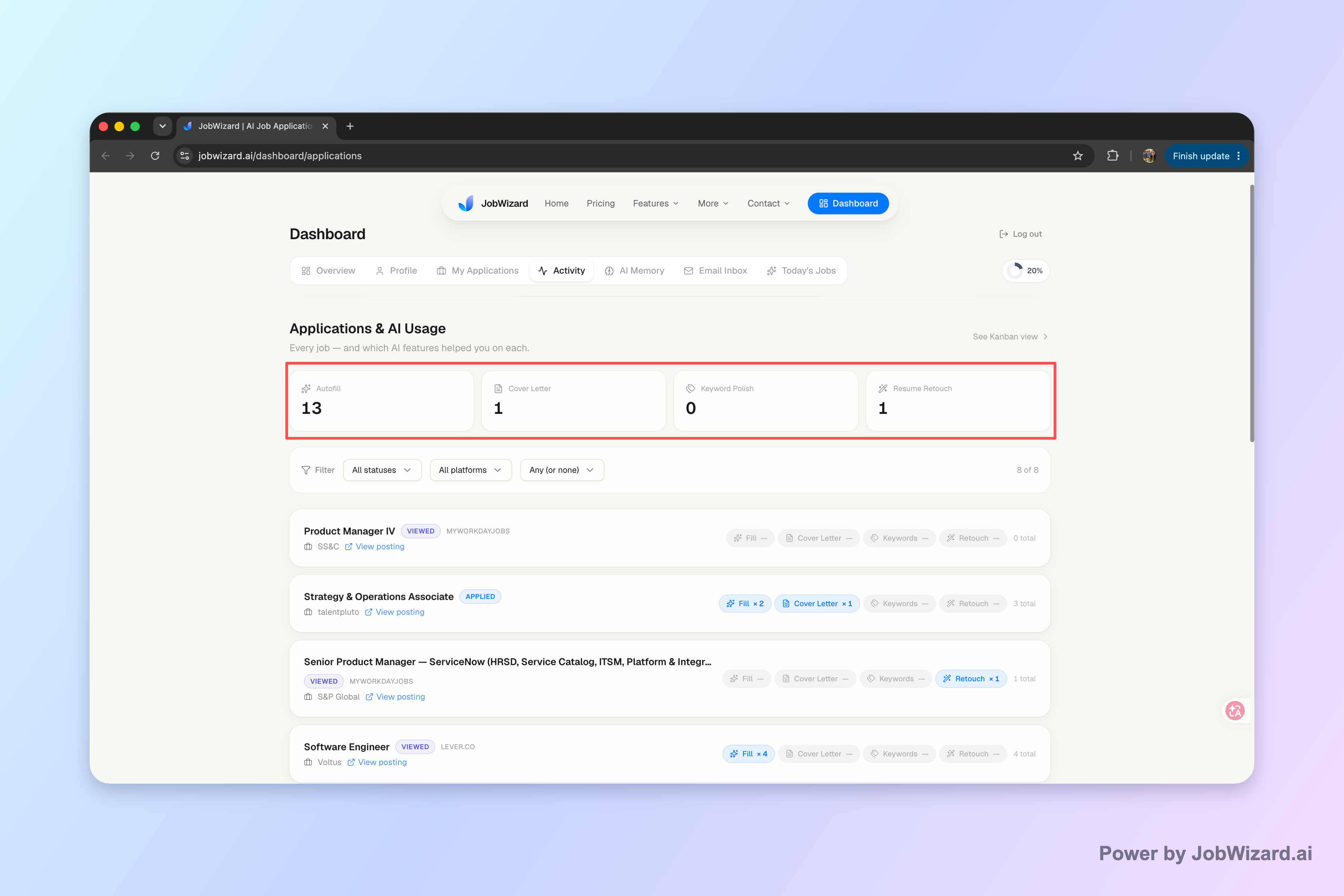
An application tracker can help you remember which roles need a thank-you or a check-in. JobWizard’s Activity view shows application status and which JobWizard tools were used for each role; it does not mean every application update is detected automatically or guarantee a hiring outcome.
For a practical system to record applications and next steps, read How to Track Job Applications: A Practical System. For another thank-you approach during an interview loop, see this follow-up thank-you email example for an interview loop.
Do this automatically with JobWizard
Skip the manual work — JobWizard's Application Tracker handles this for you.
Follow-up email examples after an interview: FAQs
Use these quick answers to confirm when to write, what to include, and how to handle silence. Adapt the guidance to the timeline and communication style your interviewer shared.
When should I send a follow-up email after an interview?
Send a thank-you email within 24 hours of the interview. For a decision check-in, follow the timeline the interviewer gave you; if they did not provide one, wait about a week before sending a brief, polite note.
What should I include in a follow-up email after an interview?
Include a specific subject line, a greeting, a sincere thank-you, one detail from the conversation, and a concise closing. If you are checking on a decision, mention the role and ask for an update without implying that the employer owes you an immediate response.
How do I follow up after an interview if I have not heard back?
Wait until the employer's stated decision timeline has passed, then send a short, courteous check-in that restates your interest and asks whether there is an update. If you still do not hear back, you can send one final brief note after another reasonable interval.
Can I use these follow-up email examples after an interview as written?
Use these follow-up email examples after an interview as starting points, then personalize the greeting, role, conversation detail, and timing. Check every name and detail before sending.
Keep your next step visible. Use JobWizard’s Activity view to keep each application and its next step in one place while you manage your follow-ups.
Frequently Asked Questions
Autofill your next job application
JobWizard is a free Chrome extension that fills applications, tracks statuses, and optimizes your resume.