universal yums browser extension auto apply: why bots backfire and what to do instead
“universal yums browser extension auto apply” sounds convenient, but bot-style submissions can send wrong answers and trigger spam filters. Use autofill instead—fill the form fast, then review and submit yourself.
Free Chrome extension
Autofill your next job application
JobWizard is a free Chrome extension that fills applications, tracks statuses, and optimizes your resume.
If you searched “universal yums browser extension auto apply,” you probably want faster job applications—but not a bot-driven mess. The problem is that “auto apply” workflows often fill fields without understanding what’s truly job-specific, which can lead to incorrect screening answers, mismatched profile details, and employer-side filters reacting to suspicious submissions.
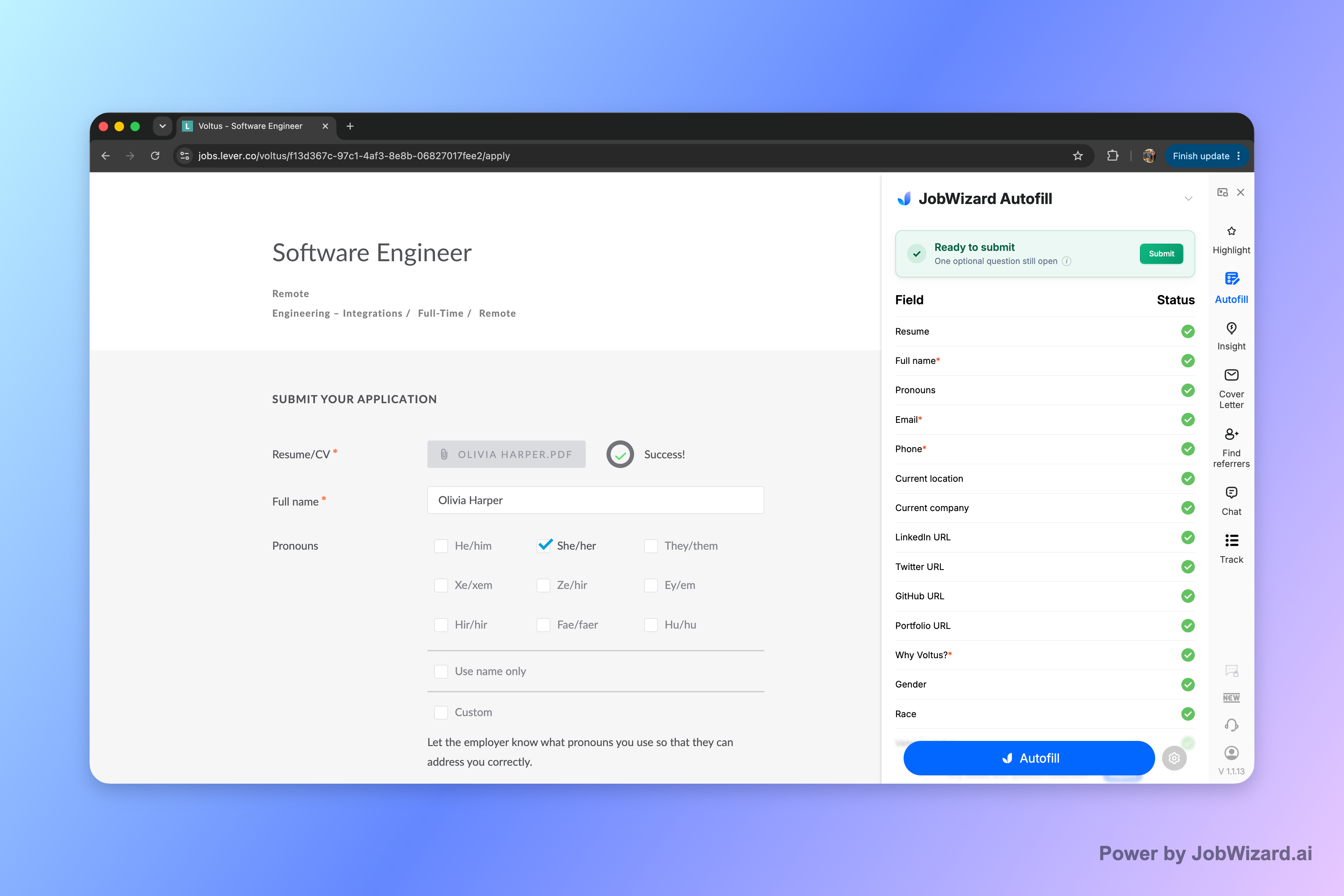
With JobWizard, you still get speed—because it fills repetitive application fields while keeping the final review and submission in your hands. That middle ground matters: faster forms without blind automation.
What “universal yums browser extension auto apply” usually gets wrong
Auto-apply bots can get the “right idea” but fail on the details that decide whether you advance. Most job applications include at least some fields that must match the role, your eligibility, or the employer’s exact screening criteria. When automation doesn’t truly “understand” those nuances, small mistakes can become deal-breakers.
Here are the most common failure modes you should expect from bot-style auto-apply behavior:
- Wrong answers to screening questions (for example, eligibility, work authorization, or role-specific preferences entered from the wrong template/profile).
- Mismatched resume/profile details (like employment dates, titles, or skills not aligned to the specific job you selected).
- Missing or mishandled required fields that the bot attempts to skip, guess, or fill incorrectly—leaving you effectively “submitted” in the worst way or not submitted at all.
- Employer-side spam/quality filtering that flags patterns associated with automated submissions (especially when multiple applications look identical or “too perfect” from a bot).
- Damaged reputation with a company you actually want if your application looks careless, inconsistent, or noncompliant due to bad automation behavior.
It’s worth being fair: automation can be tempting when you’re applying at scale. The trade-off is that “scale” plus “automation” tends to amplify errors—especially when the tool doesn’t give you time to verify custom inputs.
Why bot submissions hurt your odds (even if it “looks” submitted)
Submitting is the start of the review problem—not the end of it. Many screening steps happen after submission, and reviewers often notice inconsistencies that you might not even see in the automation’s rush to finish.
Consider how these issues show up in real applications:
- Screening logic gets mismatched: If your answers to key eligibility questions don’t reflect the current job, you may get filtered out before a human ever sees your resume.
- Resume-to-form disconnect: If the tool fills the form using one profile snapshot while your resume content reflects another, your application can read as inconsistent.
- Custom questions are where automation fails: Many employers add role-specific items that don’t map cleanly from saved profiles.
- Quality signals can trigger rejection: Repetitive application patterns can resemble low-effort bot activity, which can reduce your chance of being treated as a serious candidate.
The bottom line: wrong-but-fast beats nothing, but it can actively reduce your chances—especially when you’re applying to companies you’d genuinely want to work for.
The safer alternative: autofill the repetitive fields, then review before submit
Autofill solves the speed problem without handing your application to a bot. JobWizard autofills fields on the application pages you’re already on, then you review what it populated and submit yourself.
This workflow is designed around the reality that some fields are always job-specific. That’s why the process stays human-controlled:
- Detect and fill repetitive fields: JobWizard uses saved profile and resume data to populate detected fields on supported application pages.
- Review everything that matters: You verify the populated answers and adjust anything that’s job-specific.
- Handle required fields that need attention: When a required field still needs your input, JobWizard can identify it so you can jump to the matching question.
- Submit yourself: You’re the one clicking submit after your checks—so the application you send matches the story you want told.
In practice, this means you can move quickly through repetitive sections without risking the “bot submission” behaviors that often cause wrong screening answers or inconsistent data.
“universal yums browser extension auto apply” vs autofill tools: a practical comparison
Not all browser extension workflows behave the same—so compare what happens after the form fills. The key distinction is whether the tool merely helps you complete the application vs. whether it attempts to submit on your behalf.
| Workflow style | What you should expect | Big risk to watch | Better-fit for |
|---|---|---|---|
| Auto-apply (“auto submit”) | Attempts to complete and submit without your full review step | Wrong screening answers and inconsistent profile/resume data being sent | Situations where the form is extremely uniform (rare) and you can verify what will be submitted |
| Autofill + review-before-submit (recommended) | Fills repetitive fields quickly, then you review and submit yourself | Overconfidence (skipping review because it “looks filled”) | Fast application volume while keeping quality control |
| Autofill without guarantees | May still require manual attention on required fields | Leaving required fields unresolved or not noticing job-specific changes | Applicants who are comfortable reviewing and correcting what needs attention |
If you want a deeper dive into extension-based autofill options, start with which tools offer browser extension autofill and then compare the workflow details—not just the feature name.
And if your goal is to keep everything consistent across applications, you may also like autofill job applications extension: a chrome workflow that fills, reviews, and helps you apply faster.
Build a faster, safer application workflow with JobWizard
The fastest application process is the one where you control the last mile. JobWizard is built for autofill + review-before-submit, so you don’t have to rely on a bot to decide what’s correct.
If you apply frequently, you can think of it like this: repetitive fields get filled fast, while the parts that commonly cause rejection still get your attention. JobWizard has been used in 720,000+ applications submitted and 600,000+ autofill sessions run through JobWizard, with its autofill completing an average of ~18 repetitive fields per application. (The key is that this supports your review step, not blind submission.)
To keep your workflow clean, use this checklist every time you apply:
- Confirm screening answers (eligibility, work status, and any yes/no items).
- Verify the resume alignment between your form entries and what your resume actually claims.
- Check job-specific questions that may vary by posting.
- Submit only after review—even if the form is already populated.
Want a broader systems view (especially when you’re dealing with lots of repeat forms)? Read job search extension: the practical way to speed up repetitive applications (without blind auto-apply) and then connect it to the full step-by-step guide: how to autofill job applications (step-by-step with JobWizard).
Quick verdict: if a “universal yums browser extension auto apply” workflow is submitting without your review, you’re trading speed for avoidable errors. Choose autofill + review-before-submit instead.
Try JobWizard on your next application: let it fill the repetitive fields, then review every answer and submit yourself—faster forms, controlled outcomes.
Do this automatically with JobWizard
Skip the manual work — JobWizard's Smart Autofill handles this for you.
FAQ
Does JobWizard do “universal yums browser extension auto apply” (automatic submission)?
No. JobWizard autofills fields on the application page, but you review what’s been filled and you submit the application yourself—so nothing goes out without your check.
What goes wrong when a browser extension auto-applies for you?
Common issues include wrong answers to screening questions, mismatched resume/profile details, missing or incorrectly handled required fields, and employer-side spam or quality filters reacting to bot-like behavior.
How is autofill + review-before-submit different from auto-apply bots?
Autofill fills repetitive fields quickly, but you control the final step. You can verify custom items like sponsorship, salary, EEO, and any role-specific questions before submitting.
Will JobWizard fill every field perfectly on every site?
No. JobWizard may still leave fields that need your attention. When a required field needs attention, it can identify it so you can jump to the matching question and review.
What’s the safest workflow for applying faster without risking wrong submissions?
Use autofill to speed up repetitive sections, then review every answer on the filled application and submit yourself—double-checking screening questions and any fields that can change by job.
Frequently Asked Questions
Autofill your next job application
JobWizard is a free Chrome extension that fills applications, tracks statuses, and optimizes your resume.