samples sales interview follow up email: 6 ready-to-send templates (and a tracking-first system)
Looking for samples sales interview follow up email messages you can send quickly after a sales interview? Use these templates plus a tracking-first approach so you know what to send next.
Free Chrome extension
Autofill your next job application
JobWizard is a free Chrome extension that fills applications, tracks statuses, and optimizes your resume.
Samples sales interview follow up email that sound specific, not generic
If you’re searching for samples sales interview follow up email templates, the goal is simple: reinforce fit, reference something real you discussed, and make it easy for the hiring team to respond. Below are ready-to-send versions you can customize in minutes—plus a tracking-first workflow so your follow-ups match the correct role and timeline.
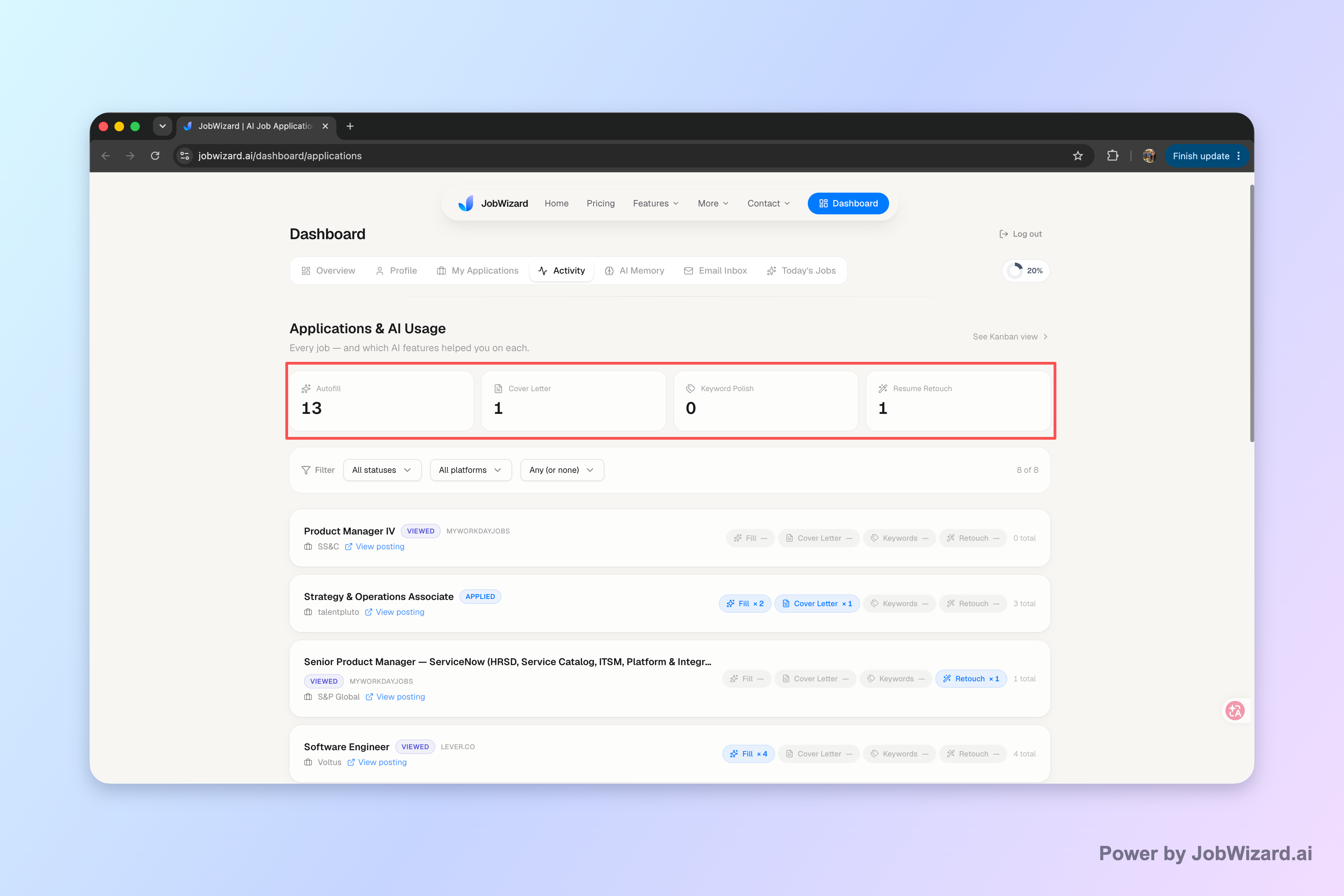
Pro tip: After you apply or interview, keep each application’s status and your next step in one activity view—so follow-ups don’t become guesswork. In JobWizard, the Activity view shows application status and which JobWizard tools were used for each role.
Use these samples sales interview follow up email templates (with subject lines)
Sales teams respond to clear, concise communication. Your follow-up should mirror that: one screenable paragraph, one specific reference, and one question about next steps.
1) First follow-up (24–48 hours after the sales interview)
Best for: Showing professionalism right away without sounding pushy.
Subject line options: Thank you — [Role] interview + next stepsThanks for your time, [Interviewer Name] — [Role]Great speaking today — [Role]
Email: Hi [Interviewer Name], Thank you for taking the time to speak with me about the [Role Title] position. I enjoyed our discussion about [specific topic you discussed—e.g., handling pipeline objections, qualification process, or a product pitch flow]. I’m especially interested in [company name] because [one sentence linking your background to the role]. If helpful, I can also share [any requested item—talk track, example, references, etc.]. Would you be open to sharing what the next step looks like and the expected timing for decisions? Best regards, [Your Name] [Phone] | [Email] | [LinkedIn]
2) Follow-up that references a specific “moment” (24–48 hours, but more memorable)
Best for: When you want to stand out by name-checking a detail.
Subject line options: Following up on our [topic] conversationQuick follow-up — [specific detail]
Email: Hi [Interviewer Name], Thanks again for your time today. I appreciated our conversation about [specific detail—e.g., how you evaluate deal velocity, how you coach reps through objections, or how you measure discovery quality]. Since we talked about [moment], I wanted to highlight [one short proof point—e.g., a campaign, quota attainment context, or sales process improvement] and how I’d apply that approach to [Role Title]. If there’s anything else you need from me to move forward, I’m happy to provide it. What are the next steps from here? Sincerely, [Your Name]
3) “Loop me in” follow-up (after 5–7 days)
Best for: Checking in politely when there’s been no response.
Subject line options: Checking in — [Role Title]Following up on [Role Title] interview
Email: Hi [Interviewer Name], I hope you’re doing well. I wanted to follow up on my interview for the [Role Title] position and see if there’s an update on next steps. I remain very interested in [company name], particularly around [relevant sales area from the interview]. If it’s easier, I’m happy to resend anything from my application. Is there a timeline you can share for the next stage? Thanks again, [Your Name]
4) Follow-up after no response for ~2 weeks (confident check-in)
Best for: A later-stage nudge that still feels professional.
Subject line options: Following up on [Role Title] — interview check-inAny update on next steps?
Email: Hi [Interviewer Name], I wanted to check in regarding the [Role Title] interview from [date]. I’m still very interested in the role and would welcome the chance to learn about the next steps when available. If the team is moving in a different direction, I’d appreciate any feedback—so I can improve for future roles. Either way, thank you for your time and consideration. Best regards, [Your Name]
If you want a dedicated version written for the “2 weeks later” moment, see Interview Follow-Up Email After 2 Weeks: A Confident Check-In That Gets Replies.
5) Short LinkedIn/email hybrid follow-up (for busy sales leaders)
Best for: When you need something fast and scannable.
Subject line options: Following up — [Role Title]Quick check-in
Email: Hi [Interviewer Name], Thanks again for the conversation about [Role Title]. I’m still excited about the opportunity—especially around [one topic]. Do you know what the next step/timeline looks like? I’m happy to provide anything you need. Thank you, [Your Name]
6) “I’m still interested—closing the loop” follow-up (later, optional)
Best for: When you want closure without burning the relationship.
Subject line options: Closing the loop — [Role Title]Still interested in [Role Title]
Email: Hi [Interviewer Name], I wanted to close the loop on my interview for the [Role Title] position. I remain very interested in the opportunity and would love to know whether next steps are still on the table. If you’ve moved forward with another candidate, I completely understand—thank you again for your time. Either way, I appreciate any update you can share. Sincerely, [Your Name]
For additional options, you can also adapt the guidance in Follow Up Thank You Email After Interview: The Message That Keeps You in the Loop.
Make your email “sales-real”: what to say (and what to avoid)
Sales interview follow-ups work best when they’re specific and action-oriented—not long and generic.
What to include for maximum relevance
- A specific reference to a topic from the interview (qualification, objections, discovery, forecasting, product fit, territory, or process).
- One clear proof point tied to that topic (a method you used, a sales motion you improved, or a result you can describe).
- A next-step question that invites a response (“What does the next stage look like?” “Is there anything else you need from me?”).
What to avoid
- Over-apologizing (“Sorry to bother you…”)—you’re not bothering anyone; you’re following up.
- Unclear asks (no “Just checking in” with no question). Always include one direct request or question.
- Compensation probing too early if the interviewer hasn’t raised it. In early follow-ups, prioritize fit and next steps.
Where tracking fits (so you don’t send the wrong follow-up)
When you apply to multiple roles, it’s easy to lose track of which interview belongs to which company, and when your last outreach was. Tracking prevents those mix-ups.
In JobWizard, the Activity view shows application status and which JobWizard tools were used for each role—so you can align each follow-up email to the correct stage and history.
If you want a systematic approach to timing and “what’s next,” read Interview Follow Up Email: A Tracking-First System That Gets You Seen (and Responded To).
Build your follow-up timeline (use this simple sequence)
A consistent timeline helps you stay professional and reduces the mental load of “Did I already email them?”
- Day 1–2: Send the first follow-up (thank you + specific reference + next-step question).
- Day 5–7: Send a brief check-in if you haven’t heard back.
- Day ~14: Send the 2-week style check-in (confident, still interested, optional feedback ask).
Important: Keep compensation and detailed negotiation for later conversations unless the interviewer introduces it first. Your early emails should focus on fit, momentum, and the next step.
Also, consider using your tracking system as your “source of truth.” If you want to connect interview follow-ups to the rest of your process, combine these timelines with How to Track Job Applications: A Practical System (JobWizard + Beyond).
How JobWizard supports your follow-up workflow (autofill + review-before-submit)
JobWizard helps you reduce the busywork between interviews—so you can spend your energy on the emails that need your voice.
What it does for your job search process
- Autofills repetitive application fields so you can move faster to the part that requires your judgment.
- Review-before-submit: you still review sponsorship/salary/EEO/custom questions before submitting.
- Tracks application activity so you can see status and what tools were used per role.
Why that matters for interview follow-ups
Follow-up timing is easier when you know what’s actually “in process,” what’s “under consideration,” and what you’ve already submitted. JobWizard’s Activity view is designed to keep that context visible.
JobWizard has run 720,000+ applications submitted and 600,000+ autofill sessions. It also autofills an average of ~18 repetitive fields per application (typically 11–23) and supports several common ATS platforms (with Workday where it tends to save the most time). Remember: repetitive fields are filled fast while you review key custom questions before submitting.
To make the most of your next interview follow-up, keep everything aligned: the role, the interview date, and the email template that matches where the process is right now.
Do this automatically with JobWizard
Skip the manual work — JobWizard's Application Tracker handles this for you.
FAQ: samples sales interview follow up email
When should I send a samples sales interview follow up email after a sales interview?
Typically send your first follow-up within 24–48 hours, then a second check-in after about a week if you haven’t heard back (and use the later “2 weeks” style email when it’s been 14 days).
What should I include in a sales interview follow up email besides gratitude?
Reference one specific moment from the interview (a metric, objection, product detail, or call flow you discussed), restate your fit for the role, and add a clear next step question like “Is there anything else you need from me to move to the next stage?”
Should I ask about salary or benefits in my first follow up?
Save compensation details for later stages or when the interviewer has opened the door. In the first follow-up, prioritize fit, next steps, and any follow-up materials (like examples or references).
How do I avoid sending the wrong follow up email to the wrong company or role?
Track each interview and application in one place, then align the email to the correct role and date (so you’re following up on what’s actually in progress).
Ready to send your next follow-up without losing track? Create and review your applications faster with JobWizard, then use the Activity view to keep each role’s status and next step in one place.
Frequently Asked Questions
Autofill your next job application
JobWizard is a free Chrome extension that fills applications, tracks statuses, and optimizes your resume.