Product Management Keywords: The Smart Checklist for Matching Any JD Without Guessing
Product management keywords help you translate any job description into a clear set of requirements—then you can tailor your resume and application with confidence. Learn exactly what to look for and how to use them.

Free Chrome extension
See your resume's match score for any job
JobWizard compares your resume to each job description and shows the exact keywords to add — free.
Why “product management keywords” decide how well you match a job description
Product management keywords are the exact terms a role uses to describe what you must do and what you must already know—so you can tailor your resume and application to the job, not just to a generic PM profile. When you mirror the job’s requirements clearly, you reduce the guesswork for the reader and you increase the chance your experience is recognized as relevant.
In practice, the highest-impact keywords usually fall into two buckets: responsibilities (what the PM will execute) and qualifications (what the PM must have done before). Your goal isn’t to “stuff” keywords—it’s to translate the job’s language into proof you can back up.
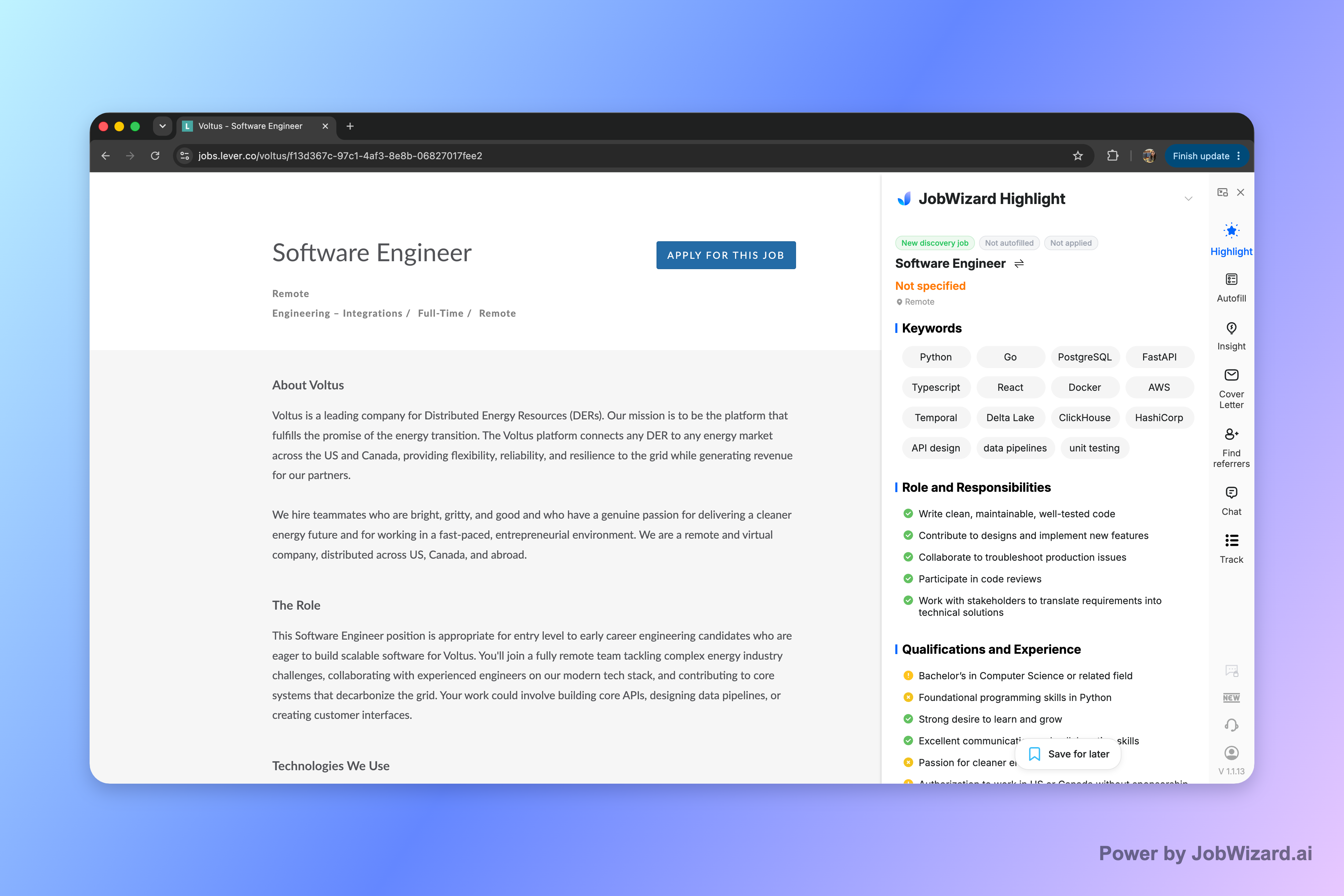
JobWizard can help you work faster by organizing a job description into keywords, role responsibilities, and qualifications so you can review the requirements more systematically before you apply. That structure makes it easier to extract the same product management keywords the posting emphasizes, without reading the entire page multiple times.
How to pull product management keywords from a PM job description (without missing the important ones)
Use a consistent extraction method so you collect the right product management keywords from every posting you target. The job description already signals what the hiring team cares about—your job is to capture it in a reusable list.
Step 1: Split the JD into “responsibilities” and “qualifications”
Most PM roles repeat their intent across two sections: what you’ll be responsible for day-to-day, and what qualifies you to do it. Treat these as separate keyword sets so you can tailor your resume bullets differently (execution vs. proof).
- Responsibilities keywords: discovery, requirements, roadmap, prioritization, launch, stakeholder management, experimentation, documentation.
- Qualifications keywords: years of PM experience, domain expertise, analytics/metrics, cross-functional leadership, technical fluency, product lifecycle experience.
Step 2: Capture the “verbs” and the “frameworks” the posting uses
In product management, the strongest keywords are often action verbs tied to a method. For example, instead of only collecting “strategy,” also capture “define,” “align,” “prioritize,” “validate,” “measure,” and “iterate.” These verbs show how the team expects you to work.
Look for framework-like terms too. Common ones include user stories, acceptance criteria, PRDs, OKRs, KPIs, A/B tests, and go-to-market. You don’t need to adopt their exact framework names everywhere—but using the same language where appropriate helps your resume reflect the role’s expectations.
Step 3: Add “scope” terms (what product area and what constraints)
Many PM job descriptions include scope keywords that narrow down the role. These can include B2B vs. B2C, platform vs. consumer app, APIs vs. integrations, payments vs. ads, or internal tools. Scope keywords are important because they signal the environment where you’ll need to deliver.
- Scope keywords: enterprise customers, developer platform, internal workflow tool, regulated domain, integrations, multi-tenant, performance/latency, reliability.
- Constraint keywords: timelines, compliance, scalability, risk management, data privacy, accessibility, experimentation limits.
Step 4: Confirm “must-have” vs. “nice-to-have” wording
Don’t treat every keyword as equally important. “Must” and “required” language usually maps best to your strongest resume bullets and the answers you give in your application.
A practical approach: highlight top “must” keywords and only add supporting ones after you’ve aligned your core experience. This keeps your resume and application truthful while still being targeted.
The product management keywords that show up most often in PM roles
While every company writes differently, most product management keywords cluster around the same competencies. Use this list as a starting point, then verify it against your target posting so you match the wording the hiring team uses.
Discovery, learning, and requirements
- Discovery keywords: user research, interviews, discovery, customer feedback, market research.
- Validation keywords: experiments, prototypes, pilots, surveys, usability testing.
- Requirements keywords: requirements, PRD, user stories, acceptance criteria, success criteria.
Strategy, roadmap, and prioritization
- Strategy keywords: product strategy, product vision, goals, alignment, market positioning.
- Roadmap keywords: roadmap, release planning, prioritization, trade-offs, sequencing.
- Execution keywords: planning, delivery, iteration, continuous improvement.
Metrics, analytics, and outcomes
- Measurement keywords: KPIs, metrics, analytics, reporting, dashboards.
- Outcome keywords: impact, adoption, retention, activation, conversion, engagement.
- Experiment keywords: A/B testing, cohort analysis, funnel analysis.
Cross-functional leadership and launch
- Collaboration keywords: cross-functional, stakeholders, GTM, sales/marketing alignment, engineering partnership.
- Launch keywords: go-to-market, rollout, enablement, stakeholder comms, adoption plan.
- Operational keywords: documentation, risk management, product governance.
Turn product management keywords into resume bullets (examples you can adapt)
Once you’ve extracted product management keywords from the job description, the next step is converting them into bullet points that prove you can do the work. Focus on one responsibility per bullet, and include evidence like scope, stakeholders, and measurement.
Example: Requirements → a clear, measurable delivery story
- Keyword-aligned bullet: “Led requirements for a new onboarding flow by translating customer feedback into a PRD and user stories with acceptance criteria; partnered with design and engineering to deliver a launch plan and tracked activation using funnel metrics.”
Notice what’s happening: the bullet mirrors requirements language (PRD, user stories, acceptance criteria) and adds proof (launch plan, metrics).
Example: Prioritization → trade-offs and decision-making
- Keyword-aligned bullet: “Owned roadmap prioritization by running weekly stakeholder reviews, using impact vs. effort trade-offs to sequence initiatives, and updating success criteria for each release based on KPI movement.”
This style demonstrates prioritization keywords while showing your method and how you measure effectiveness.
Example: Discovery → experimentation and validation
- Keyword-aligned bullet: “Drove discovery by conducting interviews and usability testing, then validated solutions through iterative experiments; reported learnings and recommended next steps using experiment results and adoption metrics.”
Here, discovery and validation keywords become a narrative: you learn → you test → you act.
Example: Launch and GTM → cross-functional execution
- Keyword-aligned bullet: “Coordinated cross-functional launch with marketing, sales, and support by creating enablement materials and rollout plans; monitored adoption and retention post-launch and iterated based on performance trends.”
Launch keywords often require process details (enablement, rollout plan, monitoring, iteration), not just “worked on launch.”
Use JobWizard’s JD Highlights to review product management keywords before applying
Job searching gets easier when you can quickly confirm whether you match the role’s responsibilities and qualifications. JobWizard’s JD Highlights is designed to help you do that review step systematically.
What to do during your pre-application review
- Open the target role and scan the job description for responsibilities and qualifications.
- Use JD Highlights to organize the content into keywords, role responsibilities, and qualifications.
- Create your “proof list” by mapping each key qualification to a specific example from your experience.
- Tailor your resume bullets so each bullet supports one of the role’s responsibilities using the same product management keywords where truthful.
- Answer application questions intentionally using the job’s language as a guide, then review everything yourself before submitting.
JobWizard helps you fill repetitive fields fast, while you review sponsorship/salary/EEO/custom questions before submitting—so your application still reflects your choices and details.
At the platform level, 720,000+ applications submitted and 600,000+ autofill sessions run through JobWizard. While these totals show broad usage, your best results still come from the final human review: Product management keywords are only useful if they accurately reflect what you’ve done.
Finally, remember the limitation: highlighted keywords and tailored content do not predict ATS decisions or hiring outcomes. They’re a tool to help you understand the role more clearly and present your experience in a way that aligns with the job’s stated needs.
Do this automatically with JobWizard
Skip the manual work — JobWizard's Smart Autofill handles this for you.
FAQ: Product management keywords
What are the most common product management keywords employers look for?
Most hiring teams expect a mix of product fundamentals and execution language—for example: product strategy, roadmap, requirements, discovery (interviews/experiments), user stories, prioritization, metrics/KPIs, launch, and cross-functional collaboration. Use the job description sections (responsibilities vs. qualifications) to collect the exact wording for your target role.
Do product management keywords guarantee ATS approval or getting interviews?
No. Keywords can help you reflect the role’s stated requirements, but they don’t guarantee ATS decisions or hiring outcomes. Always review what you submit and ensure the content is accurate to your experience.
How should I use product management keywords when tailoring my resume?
Extract keywords from the job description, then map them to proof points you can support (projects, launches, metrics, or process improvements). Update your bullet points so they mirror the role’s language in a truthful way, and keep the focus on what you did, what changed, and what you measured.
How do I find product management keywords quickly in a long job description?
Start by scanning for repeated requirement categories (responsibilities, qualifications, and any explicit job requirements). Then use JobWizard’s JD Highlights view to organize the description into keywords, role responsibilities, and qualifications so you can review them systematically before applying.
What should I do after collecting product management keywords?
Turn them into an action checklist: confirm you meet each qualification with a concrete example, align your resume bullets to the responsibilities, and answer any role-specific questions with your most relevant experience. Finally, review everything yourself before submitting.
Ready to apply with confidence? Open the product management role you’re targeting in JobWizard and use JD Highlights to review the product management keywords, responsibilities, and qualifications before you submit—so your application matches what the team actually asked for.
Frequently Asked Questions
See your resume's match score for any job
JobWizard compares your resume to each job description and shows the exact keywords to add — free.