Keywords for Project Management Resume: Build an ATS-Ready Skills List That Matches the JD
Learn how to choose keywords for project management resume success by mapping job descriptions to your scope, tools, deliverables, and outcomes—then review changes with JobWizard.

Free Chrome extension
See your resume's match score for any job
JobWizard compares your resume to each job description and shows the exact keywords to add — free.
If you’re applying for project management roles and your resume blends in, it’s often because your keywords for project management resume don’t reflect what the job description is actually asking for—at the level of tools, responsibilities, qualifications, and deliverables. The fix is not “stuffing” words. It’s mapping the JD to the way you’ve managed projects, documented progress, handled risks, coordinated stakeholders, and delivered results.
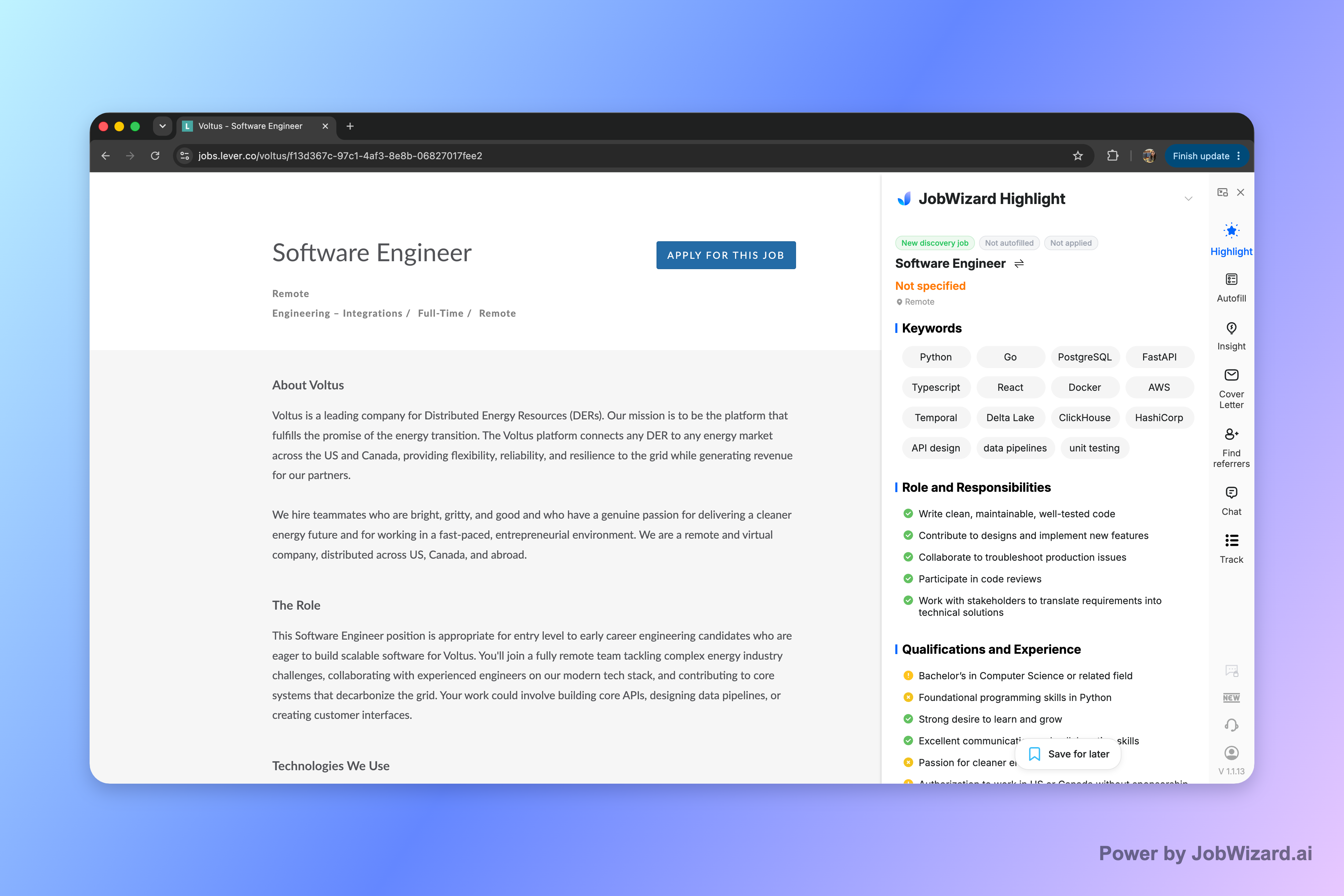
JobWizard helps you do that mapping more systematically: you can turn a job description into a structured view of the role’s key requirements, so you can review responsibilities and qualifications with the right lens.
Start by extracting keywords directly from the job description
Use the job description as your keyword source of truth so your project management resume mirrors the role’s responsibilities and qualifications. That approach is more reliable than guessing which “project manager keywords” might be popular.
When you read the posting, don’t skim for the title (e.g., “Project Manager” vs. “Program Manager”). Instead, look for the repeated requirement patterns that signal what hiring teams will screen for. These often appear in sections labeled responsibilities, qualifications, job requirements, or similar headings.
What to capture: responsibilities, qualifications, and tool references
To build strong keywords for project management resume content, collect three categories of terms from the JD:
- Responsibilities terms: what you’re expected to do day-to-day (planning, execution, reporting, stakeholder alignment).
- Qualifications terms: what you must demonstrate (years of experience, certifications, domain knowledge, leadership behaviors).
- Tool and process terms: what systems or methods the team uses (Jira, MS Project, Agile/Scrum, RAID logs, SDLC artifacts, etc.).
JobWizard’s JD-focused view is designed specifically to organize those requirements so you can review them systematically. The goal is clarity—not magic prediction. You’re building a resume that matches the job’s language where you truly have the experience.
Example: turn a JD into a keyword checklist
Here’s a practical mini-workflow you can repeat for each application. Use the job posting to create a checklist you’ll later mirror in your resume bullets.
- List the planning keywords: e.g., project planning, schedules, milestones, deliverables, resourcing.
- List the execution/control keywords: e.g., RAID management, change control, progress tracking, governance.
- List the communication keywords: e.g., status reporting, steering committees, executive updates.
- List the collaboration keywords: e.g., stakeholder management, cross-functional coordination, vendor management.
- List the methods/tools keywords: e.g., Agile, Scrum, Kanban, Jira, Confluence, MS Project, Smartsheet.
- List the evidence keywords: e.g., “scope,” “requirements,” “acceptance,” “implementation,” “launch,” “post-mortem.”
After you build the checklist, you’ll translate it into resume sections that hiring managers and keyword filters can both interpret.
Place your project management keywords in the right resume sections
Keywords work best when they’re placed where resumes explain your work, not just where they appear. The highest-signal sections for project management keywords for project management resume are usually Summary, Skills, and your project/role bullets.
Think like a reviewer: they’re looking for evidence of competence, ownership, and methods. Think like a filter: they’re looking for recognizable terms that align with the JD. Your job is to connect both through specific language.
Summary: use capability keywords, not a generic objective
Your summary should read like a tight capabilities statement. Include 4–6 project management capabilities pulled from the JD categories above, such as planning, risk management, stakeholder leadership, and reporting. Keep it specific—avoid vague phrases like “hardworking team player.”
Example summary pattern (customize to your experience): “Project Manager with experience leading cross-functional delivery using Agile and structured governance. Skilled in project planning, RAID tracking, stakeholder communication, status reporting, and coordinating requirements and acceptance.”
Skills section: mirror tools and process terminology
Your skills section is where “keywords for project management resume” becomes most visible. But don’t create an arbitrary list of buzzwords—create a list that reflects what’s in the JD and what you can defend.
- Tools: Jira, MS Project, Asana, Trello, Smartsheet, Confluence (only include what you’ve used).
- Methods: Agile/Scrum/Kanban, Waterfall, hybrid delivery (only include what matches your projects).
- Core PM practices: risk management, change control, scope planning, milestone tracking.
- Reporting: executive status reports, dashboards, KPI tracking.
- Stakeholder work: steering committees, cross-functional coordination, vendor collaboration.
Experience bullets: turn keywords into proof
Most of your resume credibility comes from bullets that show ownership and outcomes. A strong bullet connects a keyword to what you did (action) and what happened (result). Even without publishing numbers, you can still show deliverables and governance behavior.
Bullet formula for PM roles: Action + scope + artifact/process + stakeholders + cadence + outcome type.
- Example: “Built and maintained project schedules and milestone plans; tracked progress in Jira and updated status reporting for cross-functional stakeholders through weekly reviews.”
- Example: “Managed RAID (risks, assumptions, issues, dependencies), facilitated change control, and escalated items to governance to keep delivery on track.”
- Example: “Coordinated requirements gathering and acceptance criteria with business and engineering teams; documented implementation handoffs and launch readiness checks.”
If you’re worried about sounding repetitive, vary the angle: sometimes you emphasize governance, sometimes communication, sometimes execution planning. The keyword still shows up—but the bullet proves you actually did the work.
Use a gap-review process to refine keywords without overstating experience
Tailoring is safer when you treat it as a review loop—you incorporate what’s missing, and you remove anything you can’t support. This is especially important for project management roles because postings often include very specific responsibilities and qualifications.
JobWizard’s insight-style workflow can compare a selected resume with the current job description and present a match score, an overall assessment, and improvement suggestions. It can also identify resume expression gaps and turn them into an editable resume revision draft.
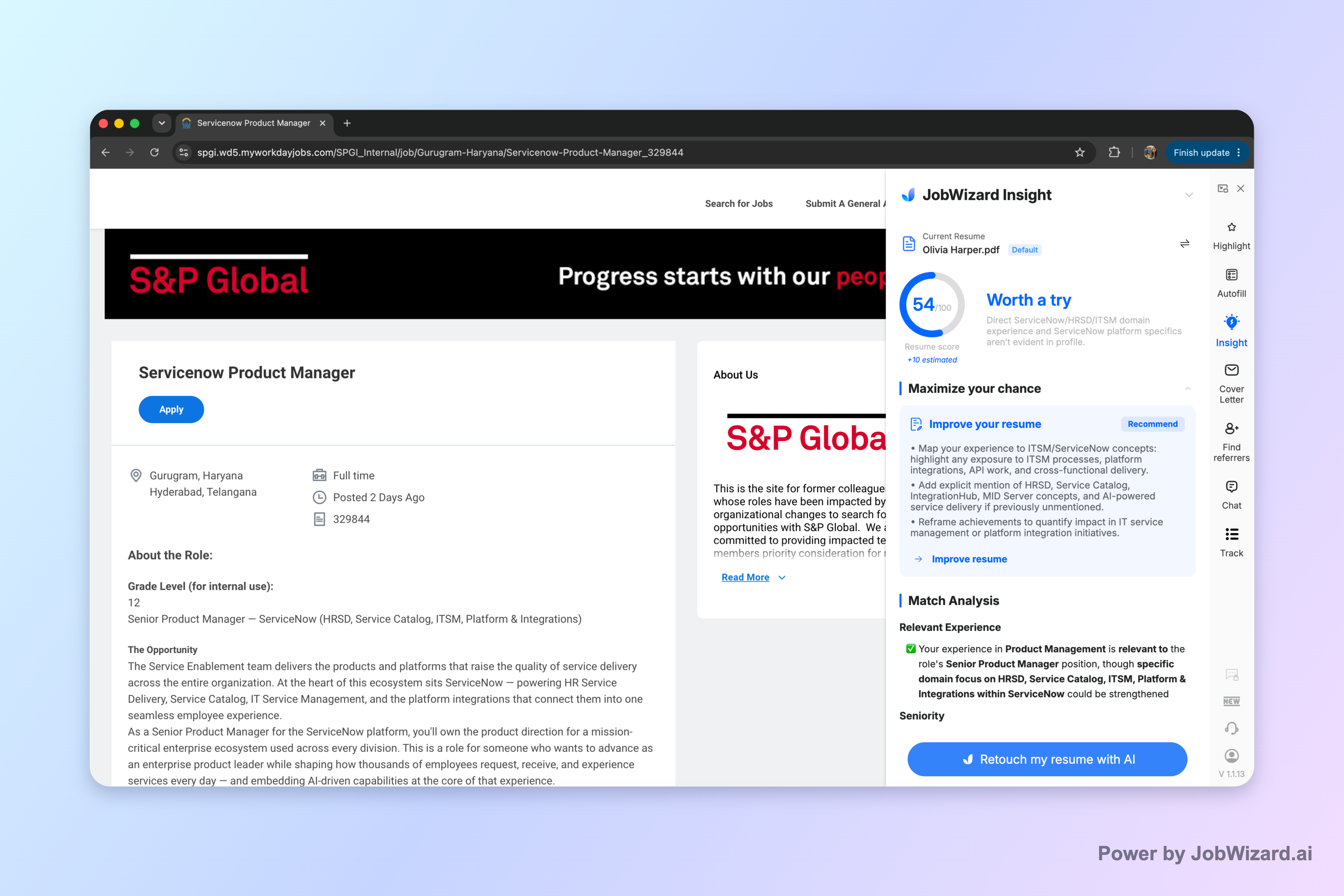
Use that output as a guide for what to look at next, not as a substitute for accuracy. As a reminder, the score is not a hiring probability and does not guarantee ATS passage or an interview. You must verify every suggested resume change and keep only accurate experience.
How to review a keyword gap like a PM
When you review suggested edits, follow a “requirements to deliverables” mindset: the JD keyword is a requirement, and your resume bullet is the deliverable that shows you meet it.
- Confirm the JD requirement: identify what the keyword actually implies (e.g., risk tracking vs. risk mitigation ownership).
- Map to your real work: find the project where you did it, and which artifacts/process you used.
- Rewrite as evidence: update the bullet to show action, scope, cadence, and stakeholders.
- Remove unsupported terms: if you can’t defend the detail, don’t include the keyword in a way that misrepresents your experience.
- Keep the resume coherent: ensure the revised bullets fit the role narrative and don’t create contradictions.
Common keyword gaps in project management resumes
Many candidates have the experience but miss the exact expression the JD uses. Typical gaps include:
- Process language: “RAID management” vs. generic “tracked risks.”
- Governance language: “steering committee updates” vs. “regular updates.”
- Execution language: “change control” vs. “managed scope.”
- Documentation language: “acceptance criteria” vs. “requirements work.”
- Tool language: “Jira dashboards” or “MS Project scheduling” vs. “project tracking.”
The fix is to translate your experience into the JD’s terminology where you can honestly say you used the method or owned the responsibility.
Keyword examples for project management resumes (customizable blocks)
Steal these keyword blocks as templates and customize them to the exact job posting—your best results come from mirroring the JD’s responsibility themes and tool references.
Below are keyword groupings you can paste into a draft resume and then refine. Adjust the tool list and the methods to match your background.
Planning & delivery keywords
- Project planning, milestones, deliverables, schedules, dependency planning, resourcing coordination
- Scope definition, work breakdown structure (WBS), roadmap management
- Implementation planning, launch readiness, acceptance coordination
Risk, change, and controls keywords
- Risk management, RAID log, mitigation planning, issue escalation
- Change control, scope control, governance reviews, constraint tracking
- Quality checks, compliance coordination (only if applicable to your roles)
Stakeholder & communication keywords
- Stakeholder management, cross-functional alignment, executive communication
- Status reporting, steering committee updates, meeting facilitation
- Requirements communication, decision tracking, action items and follow-ups
Tools & methods keywords
- Agile/Scrum/Kanban, sprint planning, backlog management, iterative delivery (match what you’ve done)
- Jira, Confluence, MS Project, Asana, Smartsheet, Trello (choose tools you used)
- Project dashboards, KPI tracking, progress monitoring
How to avoid keyword “fake-outs”
Keyword tailoring can go wrong if you include terms you didn’t do. A safe standard is: include a keyword only when your bullet can truthfully show the responsibility, the process, and the context.
Quick self-check for each keyword you add: “Could I describe a specific project where I owned this?” If the answer is no, rewrite it to reflect what you did—or remove the term.
JobWizard workflow is designed for autofill + review-before-submit: repetitive fields can be filled fast while sponsorship/salary/EEO/custom questions are left for you to review before submitting.
Do this automatically with JobWizard
Skip the manual work — JobWizard's Match Score handles this for you.
FAQ: keywords for project management resume
Get quick answers to the most common questions about writing and placing project management resume keywords.
What keywords should I put on a project management resume?
Use keywords that match the job description’s scope and responsibilities—e.g., project planning, stakeholder management, risk management, scheduling, reporting, and tools like Jira, MS Project, or Asana—then confirm each item is truthful to your experience.
How do I find the right keywords for a project management role in a job description?
Scan the job description for repeated requirement themes (qualifications, responsibilities, and “requirements” sections), then organize them into a shortlist you can mirror in your resume’s Summary, Skills, and relevant bullets.
Should I use the same keywords exactly as the job description?
Match the meaning first and use the same terminology when it reflects your real experience. If a term appears in the JD but you haven’t done that specific task or tool, revise only what you can support.
Can I rely on an ATS match score to know if I’ll get interviews?
No—an insight-style match score is not a hiring probability and does not guarantee ATS passage or an interview. Use it as a prompt to review gaps and rewrite responsibly.
How should I update my resume after I tailor it with keywords?
Treat tailoring as a review process: keep what’s accurate, rewrite bullets to show the same capabilities the JD asks for, and verify details like scope, tools, and ownership before you submit.
How to take action today with JobWizard
Turn your next application into a keyword-matched draft by using JobWizard to structure the job description and then compare it against your resume for gaps. Open the target role, review its responsibilities and qualifications, and tailor your Summary, Skills, and experience bullets so your keywords for project management resume reflect what the employer is requesting—without overstating your experience.
When you’re ready, use JobWizard’s JD highlight and insight-driven review flow to identify what to adjust, verify each suggested change, and then submit with confidence that your resume language is aligned to the specific project management role.
Frequently Asked Questions
See your resume's match score for any job
JobWizard compares your resume to each job description and shows the exact keywords to add — free.