Manager Keywords That Get Noticed: Turn JD Requirements into Strong Interview-Ready Answers
Learn how to use manager keywords—taken directly from job descriptions—to sharpen your resume bullet points and interview answers, with a system you can repeat.
Free Chrome extension
See your resume's match score for any job
JobWizard compares your resume to each job description and shows the exact keywords to add — free.
Why “manager keywords” matter more than generic resume phrases
Most job seekers aiming at management roles do the same thing: they write a resume using broad leadership words—“team player,” “results-driven,” “strong communicator”—and hope it matches what the hiring team wants. The problem is that management jobs are evaluated against role-specific expectations, not just generic qualities. That’s where manager keywords come in: the exact responsibility and qualification terms the job description uses, expressed in language you can mirror and then prove with concrete examples.
If you’re not pulling those terms from the posting, you’ll often miss subtle but critical signals—like how the team defines ownership (end-to-end vs. partial), what kind of stakeholders you’ll manage, or which leadership behaviors they treat as must-have. Your goal isn’t to stuff your resume with terms; it’s to create a clear alignment between your experience and the manager role the company is actually hiring for.
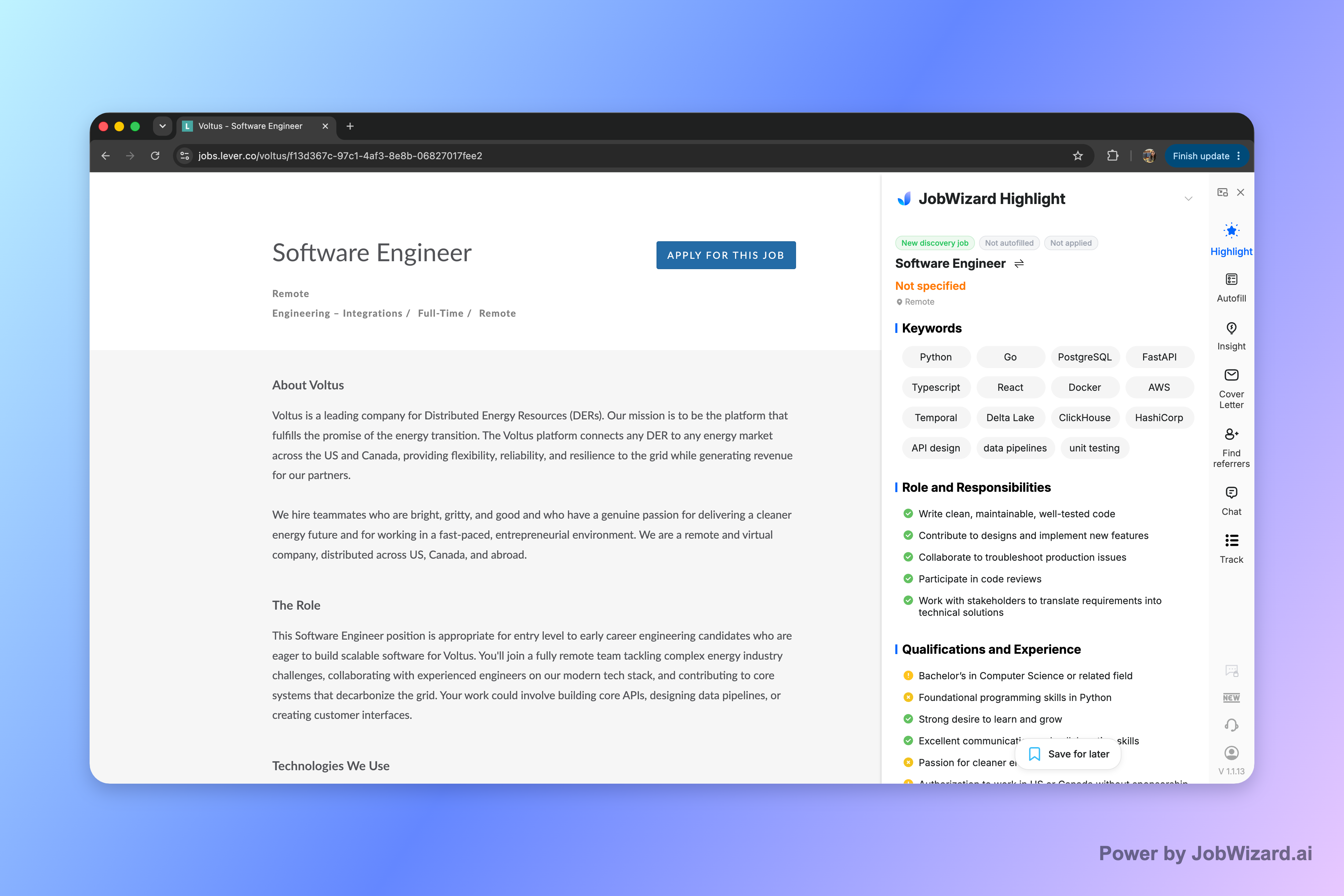
JobWizard turns a long job description into a structured view of the role's key requirements.
Extract manager keywords from the job description (and organize them so you can use them)
“Manager keywords” are most useful when you treat them like a checklist you’ll actively map to your experience. Start with the job description and break it into the three buckets hiring managers look for:
- Keywords (the terms that repeatedly show up and summarize the role’s focus)
- Role responsibilities (what you’ll actually do day to day)
- Qualifications (what they require or strongly prefer)
This is exactly the sort of structured review that helps you avoid guesswork. Instead of scanning the posting once and hoping your resume “feels right,” you can systematically review what the company claims the manager must do and then draft bullet points that directly correspond.
What “good” manager keyword sourcing looks like
Use the job description as your primary source of truth. When you’re extracting manager keywords, look for patterns in:
- Responsibilities: coaching team members, owning delivery, improving processes, managing escalations, collaborating cross-functionally, building roadmaps, forecasting, reporting metrics
- Qualifications: years of experience managing people, specific domain knowledge, leadership competency, project/program management, stakeholder management, analytics, compliance, or tools
- Requirements phrasing: “must,” “required,” “preferred,” “experience with,” “ability to,” “demonstrated”
Tip: don’t only capture individual words. Capture short phrases and skill bundles that represent how the employer thinks about the work. For example, “cross-functional stakeholder management” is often more valuable than “stakeholder management” alone because it reflects the scope the posting emphasizes.
Turn the posting into a simple manager-keyword map
Create a one-page mapping document (paper, notes app, or spreadsheet). For each requirement theme, capture:
- Keyword/theme (the phrase from the job posting)
- Your proof (a specific project, metric, process, or responsibility you owned)
- Your “how” (what you did: cadence, tools, communication method, leadership behavior)
- Where it goes on your resume (summary, current role, past role, skills section, or cover letter)
This workflow will keep you honest: you only include manager keywords that you can support with real examples, which improves both accuracy and credibility.
Rewrite your resume using manager keywords—without keyword stuffing
Once you have your manager-keyword map, the next step is to rewrite your resume so the alignment is obvious to both humans and automated screeners. Done well, this makes your resume feel specific—like it was written for this exact job—without inventing achievements.
Resume structure that naturally supports manager keywords
Use these locations to place your strongest keyword-aligned proof:
- Summary: 2–3 lines that capture your management style and the role focus (e.g., team coaching + delivery ownership + stakeholder management)
- Experience bullets: 4–6 bullets per role, each mapped to a job responsibility theme
- Skills/Competencies (optional): include keyword themes that are truly central to the role, not everything you’ve ever touched
Bullet formula for manager keywords (use this repeatedly)
When you write bullets, use a consistent formula so each keyword theme becomes evidence, not empty language:
- Action: what you did (owned, led, coached, implemented, improved, negotiated)
- Scope: team size, scope of work, type of stakeholders (only if truthful)
- Method/cadence: how you executed management responsibilities (weekly 1:1s, delivery reviews, escalation process)
- Outcome: results or impact (use numbers if you have them; if you don’t, describe impact clearly)
Example rewrite (illustrative—adapt to your facts):
- Job description theme: process improvement
- Weak bullet: “Improved processes to increase efficiency.”
- Stronger bullet: “Led a process improvement initiative across cross-functional teams by redesigning the escalation workflow and implementing weekly quality reviews; reduced rework and improved throughput.”
Notice how the bullet mirrors the employer’s responsibility framing, using the core manager keyword theme (“process improvement”) while adding the “how” that makes it believable.
How to avoid the biggest resume mistake: mismatched keyword claims
Be careful with keywords that imply capabilities you don’t actually have. The goal is relevance, not inflation. If a job posting requires, for example, a specific type of forecasting or a specific domain tool, you should:
- Use the closest truthful version of the skill you do have
- Explain the context (scope, maturity of process, constraints)
- Leave out anything you can’t honestly support
This keeps your application coherent, reduces interview friction, and prevents you from being “caught” on details during technical or leadership discussions.
Use manager keywords to prep interview answers that sound like the job
Manager keywords don’t stop at your resume. Interviews are where the hiring team tests whether your leadership approach matches their expectations. If you translate the job description themes into your interview stories, you’ll sound prepared and aligned.
Map manager keywords to your STAR stories
Choose 4–6 stories that cover your strongest management themes. For each story, align it to a responsibility keyword from the posting.
For example, if the job description emphasizes:
- Stakeholder management: build one story where you coordinated across teams and handled conflicts
- Coaching: build one story involving skill development, performance improvement, or onboarding
- Delivery ownership: build one story showing how you managed timelines, risks, and tradeoffs
- Escalations: build one story explaining how you handled risks and protected the team
When you answer, include the same “manager vocabulary” the job description uses—then add your specific evidence.
Turn keyword themes into ready-to-speak phrases
Instead of memorizing full responses, memorize compact phrases that reflect management keywords clearly. Examples:
- “I run leadership cadence with weekly reviews and structured 1:1s to keep priorities visible.”
- “For stakeholder alignment, I translate goals into shared deliverables and confirm decision owners early.”
- “When priorities change, I reset risk assumptions and re-plan with the team so execution stays stable.”
These phrasing templates help you stay crisp under pressure while staying aligned to the job’s expectations.
What not to do with manager keywords in interviews
- Don’t recite buzzwords—use them as signposts, then prove them.
- Don’t ignore “must-have” themes—if the posting emphasizes a leadership responsibility, you should address it directly.
- Don’t assume ATS-style keyword matching equals hiring success—your interview content is where you demonstrate judgment, communication, and leadership behavior.
Important: JobWizard can organize job descriptions into keywords, role responsibilities, and qualifications so you can review requirements more systematically. Don’t claim or assume that highlighted keywords predict an ATS decision or hiring outcome.
Do this automatically with JobWizard
Skip the manual work — JobWizard's Smart Autofill handles this for you.
Manager keywords vs. leadership “tone”: how to balance alignment with authenticity
It’s tempting to treat manager keywords as a checklist that replaces your voice. But the best management resumes and interview answers combine two things:
- Alignment to the company’s role expectations (manager keywords from the job description)
- Authenticity in how you describe your actual work and leadership style
A good test: if you removed every keyword phrase, would your resume still clearly show you did the work? If the answer is no, you’re probably leaning too hard on matching language rather than evidence. If the answer is yes, the keywords are supporting clarity—not replacing it.
A quick self-audit checklist
Before you submit, review your resume and interview notes against this checklist:
- For each major manager keyword theme, do you have at least one concrete example?
- Do your bullets describe how you led (cadence, process, decision-making), not just what you achieved?
- Does your summary reflect the role’s real focus (as described in the job posting)?
- Have you left room for sponsorship / salary / EEO / custom questions to be reviewed by you before submission? (This is especially important whenever your application workflow includes automation.)
Comparison table: how to use manager keywords across documents
| Where you use manager keywords | Best use | Main risk |
|---|---|---|
| Resume summary | Signal management focus and leadership style in 2–3 lines | Sounding generic if you don’t mirror the role’s responsibilities |
| Experience bullets | Map responsibilities and qualifications to specific proof | Keyword stuffing without evidence |
| Interview STAR stories | Use the same requirement themes, then explain decisions and leadership behavior | Buzzword recitation without details |
| Cover letter (if you use one) | Reinforce “why you” using 1–2 key responsibility themes | Restating your resume instead of adding perspective |
How JobWizard fits into a manager-keyword workflow
If you’re applying to multiple management roles, the hardest part is staying consistent: pulling the right themes from each job posting and then rewriting your content fast. JobWizard helps by organizing the job description into keywords, role responsibilities, and qualifications so you can review the requirements more systematically. Then you do the final work—rewriting your resume bullets and interview answers based on your real experience—before submitting your application yourself.
Best next step: open the target role you want, review the responsibilities and qualifications it lists, and use the manager keywords you identify as your mapping guide for resume bullets and interview stories.
Ready to work with manager keywords faster? Open your target job posting in JobWizard, review the responsibilities, qualifications, and keywords it organizes, and then rewrite your resume and interview notes to match those role-specific themes before you apply.
FAQ: Manager keywords
What are manager keywords, and where do I find them?
Manager keywords are the recurring terms and phrases in a job description that describe the manager’s responsibilities and qualifications—like coaching, stakeholder management, forecasting, process improvement, or specific leadership competencies. The best source is the target role’s job description itself, where you can pull responsibilities, qualification themes, and requirement phrases directly from the posting.
Do manager keywords help with ATS?
Manager keywords can help you align your resume language with what the job description asks for, which is often important for screening. However, you shouldn’t assume highlighted or matched keywords guarantee an ATS decision or hiring outcome. Use them to improve relevance, then review and customize your content so it’s truthful and specific to you.
How many manager keywords should I include on my resume?
There’s no single perfect number. A practical approach is to identify the most repeated or most important requirement themes in the job description and reflect them across your resume where they fit naturally—especially in the summary and role-specific bullet points. Prioritize relevance over stuffing.
What if my experience doesn’t match every manager keyword in the job posting?
Use the job description to find keyword themes, then map your closest real evidence to each theme—even if the scope differs. You can also add clarifying context (scale, tools, constraints) so the reader understands your closest match. If there’s a keyword you truly don’t have, don’t fabricate; instead, emphasize adjacent skills you do have.
How can JobWizard help me work with manager keywords from a JD?
JobWizard can organize a job description into keywords, role responsibilities, and qualifications so you can review the requirements more systematically. You can then rewrite your resume bullets and interview answers using the same requirement themes—while still leaving sponsorship, salary, EEO, and any custom questions for you to review before submitting.
Frequently Asked Questions
See your resume's match score for any job
JobWizard compares your resume to each job description and shows the exact keywords to add — free.