Keywords for Sales Executive: A Targeted Vocabulary That Wins Interviews
Use keywords for sales executive roles to mirror what hiring teams look for—without guessing. Learn how to extract, organize, and apply role-specific terms.

Free Chrome extension
See your resume's match score for any job
JobWizard compares your resume to each job description and shows the exact keywords to add — free.
If you’re searching for keywords for sales executive roles, you’re probably tired of one-size-fits-all advice—because sales jobs don’t hire “generic salespeople.” They look for specific revenue behaviors, leadership proof, and the exact capabilities tied to that company’s product motion.
In this guide, you’ll learn how to build a practical keyword set for a sales executive application using the job description as your source of truth, then map each term to bullets you can defend in an interview.
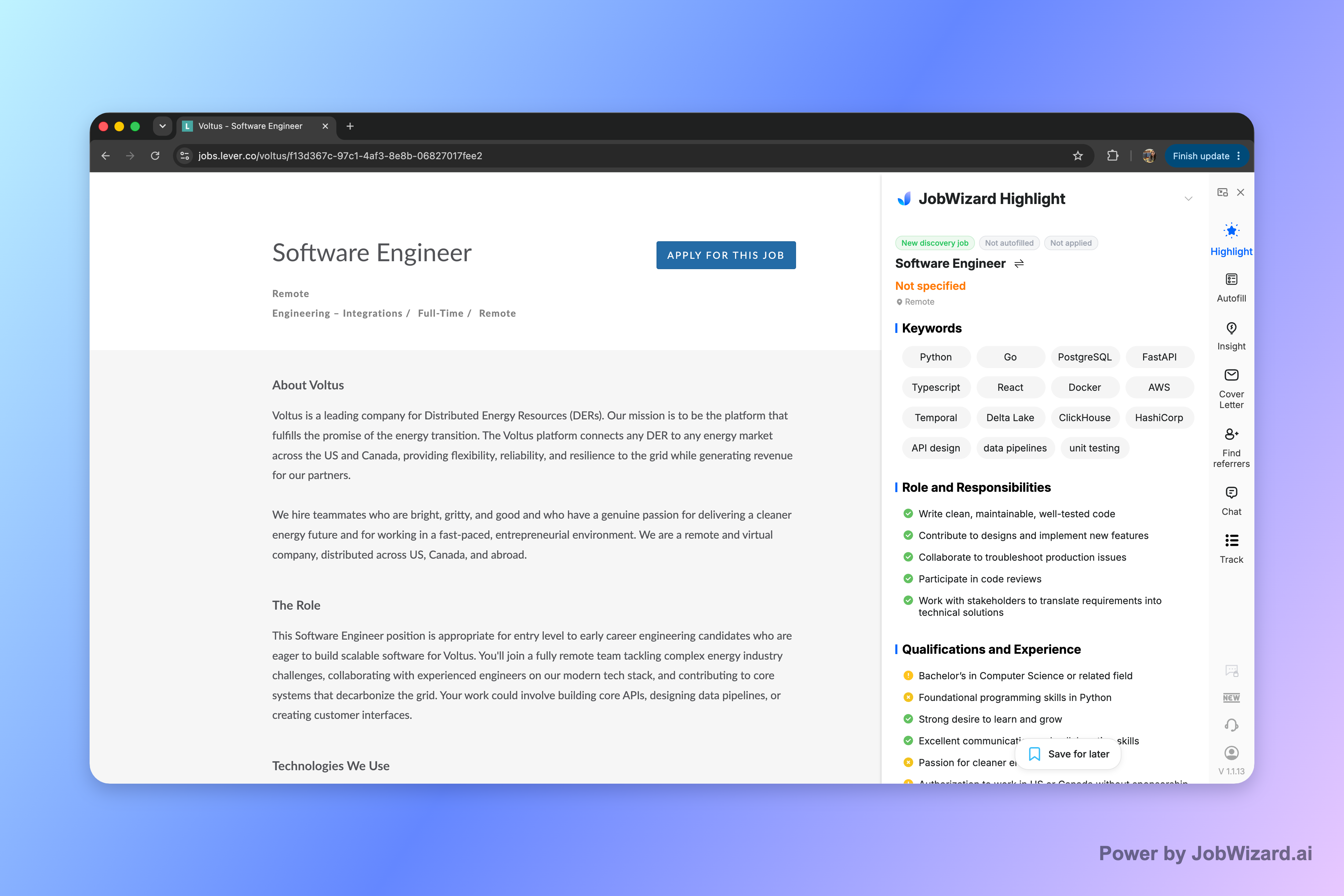
JobWizard can help you turn a long job posting into a structured view so you can review the role’s requirements more systematically—keywords, responsibilities, and qualifications—before you apply.
Start with the job description: build your “sales executive keyword” shortlist from requirements
Your best keywords come directly from the posting’s responsibilities and job requirements. Don’t guess—use the company’s own language to find the pattern of what “good” looks like for that specific sales executive role.
When you read a sales executive job description, categorize items into two buckets: what they want you to do (actions) and what outcomes they expect (results). That’s where the most useful keywords for sales executive applications actually live.
What to extract (and what to ignore)
- Actions: terms tied to selling activities (discovery, demos, closing, deal structuring, negotiations, stakeholder management).
- Outcomes: revenue-focused targets and proof language (quota, pipeline creation, bookings, forecast accuracy, revenue growth, retention).
- Requirements: qualifications and tools that signal fit (CRM, sales methodology, leadership experience, industry knowledge).
- Nice-to-haves: anything optional—keep it, but don’t let it dilute your core keyword alignment.
Quick example: how the keyword set emerges
Imagine the posting says the sales executive will “own a territory,” “run discovery,” “manage a full-cycle sales cycle,” “forecast in CRM,” and “collaborate with marketing and product.” Your keyword shortlist might include:
- territory ownership
- full-cycle sales
- discovery
- forecasting in CRM
- cross-functional collaboration
Now you can tailor your resume bullets around those terms without stuffing irrelevant phrases.
Use keyword clusters that match how sales teams evaluate executives
Hiring managers don’t just scan for “sales” words—they scan for clusters that signal revenue leadership, pipeline discipline, and execution maturity. Build your resume keyword strategy around clusters, not individual phrases.
Below are practical clusters you can adapt to the role you’re applying for. Pick the cluster terms that match the posting’s responsibilities and qualifications.
Cluster 1: Pipeline creation & deal motion
- pipeline generation
- prospecting / outbound / inbound conversion
- lead qualification
- deal cycle management
- stage progression (e.g., qualification → proposal → negotiation)
Cluster 2: Closing, negotiation & commercial skills
- closing
- negotiation
- commercial terms
- contracting / procurement collaboration
- objection handling
Cluster 3: Forecasting, metrics & pipeline hygiene
- forecasting
- quota attainment language
- CRM hygiene
- weekly / monthly reporting
- pipeline coverage
Cluster 4: Account ownership & retention signals
- account management
- renewals / retention
- expansion (upsell/cross-sell)
- customer success collaboration
- stakeholder mapping
Cluster 5: Leadership & cross-functional influence
- sales leadership
- mentoring / coaching
- team collaboration
- cross-functional alignment (marketing, product, finance)
- executive stakeholder management
Use the keyword cluster that matches the posting’s emphasis. If it’s heavy on forecasting and CRM reporting, lean into that cluster; if it’s heavy on negotiations and closing, foreground commercial terms.
Turn keywords into proof: write bullets that “justify” each sales executive term
Keywords for sales executive roles matter most when they’re backed by specifics. Your resume should make each keyword feel like an evidence-based conclusion, not a tagline.
Use a simple bullet formula: Action + Method + Result, where “Method” includes the terms from the job posting and “Result” includes measurable or clearly described outcomes.
Bullet templates you can tailor
- Pipeline build: “Built and managed pipeline using [job’s methodology/tools] to support [quota/outcome].”
- Full-cycle execution: “Owned full-cycle deals from discovery to negotiation, aligning [stakeholders/functions] to close [type of deals].”
- Forecast discipline: “Owned forecasting and reporting in CRM, improving visibility into stage progression and coverage for [time period].”
- Account strategy: “Led account plans for [customer type], driving expansion/renewals through stakeholder mapping and value messaging.”
- Leadership leverage: “Coached sales team members on [skills], improving execution consistency across the territory.”
Concrete example: rewriting a generic bullet
Generic (too vague): “Responsible for generating new business and meeting targets.”
Tailored with keyword anchors: “Generated new pipeline through structured prospecting and discovery, progressed deals through defined stages, and supported quota attainment by maintaining CRM hygiene and forecast accuracy.”
That version uses likely keywords for sales executive postings—pipeline generation, discovery, deal stages, quota language, CRM, forecasting—without resorting to keyword dumping.
Match the sales executive job’s “qualifications” section
When you see qualifications like “X years in enterprise SaaS” or “experience with consultative selling,” translate them into your resume claims. If you don’t fully match a qualification, don’t fake it—bridge with the closest relevant evidence and use your cover letter to explain the overlap.
Remember: highlighting relevant requirements is about clarity and fit, not about predicting outcomes.
Common keyword mistakes that quietly hurt sales executive applications
Most keyword problems aren’t missing words—they’re misalignment between what the job asks for and what your bullets prove. Here are the pitfalls to avoid.
- Copying slogans instead of responsibilities: “Hard-working team player” doesn’t map to pipeline, forecasting, negotiation, or leadership.
- Overloading with broad sales words: “sales, revenue, growth” are vague unless you connect them to deal motion and metrics.
- Ignoring the CRM/tool requirements: if the posting calls out CRM or reporting, make sure your bullets explain what you did, not just that you used it.
- Mixing up buyer vs. user value: enterprise sales often requires stakeholder mapping and executive alignment—mirror that if it’s in the JD.
- Listing keywords without execution detail: keywords should appear where your story explains them (not in a standalone list).
How to self-check before applying
- For each major keyword cluster in the posting, ask: Do I have at least one bullet that proves it?
- Do my bullets include the role’s “shape of work” (discovery → deal motion → negotiation/closing → forecasting/reporting)?
- Are my metrics truthful and specific—or am I using vague claims where numbers should be?
Apply strategically: tailor your “keywords for sales executive” set for each role, fast
Tailoring doesn’t have to be a multi-day rewrite. Your goal is to tailor keywords and proof where the hiring team is likely to look first: responsibilities, qualifications, and your top accomplishments.
Here’s a workflow you can use for each sales executive job posting.
A repeatable tailoring workflow (15–30 minutes)
- Extract keywords: pull the posting’s requirements into a shortlist (keywords for sales executive fit).
- Choose 5–10 anchors: pick the terms that describe outcomes and activities most central to the role.
- Map anchors to bullets: revise 3–5 achievement bullets so each anchor shows up where you explain your execution.
- Confirm “qualifications” coverage: ensure your resume reflects the years/experience type/tools or provides an honest bridge.
- Review-before-submit: check that sponsorship/compensation/EEO/custom questions (if present) are accurate and left for your review before submitting.
If you’re applying at scale, the volume can creep up quickly. JobWizard is built for autofill + review-before-submit workflows—so repetitive fields get filled fast while you keep control of the application content.
Across all applications submitted through JobWizard, 720,000+ applications have been submitted and 600,000+ autofill sessions have run. JobWizard autofills an average of ~18 repetitive fields per application, typically 11–23, and most submissions go through Workday (~65%), followed by Greenhouse (~19%), Ashby (~12%), and Lever (~4%). You still review and submit yourself, especially for sponsorship / salary / EEO / custom questions.
In other words: treat your keyword set as the “story core,” and use tools to speed up the mechanical parts—then invest your time in the resume bullets that match the job description.
Do this automatically with JobWizard
Skip the manual work — JobWizard's Match Score handles this for you.
FAQs about keywords for sales executive resumes and applications
How many keywords for sales executive roles should I include on my resume?
Aim to include only the keywords you can back up with real experience. Use a handful of the most relevant terms from the job description, then reinforce them across your bullets (not in one keyword dump).
What are the best keywords for a sales executive resume if I’m changing industries?
Focus on revenue-driving skills that transfer across industries—like pipeline generation, account management, discovery, deal cycles, forecasting, and cross-functional collaboration. Then pair them with industry-adjacent proof (metrics, tools, or customer types) you can genuinely claim.
Should I copy the job description’s exact keywords word-for-word?
You can mirror phrasing, but prioritize matching meaning. Rewrite in your voice (and with your metrics), while using the job description terms as anchors in your most relevant bullets.
How do I find the right keywords for a sales executive job posting quickly?
Start by reading the job requirements and responsibilities, then extract the terms that describe outcomes and activities (pipeline, quota, forecasting, stakeholders, deal stages). Organize them into a shortlist you can check off while you tailor your resume.
Does using the right keywords guarantee I’ll pass an ATS or get hired?
No. Using accurate keywords helps your resume reflect the role’s requirements, but it can’t predict an ATS decision or hiring outcome. You still need strong, truthful experience and clear evidence in your resume and application.
Ready to apply with confidence? Open the target sales executive role, review its responsibilities, qualifications, and keywords, and then tailor your resume bullets to match. If you use JobWizard, you can speed up repetitive parts with autofill + review-before-submit, while keeping your keyword-proof story in your control.
Frequently Asked Questions
See your resume's match score for any job
JobWizard compares your resume to each job description and shows the exact keywords to add — free.