jobscan vs chatgpt: Which one actually helps you tailor your resume to the job description?
If you’re comparing jobscan vs chatgpt for resume tailoring, here’s how to use each approach to close your skills gap—without assuming a match score equals a hiring decision.
Free Chrome extension
See your resume's match score for any job
JobWizard compares your resume to each job description and shows the exact keywords to add — free.
jobscan vs chatgpt is a common showdown—but the real question isn’t which tool is “smarter.” It’s which approach gives you actionable resume tailoring against the exact job description, while keeping you in control of accuracy before you apply.
Below, you’ll get a practical way to think about each option: what they can do well, what they can’t promise, and a workflow you can use when you’re deciding whether you should apply.
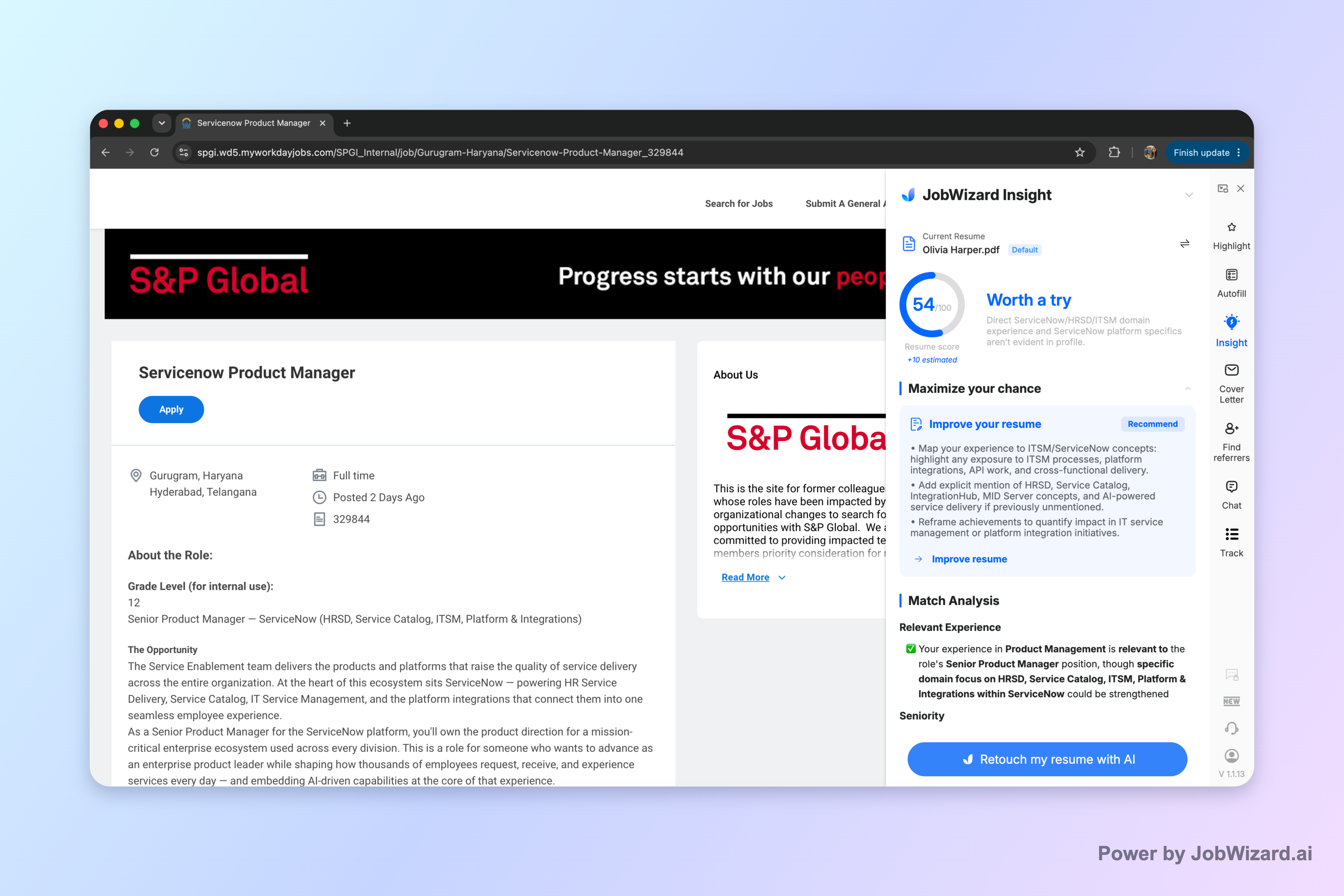
What “job matching” actually means (and what a score does not mean)
A resume “match” workflow works by comparing your resume to the current job description (JD) and surfacing gaps you can edit—usually around ATS keywords and how your experience is expressed. With that framing, you can evaluate jobscan vs chatgpt based on how directly they help you close those expression gaps.
One important limitation to understand up front: a match score isn’t a hiring probability. It also doesn’t guarantee ATS passage or an interview. Treat it as a diagnostic, not a verdict.
What you can expect from JD-based diagnosis
JD-based diagnosis is designed to do two things:
- Compare your resume to the job description and present an overall assessment plus improvement suggestions.
- Identify resume expression gaps and turn them into an editable resume revision draft.
What you must verify no matter what
Even the best tailoring feedback can be wrong in the details—so you have to verify every suggested change. The core rule: keep only accurate experience and review what you’re about to submit.
jobscan vs chatgpt: where each approach fits best in your tailoring workflow
In jobscan vs chatgpt comparisons, it helps to separate “analysis” from “drafting.” Some tools focus on JD-to-resume matching and gap spotting; others are strongest at rewriting once you provide source text.
Here’s a practical way to choose the right fit for your next application.
Use a match-score style tool when you need gap detection
If your bottleneck is figuring out what your resume is missing relative to a specific JD, you want a flow that compares your resume to the job description and flags improvement suggestions. That’s the job of a match-score diagnostic: it helps you understand where your current wording doesn’t line up yet.
Then you can use the gap list to guide targeted edits—rather than guessing which ATS keywords matter.
Use chatgpt when you need rewriting help (but still verify)
If you already know what needs to change, chatgpt can be useful for drafting clearer, JD-aligned resume language from your input. The best results usually come from giving it the JD and the exact sections you want rewritten—so it can produce drafts you can edit.
But again, the tool can’t guarantee accuracy. You must verify every suggested resume change and keep only truthful experience.
A safe “tailor then apply” process that reduces guesswork
The simplest way to get value from jobscan vs chatgpt is to treat the process as a loop: diagnose gaps from the JD, draft revisions, then review before you submit.
Here’s a workflow that keeps you in control.
- Compare resume vs JD to identify expression gaps that affect the match.
- Draft edits using the gap list as the target for rewriting (via AI or your own edits).
- Verify accuracy—confirm each change matches your real experience.
- Review-before-submit—final checks before application submission, especially for any custom questions.
If you’re using an autofill-style approach alongside tailoring, the key point is still the same: autofill (or any assist) is only half the job. You fill repetitive fields quickly, but you review items that require truthful, specific answers before submitting.
Guiding principle: Use tools to speed up draft work and gap detection—then make the final decision based on verified, accurate content.
Which should you choose for “should I apply?” decisions?
If your goal is to decide whether you should apply to a specific posting, you need both clarity and edit-ready next steps.
That means your best choice often depends on what you’re missing right now.
| What you’re stuck on | Better fit | What to watch out for |
|---|---|---|
| Not sure what the JD is looking for in your wording | Match-score style job matching that compares resume to JD | A score is not hiring probability and doesn’t guarantee ATS passage or interviews |
| You know the gaps, but rewriting is slow or unclear | chatgpt for drafting JD-aligned resume language | Verify every change and keep only accurate experience |
| You want an edit-ready plan to close skills gap | JD-based diagnosis that outputs improvement suggestions and drafts | Review-before-submit to avoid inaccuracies |
For the most confident “should I apply?” decision, combine JD-based gap diagnosis (so you know what to fix) with AI-assisted drafting (so you can write faster)—then do the final verification yourself.
Do this automatically with JobWizard
Skip the manual work — JobWizard's Smart Autofill handles this for you. On these platforms: JobWizard vs Jobscan.
FAQ: jobscan vs chatgpt for resume tailoring
Is jobscan’s match score the same thing as an ATS pass or a hiring probability?
No. Job-based scoring is an assessment of how your resume matches the selected job description. It’s not a hiring probability and it does not guarantee ATS passage or an interview.
Can chatgpt help me tailor my resume for a specific job description?
Yes—chatgpt can help draft revised wording once you provide the job description and your current resume. The key is that you still verify every proposed change and keep only accurate experience.
How should I use AI feedback without making my resume inaccurate?
Treat AI suggestions as drafts. Verify each change against your real experience, keep only truthful details, and remove or edit anything that doesn’t match your background.
What’s the fastest safe workflow for jobscan vs chatgpt when you’re deciding to apply?
Start by comparing your resume to the exact job description, identify the expression gaps, draft revised text, then review-before-submit. Keep sponsorship/salary/EEO-style answers (or any custom questions) for you to verify before sending.
Ready to tailor with less guessing? Compare your resume against the exact job description, review the identified gaps and draft revisions, and then submit with confidence using JobWizard’s fill-fast, review-before-submit workflow.
Frequently Asked Questions
See your resume's match score for any job
JobWizard compares your resume to each job description and shows the exact keywords to add — free.