huntr vs jobscan: How to Choose the Right Resume-Matching “Skills Gap” Workflow
If you’re comparing huntr vs jobscan, focus on how each tool turns a job description into an editable resume plan. JobWizard Insight shows a match score plus improvement suggestions—so you can tailor with confidence and keep accuracy.
Free Chrome extension
See your resume's match score for any job
JobWizard compares your resume to each job description and shows the exact keywords to add — free.
huntr vs jobscan: pick the workflow that turns a job description into usable edits
When people search huntr vs jobscan, they usually want the same end result: a resume that’s tailored to a specific job description without guesswork. The key is choosing a workflow that helps you identify ATS keyword and expression gaps, then makes those gaps actionable for edits you can verify.
Job seekers often assume “match scoring” automatically means “ready to apply.” But match scores are only one part of the decision. The best approach is to use the score as a diagnostic, then focus on the improvement steps you can review and correct before you submit.
What “match score + skills gap” should do (and what it can’t)
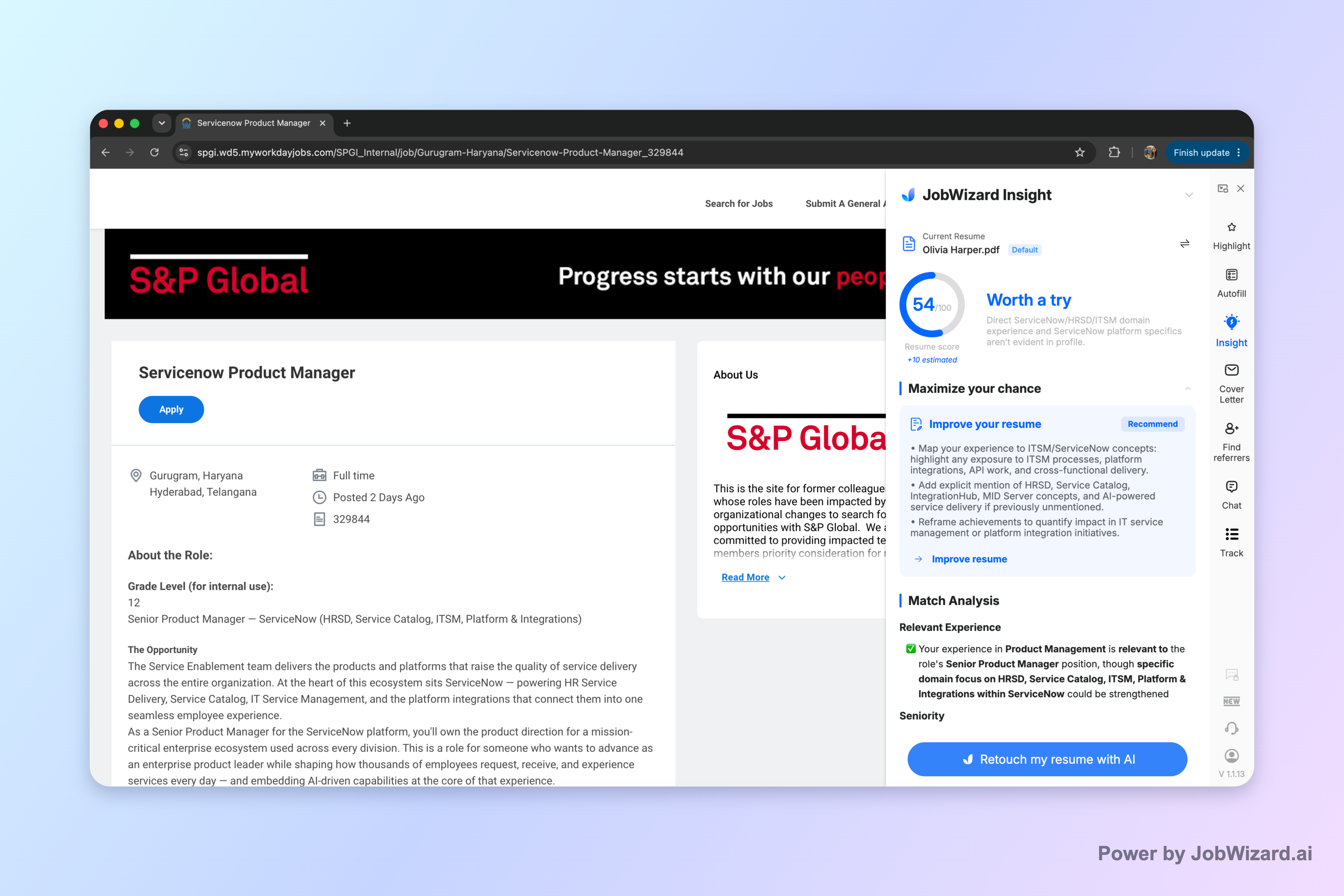
A strong resume-matching tool compares your selected resume against the current job description and provides an analysis that you can turn into concrete changes. Specifically, JobWizard’s Insight compares the resume with the job description and presents a match score, an overall assessment, and improvement suggestions.
The same workflow can also surface resume expression gaps and turn them into an editable resume revision draft—so you can tailor more directly instead of manually scanning for every ATS keyword by yourself.
That said, there are important limits to keep in mind—especially when you’re comparing huntr vs jobscan tools based on their outputs.
- Match scores are not hiring probability and they don’t guarantee ATS passage or an interview.
- You must verify suggested changes and keep only accurate experience, since the tool can’t know your full career context as reliably as you can.
So how do you evaluate huntr vs jobscan fairly?
Instead of asking “Which one gives a higher score?”, compare how each tool supports your actual tailoring process. Look for whether the tool:
- Explains the gaps between your resume and the job description in a way you can act on.
- Provides improvement suggestions you can review as drafts (not just a number).
- Reminds you to keep accuracy—so you don’t accidentally alter honest details.
If a tool’s primary output is only a score without useful next steps, you may still end up doing manual work. If the tool provides suggestions you can edit and verify, you’re more likely to translate “insight” into resume changes.
How to run a “job description → edits” loop in under an hour
You can move from a job posting to tailored resume edits quickly by treating the tool as a diagnostic and your review as the quality gate. Here’s a practical loop you can repeat for each role.
- Select the correct resume version before you analyze, so the comparison reflects what you’d actually submit.
- Paste or load the job description you’re targeting (use the same JD text you plan to apply with).
- Review the match score and overall assessment to understand where the resume aligns—and where it doesn’t.
- Check the improvement suggestions line by line and turn any resume expression gaps into edits.
- Verify every change for accuracy and remove anything that doesn’t match your real experience.
This mirrors the most reliable “tailor, then submit” mindset: the analysis speeds up your identification of gaps, while you stay responsible for truth, completeness, and final formatting.
When the “skills gap” is telling you to revise vs. just reword
Not every gap requires a dramatic rewrite. Sometimes the fix is expression—using language that more closely matches the job description while still describing the same responsibilities you truly had.
If the tool suggests a resume revision draft, treat it as a starting point. Then customize it so the story stays consistent with your achievements, tools, metrics, and scope.
Which tool wins for you in huntr vs jobscan: match scoring or “editable gap plans”?
The most important differentiator in huntr vs jobscan decisions is what you get after the analysis. Some tools focus heavily on a score; others support a clearer path from identified gaps to edits you can review before applying.
JobWizard’s Insight is designed around that exact review-before-submit principle: it compares your resume to the job description, provides a match score and improvement suggestions, and can convert identified gaps into an editable resume revision draft—then you verify everything before using it.
Use the following checklist to decide what “right fit” means for your workflow:
- You want a diagnostic match score you can interpret quickly.
- You want gap-driven suggestions you can convert into editable resume revisions.
- You want to stay in control of what gets changed and what remains accurate.
Ready to test your resume against a specific role? Start by comparing your resume with the job description and review the identified gaps—so you can tailor with confidence rather than guessing.
Do this automatically with JobWizard
Skip the manual work — JobWizard's Smart Autofill handles this for you. On these platforms: JobWizard vs Jobscan.
FAQ: huntr vs jobscan
Is a “match score” from huntr vs jobscan the same as an ATS pass or a guaranteed interview?
No. A match score is an analysis of how your selected resume aligns with a job description, not a hiring probability, and it does not guarantee ATS passage or an interview.
How should I use “skills gap” suggestions without harming my resume accuracy?
Treat the suggestions as drafts. Verify every proposed resume change against your real experience, and keep only updates that are accurate and truthful for your background.
What’s the fastest way to get from a job description to resume edits?
Use the job description as the diagnosis input, then review the tool’s improvement suggestions and turn the identified expression gaps into edits. Finally, proofread for accuracy before you submit.
When should I decide whether to apply, not just tailor?
Use the match score and improvement suggestions to decide whether your resume is meaningfully aligned with the role. Then review everything yourself and submit only if the changes reflect your actual experience.
CTA: Compare your resume with the specific job description, review the match score and improvement suggestions, and update only the gaps you can verify—then submit your application with confidence.
Frequently Asked Questions
See your resume's match score for any job
JobWizard compares your resume to each job description and shows the exact keywords to add — free.