Is JobCopilot Legit? What Auto-Apply Bots Get Wrong (and a Safer Way to Apply)
Wondering “is jobcopilot legit”? Learn what typically goes wrong with auto-apply bots, how to protect yourself, and a safer alternative for getting applications out fast.

Free Chrome extension
Autofill your next job application
JobWizard is a free Chrome extension that fills applications, tracks statuses, and optimizes your resume.
Wondering is jobcopilot legit? The core question isn’t just whether a tool is “real”—it’s what it does during submission. Auto-apply bots can send the wrong answers, mismatch your resume to the role, and even trip employer spam filters, all while you’re not fully in the loop.
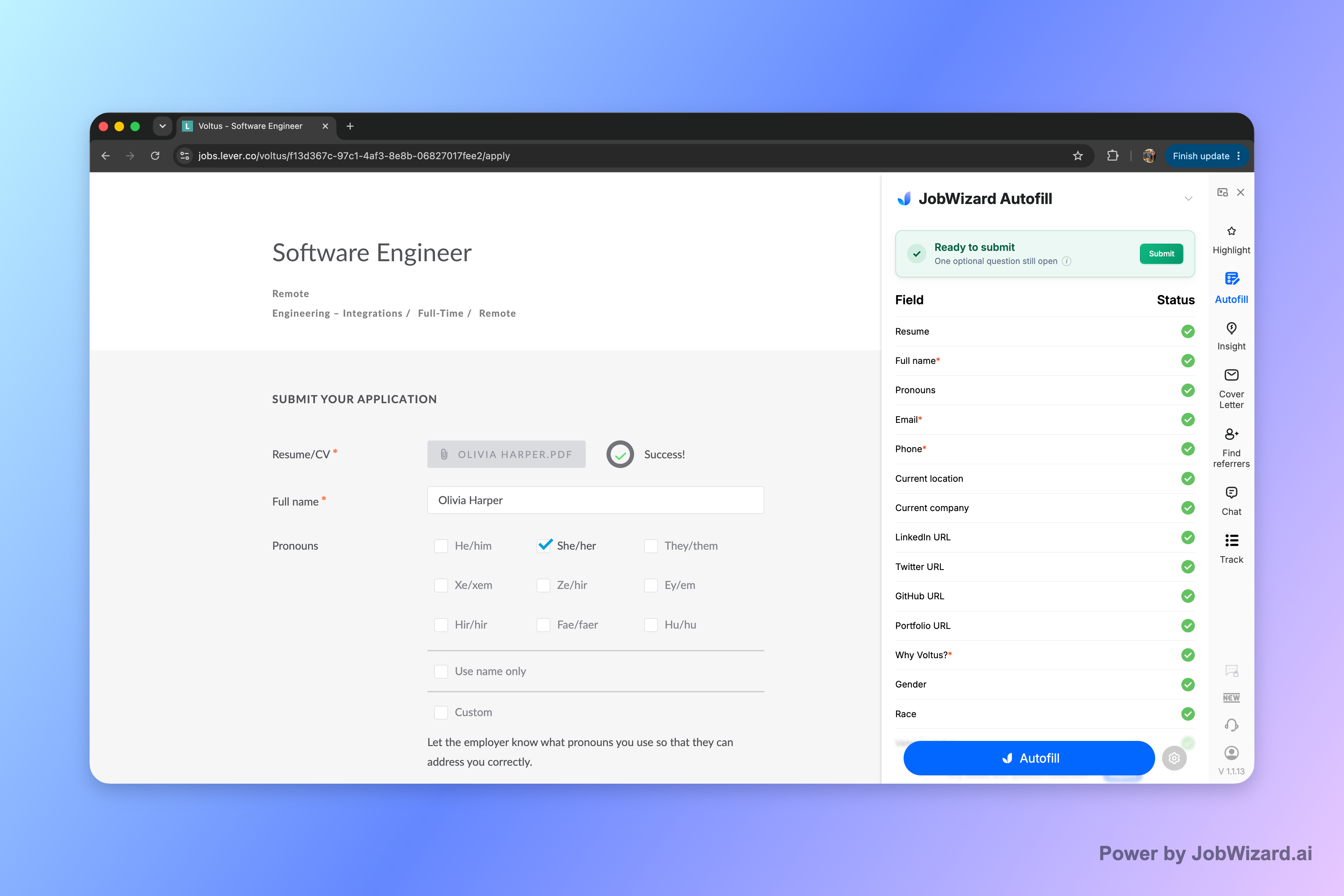
This guide breaks down the common failure modes behind “auto-apply” approaches, what to watch for in any tool claiming to apply for you, and a safer alternative that keeps you in control: autofill the repetitive fields fast, then review and submit yourself.
“Legit” isn’t enough—what can go wrong when bots submit for you?
When people search is jobcopilot legit, they’re usually trying to understand whether the tool is trustworthy in practice—especially if it applies on your behalf. The real risk isn’t “malware” as much as workflow mistakes that happen when a bot pushes an application forward before you verify every answer.
Here are the most common ways auto-submit tools create trouble for job seekers:
- Wrong answers to screening questions: Screening fields often require specific, sometimes nuanced responses. If an auto tool guesses or maps your data incorrectly, you can be disqualified instantly.
- Mismatched resume-to-role details: Many forms ask about recent titles, employment dates, tools used, or project focus. If the tool selects the wrong resume or pulls the wrong details, the employer receives an inconsistent story.
- Repetitive/low-context submissions: Employer systems and recruiters expect applications to vary appropriately by role. When submissions look copy-pasted or incomplete, they may be deprioritized or filtered.
- Damaged reputation with the companies you want: If you submit multiple applications with conflicting information, it can create an avoidable “this candidate isn’t serious/accurate” impression—even if you actually are.
Key point: “Automation” is only beneficial if the final content is correct. For hiring workflows, accuracy matters more than speed.
How auto-apply bots fail in real application flows (concrete examples)
Even good-looking automation can break at the exact moment it should be careful—custom questions, sponsorship details, and free-text fields. Below are examples of how errors typically surface when someone relies on auto-apply behavior instead of review-before-submit.
Example 1: Screening question mismatch
You applied to a role that asks about eligibility or availability. An auto tool might fill a generic “yes/no” incorrectly, or fail to match the exact wording the employer used. The result: your application is rejected without you ever knowing why.
Example 2: Work authorization / sponsorship confusion
Some applications include fields about sponsorship or work authorization status. If the autofill mapping doesn’t match the employer’s specific options, you can end up indicating the wrong situation—or leaving it inconsistent with the rest of your resume.
Example 3: Resume selection or experience date conflicts
Many ATS forms quietly include date-related expectations (start/end dates, last employment status, or current role). If the tool uses one resume but you meant another, you can submit conflicting timelines that harm credibility.
Example 4: Custom questions left wrong—or left blank
Tools that “push through” submission may not fully understand what a custom question is asking. Even if most fields are filled, a single blank high-importance answer can derail your application.
In practice, the most expensive mistakes are the ones you don’t see—because you didn’t review before submission.
Employer-side filtering: why “spammy” can be a side effect
Auto-apply tools don’t always “spam” intentionally, but the pattern of applications matters. When employers see repetitive submissions or incomplete context, they may apply automated screening or filtering to reduce recruiter workload.
That’s why the safest approach is still review-before-submit. If your content is accurate and tailored—even lightly—it typically looks more like a real application and less like a bulk attempt.
What filtering can look like (without guessing specific vendor behavior)
- Lower priority for applications that contain inconsistent details.
- Deprioritization when screening answers don’t align with the role requirements.
- Automated rejection when required fields are missing or obviously mismatched.
None of this requires wrongdoing by the tool itself. It’s a structural problem: if a bot submits content you didn’t verify, the employer’s systems can’t “trust” what they receive.
The safer alternative: autofill for speed, then you decide what gets submitted
If your goal is to apply faster without trading away accuracy, the right workflow is autofill + review-before-submit. The speed comes from filling repetitive fields quickly, while the final judgment stays with you.
JobWizard is built around that reviewed submission model. It autofills application fields for the positions you’re already working on, then you review and submit yourself—so screening answers, custom questions, and any role-specific details remain under your control.
Why this matters (and how it compares to “apply while you’re away”)
Auto-submit tools can be tempting because they promise less effort. But the trade-off is that you lose your chance to catch incorrect mapping before it gets sent. With an approach that keeps you in the loop, you still get speed without the same risk of submitting wrong information.
JobWizard has strong real-world usage reflecting this model: 720,000+ applications submitted and 600,000+ autofill sessions have been run through the platform. Across submitted applications, it autofills an average of about ~18 repetitive fields per application (typically 11–23), then you review before submitting.
Also, most autofill is happening on common ATS workflows: roughly ~65% on Workday, ~19% on Greenhouse, ~12% on Ashby, and ~4% on Lever. Workday is where it tends to save the most time.
What “fill in seconds, check, submit yourself” looks like
- Autofill repetitive fields: the tool drafts the standard details quickly based on what you already set up.
- Review the high-impact parts: especially screening questions, sponsorship/work authorization, and custom prompts.
- Confirm resume match: check titles, dates, and role-specific experience alignment.
- Submit yourself: you’re the final gate before it reaches the employer.
If your real question is is jobcopilot legit, you can apply the same standard to any auto-apply product: ask whether you maintain review control. If a tool encourages “send it without you,” that’s where mistakes become irreversible.
Quick checklist: decide whether a tool’s workflow protects you
Before using any auto-apply assistant, use this checklist to protect your credibility and reduce bad submissions.
- Does it submit without your review? If yes, you’re accepting the risk that screening answers or custom fields are wrong.
- Can you review every filled field? If not, you can’t catch mapping errors before submission.
- Does it support the ATS you’ll see? (Even the best workflow can fail if the form format isn’t handled well.)
- Does it respect “final mile” questions? Sponsorship, salary, EEO, and custom prompts should be reviewed carefully.
- Will it reduce mistakes, or just reduce effort? Legitimate speed should come with quality control.
If you want speed with fewer errors, focus on tools that help with repetitive data entry while keeping you as the decision-maker right before the submit action.
Next step: Try JobWizard to autofill applications on positions you’re already applying to—then review and submit yourself with confidence.
Do this automatically with JobWizard
Skip the manual work — JobWizard's Smart Autofill handles this for you. On these platforms: JobWizard vs JobCopilot.
FAQ: Is JobCopilot legit?
Is JobCopilot legit?
“Legit” usually comes down to what the tool actually does on your behalf. Many auto-apply tools submit without you checking every field, which can create avoidable errors (wrong answers to screening questions, mismatched experience, and employer spam filtering triggers). If you use an AI helper, the safest pattern is: it prepares the application quickly, then you review and submit yourself.
What are the biggest risks of using an auto-apply bot?
The biggest risks are incorrect screening answers, resume/experience mismatches, and higher chances of employer-side filtering when applications look repetitive or incomplete. In the worst case, you can damage your reputation with a company you genuinely want by submitting low-quality or inconsistent answers.
How can I tell if an auto-apply tool is safe to use?
Look for a workflow where you review every relevant detail before submission, especially screening questions, employment dates, and any custom fields. Avoid tools that imply “set it and forget it” submission while you’re away, because that removes your chance to correct mistakes before they’re sent.
What’s the safer alternative to auto-submit tools?
Use a helper that autofills fields while you stay in control—so you can fill the last mile (sponsorship, salary, EEO, and any custom questions) yourself and then submit. That keeps the speed benefit of autofill without losing quality control.
Can autofill still cause problems if I’m reviewing?
Yes—autofill can still mis-map details (for example, job titles, dates, or a screening answer) if the source data doesn’t match the form exactly. The fix is the same: review-before-submit, and verify the highest-impact fields: screening questions, work authorization, dates, and the resume match.
Frequently Asked Questions
Autofill your next job application
JobWizard is a free Chrome extension that fills applications, tracks statuses, and optimizes your resume.