Is Job Copilot Legit? What Can Go Wrong With Auto-Apply Bots—and a Safer Review-First Alternative
Is job copilot legit? Learn the real risks of auto-apply bots, why wrong answers get submitted, and how review-first autofill can be safer.
Free Chrome extension
Autofill your next job application
JobWizard is a free Chrome extension that fills applications, tracks statuses, and optimizes your resume.
When you search is job copilot legit, you’re usually trying to avoid a painful outcome: spending hours applying only to realize your “assistant” may have sent the wrong answers—at the wrong time—to the wrong employer.
So let’s be direct: many “copilot” or auto-apply style tools can look impressive, but the real question isn’t whether they can generate submissions—it’s whether the submissions are accurate enough to survive employer screening and whether you’re in control before anything is sent.
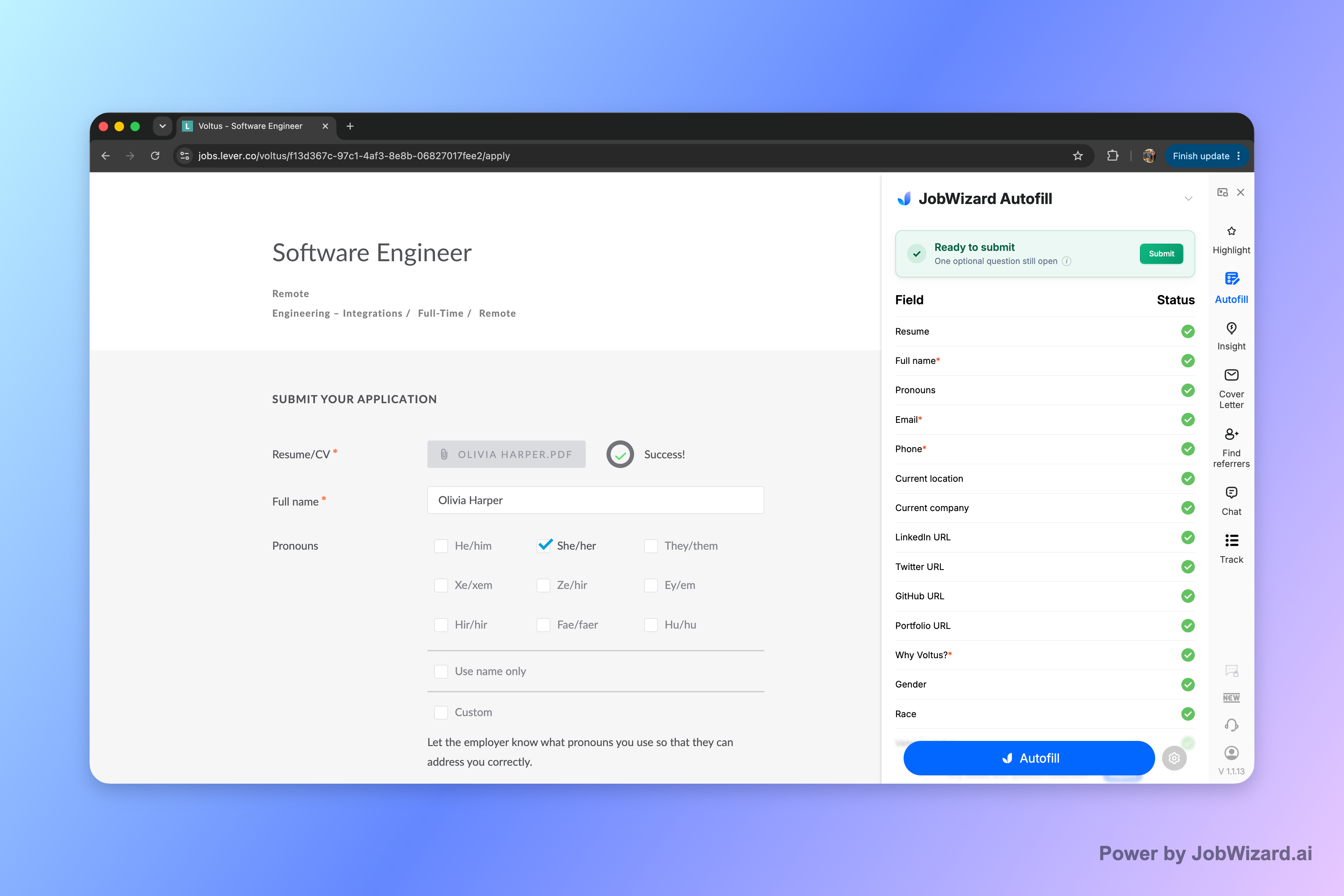
Reality check: JobWizard autofills repetitive fields on the application you’re already viewing, and you review before you submit. It’s not a blind “auto-apply” system.
So, is job copilot legit?
“Legit” depends on what the tool actually does with your information. A tool may be legitimate software, but the workflow can still cause legit job seekers to get rejected for avoidable reasons.
When people ask is job copilot legit, they often mean one of these two scenarios:
- Auto-apply behavior: the tool submits while you’re not actively reviewing answers.
- Assisted autofill behavior: the tool fills in repeatable fields, then you confirm and submit.
The difference is critical. Auto-apply tools can appear to “work” at scale, but job applications are not standardized forms—employers add screening questions, custom prompts, and role-specific requirements. A bot can fill out a field quickly, but it can’t reliably interpret every nuance of what an employer actually wants.
That’s why it’s possible for a “job copilot” to be well-built as software while still being a poor fit for job seekers who care about accuracy, fit, and reputation.
What can go wrong when a bot submits for you?
Auto-submission can turn small mistakes into instant rejection. Here are the most common failure modes job seekers run into with “auto-apply” or bot-driven submissions.
1) Wrong answers to screening questions
Screening questions can be binary (“yes/no”), but they’re also interpretation-heavy (“are you authorized to work?” “do you have X experience?” “are you willing to relocate?”). If your situation doesn’t match the bot’s guess—or the bot misreads the question—you may submit incorrect answers.
That can lead to:
- Immediate rejection even if you’re otherwise a strong candidate.
- Bad first-impression data that recruiters and hiring managers may never see—because an ATS rejects you earlier.
2) Mismatched resumes or content
Even when your main resume looks correct, applications often require role-aligned details. A bot may pull the wrong resume file, or it may populate sections in a way that doesn’t reflect the job you’re targeting today.
Common issues include:
- Dates and titles that don’t match the application you intended to send.
- Projects or achievements that are irrelevant for the specific posting.
- Missing details an employer expects in custom fields.
3) Employer-side spam filters and “bot-like” patterns
Employers and staffing systems may flag high-volume or repetitive activity patterns. Even if the bot fills forms correctly, the submission pattern can look like automation.
This matters because you may get filtered before a human ever reviews your profile. You don’t want your job search to resemble unsolicited bulk outreach—especially when you’re applying to companies you actually care about.
4) Reputation damage with employers you might want later
If a bot submits multiple applications with incorrect answers, inconsistent information, or low-quality responses, it can create a paper trail. Recruiters and systems may not “remember” you personally, but the record can persist.
The reputational risk is that you become “the applicant who always answered wrong” rather than “the applicant who misread one question once.” If you’ve ever followed up with a company you applied to, you know how valuable clean, consistent applications are.
Why “review-before-submit” is the safer alternative
The safest approach keeps you in the loop right before submission. That’s the key difference between assisted autofill and true auto-apply.
JobWizard is designed around a review-first workflow: it autofills repetitive fields on the application you’re already viewing, and you review the content before submitting. That helps prevent the most damaging outcome of auto-apply bots: inaccurate answers leaving your control.
Why that matters:
- Repeatable fields get filled fast: you spend less time on boilerplate details.
- You verify everything else: sponsorship, salary, EEO, and custom questions remain in your control.
- Submission quality stays human: you decide whether the content truly matches the role.
For context from our real usage data, JobWizard has supported 720,000+ applications submitted and 600,000+ autofill sessions. It also autofills an average of about ~18 repetitive fields per application (typically 11–23). And importantly, this is framed as autofill + review-before-submit, not blind auto-application.
In other words: the tool reduces repetitive typing, while you keep authority over the answers that affect eligibility, fit, and screening.
How to tell whether a “job copilot” is legit for you
Use these checks to decide if the tool matches your risk tolerance and goals. “Legit” for job seekers should mean “you can verify what gets sent.”
Check #1: Does it submit automatically or only autofill?
If the product description emphasizes auto-submission while you’re away, treat that as a red flag for accuracy. Applications aren’t just forms—your credibility depends on correct answers and consistent materials.
If it emphasizes autofill that you review, it’s generally a better fit for careful applicants.
Check #2: Can you validate custom questions before sending?
Custom questions are where most mistakes happen—especially for role-specific requirements and short-form prompts. You want a workflow where you can read, adjust, and confirm before the final click.
Check #3: Does it keep the resume aligned to the posting?
Ask yourself: can you verify that the resume details shown in the application match the role you’re targeting? If you can’t confidently review what’s about to be submitted, you’re delegating credibility.
Check #4: Does it help you move faster without removing accountability?
A good “assistant” should improve throughput on the repeatable pieces. Speed is useful, but not if it compromises the correctness that employers rely on.
To be clear: tools that automate submissions can still have legitimate use cases for some applicants. The trade-off is accuracy and control versus convenience and speed. The best choice is the one that aligns with your standards—and the type of roles you’re applying to.
Realistic workflow: fill seconds, check, submit yourself
Your goal is to reduce repetitive work while keeping your answers accurate. Here’s a practical review-first workflow that avoids the biggest “copilot bot” pitfalls.
- Start the application: open the posting in the employer’s site (or the ATS flow).
- Autofill repeatable fields: use your tool to populate boilerplate information quickly.
- Scan for screening questions: verify every eligibility-style question and any yes/no responses.
- Confirm resume alignment: check titles, dates, and the most relevant projects for this specific role.
- Answer custom prompts yourself: tailor your responses and ensure the tone matches the employer.
- Submit only after review: final check, then submit yourself.
This workflow is exactly the logic behind review-first autofill tools like JobWizard. By filling repetitive fields quickly and leaving the final decision to you, you avoid the most costly problem: having a bot confidently submit inaccurate answers to questions that can’t be “fixed later.”
If you’re trying to answer is job copilot legit in a way that protects your job search, this is the simplest rule: automation should help you type less, not help you avoid reading.
Do this automatically with JobWizard
Skip the manual work — JobWizard's Smart Autofill handles this for you.
FAQ: is job copilot legit?
Is job copilot legit if it auto-applies?
Legit tools can still create problems when they submit automatically. If screening answers, resume sections, or location details are off, you can end up being rejected (or worse) for reasons unrelated to your actual fit.
What are the biggest risks of auto-apply or “copilot” bots?
The biggest risks are incorrect answers to screening questions, mismatched resume materials (wrong role, wrong dates, or missing projects), triggering employer-side anti-spam filters, and damaging your reputation with companies you genuinely want.
How is review-first autofill different from auto-apply?
With review-first autofill, the tool fills repetitive fields while you stay in control of the content. You review everything—including any custom questions—then submit yourself, which reduces the chance of sending inaccurate or mismatched information.
Can a tool really fill out applications correctly every time?
No tool can guarantee 100% correctness for every employer’s screening flow and custom questions. The practical approach is to use automation only for repeatable pieces, then verify the answers before you submit.
What should I check before submitting an application?
Before submitting, verify screening questions, ensure the resume shown matches the role and your most relevant experience, confirm location/authorization details, and review any custom questions carefully.
Ready to apply faster without risking bot-submission mistakes? Try JobWizard for review-first autofill—fill repetitive fields quickly, verify screening and custom answers, and submit applications yourself.
Frequently Asked Questions
Autofill your next job application
JobWizard is a free Chrome extension that fills applications, tracks statuses, and optimizes your resume.