How to Answer an Interview Question About Weakness: Flip “Flaw” Into a Growth Story
Learn how to answer an interview question about weakness with a clear, credible growth story and job-relevant examples—without sounding defensive.
Free Chrome extension
Let AI answer these questions for you
JobWizard fills sponsorship, work-auth, and availability answers correctly on every application — free.
Most interview questions about strengths are easy—weakness is where candidates stumble. If you’re wondering how to answer an interview question about weakness without hurting your chances, the fix is simple: give the interviewer a believable growth story that stays relevant to the role.
In this guide, you’ll get a repeatable framework, practical weakness examples, and interview-ready phrasing you can customize. You’ll also learn what to avoid so your answer sounds honest, thoughtful, and coachable.
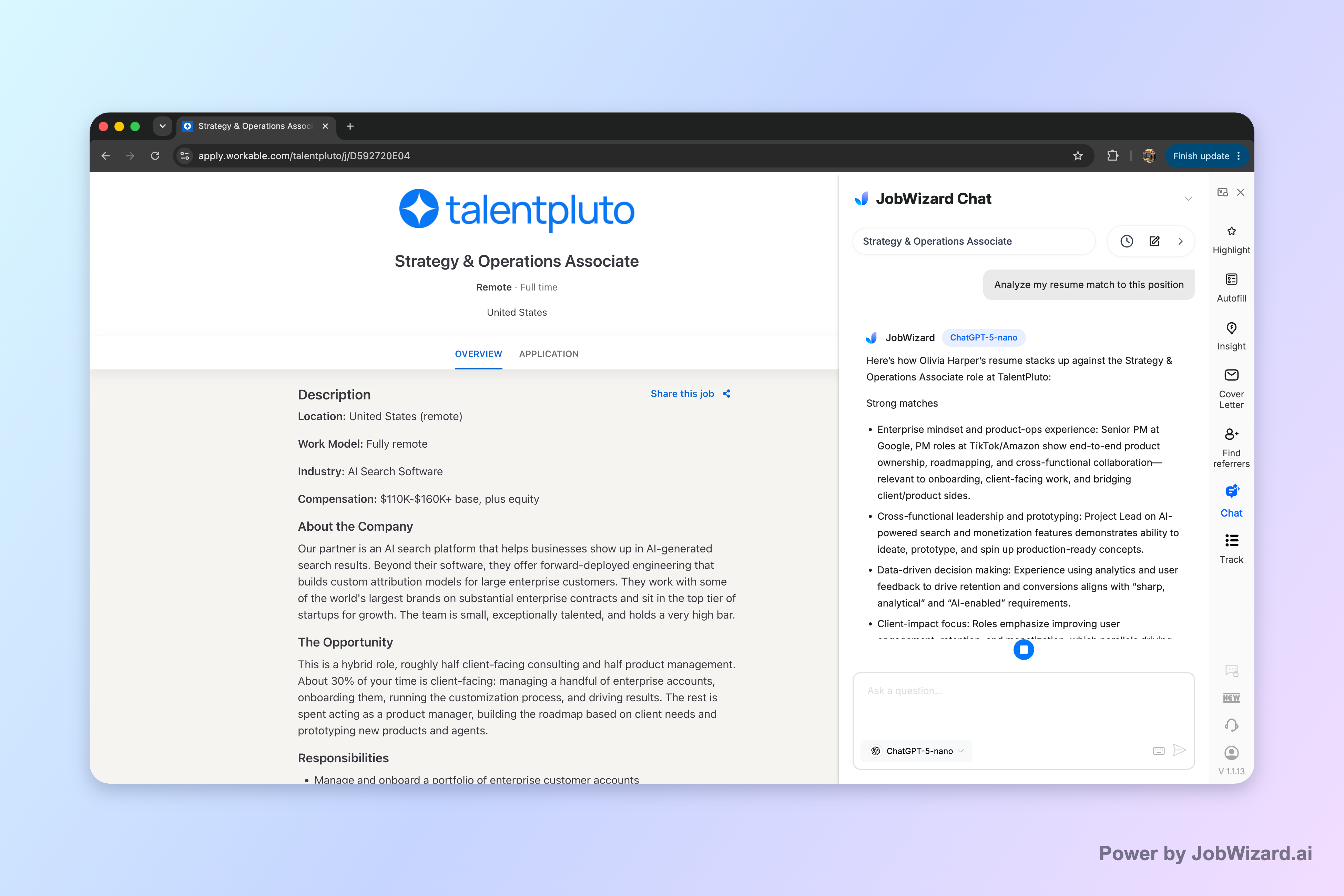
Career Chat in JobWizard can help you keep your weakness example aligned to the job you’re applying for. It keeps the current role in context, so you can ask follow-up questions about resume fit and interview strategy without pasting the job description again.
Answer the question with a “weakness → impact → improvement” structure
Use a three-part flow so the interviewer hears accountability first, then evidence of improvement.
When interviewers ask about weakness, they’re usually testing for maturity and self-awareness—not looking for a confession. The best answers do three things:
- Name the weakness in plain language (not vague self-criticism).
- Describe a real impact (how it showed up in your work).
- Explain the improvement (what you changed and what you do now).
A common mistake is stopping after “I’m a perfectionist.” That line tells them nothing about impact or growth. Instead, add one concrete mechanism you’ve implemented and how you use it consistently.
Weakness selection: pick something real, but not mission-critical
Choose a weakness that won’t undermine the role—then show how you’re actively managing it.
Use this rule of thumb while drafting:
- If the weakness affects a job-critical competency, don’t force it. Choose another area you can reliably mitigate.
- If the weakness is real but manageable, describe your system for preventing recurring problems.
- Avoid weaknesses that are actually personality red flags (e.g., “I get impatient with people” without a mitigation plan).
To stay aligned, compare your examples to the job’s core responsibilities. If you’re unsure how your draft maps to what the employer needs, a “role-in-context” coaching approach can help you tighten the fit before you practice.
Choose weakness examples that sound credible (with plug-and-play phrasing)
Strong weakness answers sound like someone who’s already working on it, not someone hoping the interviewer won’t notice.
Below are weakness categories that often work well—because they’re common enough to be credible, but specific enough to be useful. For each one, you can adapt the template to your experience.
Example 1: “I used to over-research before deciding.”
Template: “Early on, I would spend too much time validating options before making a call. In [situation], it slowed decisions. What changed is [specific process], and now I set a decision checkpoint with clear criteria.”
Interviewers like this because the weakness is not competence—it’s a decision style. You show control by naming the decision framework you now use.
Example 2: “I can focus so deeply that I forget to summarize.”
Template: “I’ve learned that when I’m in the details, I sometimes delay summaries. In [situation], stakeholders didn’t have the quick context they needed. I fixed it with [weekly updates / structured summaries / recurring check-ins], and I now time-box my deep work with regular communication.”
This works especially well for roles involving cross-functional collaboration, documentation, or stakeholder management.
Example 3: “I used to be too cautious with delegation.”
Template: “Previously, I hesitated to delegate because I wanted to maintain quality. It showed up when [example], and the workload became inefficient. I improved by [how you delegate—clear scope, checklists, milestones], and quality is now more consistent.”
To keep it credible, mention a specific workflow you implemented, not just “I learned to delegate.”
Example 4: “I needed to improve my prioritization under competing requests.”
Template: “When multiple priorities came in at once, I struggled to balance them early in my career. In [situation], that meant I got behind on [area]. Today, I use [priority matrix / intake process / stakeholder alignment], and I confirm expectations before committing.”
This is a strong weakness for operations, project work, and any role where priorities shift.
Example 5: “I used to ask for feedback later instead of earlier.”
Template: “I used to wait until I finished a deliverable to get feedback, which occasionally led to late revisions. In [situation], I changed the outcome by [feedback checkpoints / drafts / review cycles]. Now I schedule feedback at [specific stage], so alignment happens sooner.”
The improvement should sound repeatable. A feedback cadence is a system, not a hope.
Make the answer job-relevant and recruiter-proof
Your job is to show self-awareness without self-sabotage—so the interviewer can trust both your honesty and your competence.
Interviewers want to hear that you can learn and improve while still delivering outcomes. To do that, add one of the following “credibility signals” to your answer:
- Time you caught it: “I noticed it during X and realized Y.”
- What you changed: the exact habit, workflow, or tool you adopted.
- How you prevent recurrence: what you do today to avoid repeating the same pattern.
- Where you’re stronger now: tie it back to collaboration, quality, speed, or reliability.
Then, end with a forward-looking line that connects improvement to the role you want. Keep it direct—no apology language.
Say it like this (short, confident phrasing)
Good weakness answers are concise, usually 45–75 seconds. Here’s a model you can adapt:
“One area I’ve been working on is [weakness]. Early on, I noticed it when [situation], and it led to [impact]. I addressed it by [specific improvement]. Today I [what you do now], so I’m confident I can handle [relevant job scenario].”
If you get nervous, practice saying the structure out loud once per rehearsal: weakness → impact → improvement → current behavior.
Common mistakes (and how to avoid them fast)
Avoid these patterns and your answer will sound more credible immediately.
| What candidates do | Why it backfires | What to do instead |
|---|---|---|
| Pick a weakness that’s actually a strength (“I’m too detail-oriented”). | It doesn’t answer the question and feels rehearsed. | Choose a real development area and describe a real impact. |
| Vague phrasing (“I’m not good at communicating”). | The interviewer can’t assess your self-awareness or improvement. | Use a specific example and name the system you adopted. |
| Over-apologize or sound insecure. | It reduces confidence and may raise concerns about performance. | Use accountability language + action-focused improvement. |
| Choose a weakness that makes you seem unqualified. | If it’s core to the job, it triggers doubt. | Select a manageable weakness and explain mitigation. |
| End without showing what you do now. | The interviewer learns you struggle, not how you improve. | Close with current behavior and what it enables in the role. |
If you want to make your answer even tighter, review it next to your broader interview prep. For example, you can pair this weakness response with a consistent approach to job application questions and interview structure—see How to Answer Job Application Questions: A Field-Tested Method for Confident, Consistent Responses.
You may also find it helpful to practice a “weakness” answer specifically for your most relevant development area: How to Answer My Greatest Weakness Interview Question (Without Sounding Defensive).
And if you’re prepping for behavioral interviews, connect your weakness story to evidence-based examples like those used in Behavioral Interview Questions for Healthcare Professionals: How to Answer With Evidence, Not Rehearsal.
Finally, if you want a script-ready structure you can reuse across interviews, use the same thinking as Tell Me About a Time Interview Questions: A STAR Answer Script That Sounds Like You—the difference is you lead with the weakness, then walk through the scenario.
Do this automatically with JobWizard
Skip the manual work — JobWizard's Smart Autofill handles this for you.
FAQ: how to answer an interview question about weakness
What’s the best way to choose a “weakness” for this question?
Pick a real development area that isn’t central to the job. Then frame it as something you’ve already started improving (with a concrete example), so you sound capable—not careless.
Should I say I have “no weaknesses” or only strengths?
No. Saying you have no weaknesses usually reads as rehearsed or untrustworthy. Instead, share a genuine weakness and immediately connect it to what you’re doing to manage it.
How specific should my weakness example be?
Be specific enough that the interviewer can see the situation, what you changed, and the result. Keep the story short: context → your earlier approach → the adjustment you made → what you do now.
Can I mention a weakness that’s job-related?
Yes—sparingly. If the role truly needs that skill, choose a weakness you’ve mitigated and describe the system you use to prevent the problem. If it’s a must-have competency you can’t perform reliably, choose a different weakness.
What follow-up questions should I be ready for after my answer?
Be ready to expand on: what triggered the weakness, what you do today to prevent it, how you measure improvement, and how you’ll handle it in this specific role.
Ready to tighten your interview story for the role you want? Use JobWizard’s Career Chat to ask a focused follow-up question about your weakness example and verify that it still aligns with the job’s responsibilities—so you walk into the interview sounding both honest and well-prepared.
Frequently Asked Questions
Let AI answer these questions for you
JobWizard fills sponsorship, work-auth, and availability answers correctly on every application — free.