ATS Status Decoder Workday Greenhouse Lever and iCIMS Meanings Compared (Plus What to Do Next)
Confused by Workday, Greenhouse, Lever, and iCIMS application statuses? This ATS Status Decoder Workday Greenhouse Lever and iCIMS Meanings Compared guide translates common signals—and tells you exactly what to do next.
Free Chrome extension
Track all your applications in one place
JobWizard auto-tracks status changes across Workday, Greenhouse, and every major job site — free.
How can an ATS status leave you stuck wondering what “really” happened after you applied?
You applied for a role through a Workday, Greenhouse, Lever, or iCIMS career page—and the portal now shows a status like “Submitted” or “Under Review.” The problem is that those words can mean different things depending on the ATS and the employer’s internal workflow.
This is exactly why an ATS Status Decoder Workday Greenhouse Lever and iCIMS Meanings Compared guide matters: you need to translate the wording into the most likely stage, then choose the right next action.
What does “Submitted” mean in Workday, Greenhouse, Lever, and iCIMS?
“Submitted” usually means the ATS accepted your application and stored it in the employer’s system.
In practice, “Submitted” can be a receipt status (your materials are in) rather than a sign that a recruiter has already reviewed them. Some employers may not notify applicants again until the first meaningful workflow step (screening, review assignment, or interviews).
Key takeaway: “Submitted” generally confirms receipt—not review. Your next move is to verify your profile/contact info and watch for follow-up prompts.
Recommended actions when you see “Submitted”
- Check for completeness prompts: Some employers require extra custom questions after the main resume upload.
- Confirm your email: If the ATS sends system messages, a typo can block follow-up.
- Don’t resubmit by default: Unless the employer instructs it, repeated submissions can confuse the workflow.
What does “In Progress” mean in Workday?
“In Progress” in Workday typically indicates your application is actively moving through an internal workflow.
That can mean it’s been received and assigned to the next step, but it may not yet be in the hands of a reviewer. Depending on the job’s configuration, “In Progress” can cover stages like initial processing, automated checks, or routing to a hiring team queue.
Key takeaway: In Workday, “In Progress” is movement, not necessarily review. Your goal is to stay ready for any requests and keep applying strategically elsewhere.
Next steps for “In Progress”
- Verify application details: Make sure your contact info and any location/work authorization fields are correct.
- Watch for portal messages: Some roles trigger follow-up questions or screening steps.
- Plan your follow-up: If you don’t hear anything after a reasonable period, use a polite, short email (template below).
What does “In Process” mean in Greenhouse?
“In Process” in Greenhouse usually means your application is in an active pipeline, but not yet in a completed “decision” state.
That doesn’t always translate to “a recruiter is reading it today.” Many Greenhouse workflows separate collection, screening, routing, and review assignment—so you can see “In Process” during several underlying steps.
Key takeaway: “In Process” is a pipeline state. Treat it like “received + processing,” and keep your search moving while you wait.
What to do while “In Process” is showing
- Keep your materials current: If you catch an improvement you can make quickly (like clarifying a resume bullet), consider using it for your next applications.
- Don’t spam follow-ups: One well-timed message is better than repeated checking.
- Track the job posting: If the role closes or changes, your status may update accordingly.
What does “Under Review” mean in Workday, Greenhouse, Lever, and iCIMS?
“Under Review” generally indicates your application is being looked at by humans and/or by a screening workflow.
This is one of the most hopeful statuses—but it’s also broad. “Under Review” can still include recruiter routing, screening rubric checks, or initial committee review depending on the employer.
Key takeaway: “Under Review” usually means you’ve cleared the “received” step. Next, keep applying and be prepared if they request additional info.
Suggested next actions
- Stay active: Interview decisions often take time even after review begins.
- Prepare for outreach: If a recruiter contacts you, you’ll want your top talking points ready.
- Use a checklist: Keep your resume version aligned to the job description so you can quickly respond.
What does “Review Complete” or “Closed” mean in iCIMS?
“Review Complete” and “Closed” in iCIMS often signal that the employer has finished the evaluation process for that role or that the posting is no longer accepting changes.
In many cases, “Closed” is more about the role being inactive than your application being actively reviewed right up to the deadline. “Review Complete” is closer to a decision workflow step.
Key takeaway: These statuses usually mean the timeline for that specific application has reached an endpoint—move your focus to next roles unless you hear otherwise.
How to respond to “Review Complete” / “Closed”
- Look for decision wording: Some portals update again after the final verdict.
- Save your notes: The job requirements can help you tailor your next application.
- Reach out only if appropriate: If you have a connection or strong reason, a brief follow-up may be acceptable.
What does “Interview Scheduled” or “Next Round” mean across ATS platforms?
“Interview Scheduled” (or “Next Round”) typically means the employer moved from screening to scheduling.
Even when the ATS status updates, the scheduling details usually arrive via email or calendar instructions. The status is therefore a strong signal, but your next steps should still follow the instructions you receive directly from the employer.
Key takeaway: Once you see interview scheduling, switch your job-search mode from “monitoring” to “prepping and responding fast.”
Interview-ready checklist
- Confirm time zone and format: Phone, video, or in-person can change your prep.
- Match your examples: Prepare specific stories tied to the job’s skills.
- Reply quickly: Delayed responses can break the schedule chain.
What do “Rejected,” “Not Selected,” or “Application Not Advanced” mean?
“Rejected” / “Not Selected” / “Application Not Advanced” generally means your application won’t move forward for that specific role.
These statuses can feel final, but they still don’t always reveal why. Sometimes it’s timing, sometimes it’s role-fit alignment, and sometimes it’s internal prioritization (budget changes, hiring freezes, or competing candidates who match a niche requirement).
Key takeaway: Treat negative statuses as feedback you can learn from, not a verdict on your entire career.
How to use a rejection status to improve your next application
- Pull keywords from the posting: Align your resume bullets to what the job specifically asks for.
- Spot “missing field” risk: If you suspect you left something incomplete, apply again with tightened accuracy.
- Rewrite your intro bullets: Lead with the strongest relevant accomplishment for that role’s category.
What does “No Decision,” “Still Under Consideration,” or “Pending” indicate?
“Pending” or “Still Under Consideration” usually means your application is waiting—either for reviewer assignment, a hiring decision, or internal coordination.
This state can be frustrating because it doesn’t say what’s next. But in many ATS workflows, these “in-between” labels exist while scheduling and internal reviews are being finalized.
Key takeaway: Pending statuses mean patience—paired with ongoing search actions and occasional, professional follow-up.
What you should do (and what you should avoid)
- Do: Keep applying and tailor the next batch to the job requirements.
- Do: Follow ATS prompts immediately if any follow-up screening appears.
- Avoid: Repeated resubmits or emotional messages to the portal.
How can JobWizard help you avoid missing fields before review changes your status?
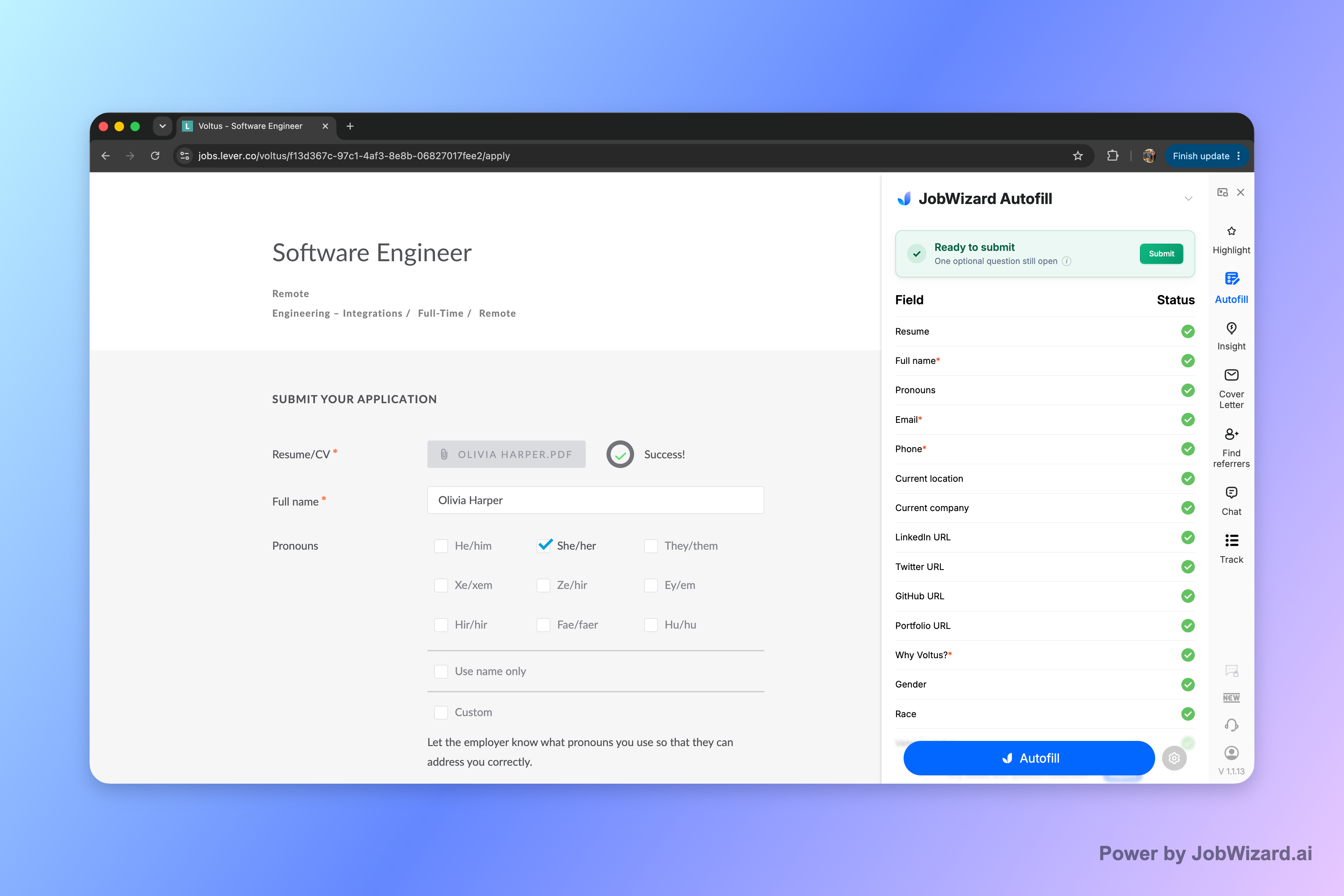
JobWizard Smart Autofill helps you fill repetitive fields on supported application pages using saved profile and resume data.
It’s important to understand the workflow: Smart Autofill fills detected fields, then you review every populated answer before submitting. If a required field still needs attention, JobWizard can identify it and let you jump to the matching question—so your application is more likely to be complete when the ATS advances statuses.
Key takeaway: Autofill doesn’t replace your review—it accelerates the repetitive parts while keeping you in control of what gets submitted.
Why this matters for Workday, Greenhouse, Lever, and iCIMS statuses
Statuses change only after the employer receives and processes what you submitted. If a required field was missed or poorly answered, your application might stall in earlier workflow states or fail screening criteria.
Using JobWizard can help you reduce avoidable friction—especially when you’re applying at scale—while keeping the final responsibility on you to verify each answer.
What the data says (high level)
Through JobWizard, there are 720,000+ applications submitted and 600,000+ autofill sessions, and autofill typically covers about ~18 repetitive fields per application (often 11–23). Of applications submitted through JobWizard, ~65% are on Workday, ~19% Greenhouse, ~12% Ashby, and ~4% Lever.
Internal links for deeper status meaning
- How to Autofill Job Applications (Step-by-Step with JobWizard) (for a full walkthrough of the setup and review workflow before submission).
- SuccessFactors Application Status Meanings: What “In Process,” “Under Review,” and More Really Mean (if you’re also seeing SuccessFactors labels).
- iCIMS Meaning: Application Stages Decoded (Status Meanings + What To Do Next) (for a platform-focused deep dive on iCIMS stages).
- Workday Application Status Under Review Meaning: What To Do Next (and How To Track It) (to go deeper on Workday-specific wording).
What is the fastest way to decode ATS status wording into next actions?
Use a simple meaning-to-action mapping to turn vague labels into concrete steps you can take today.
Below is a scannable reference you can use while monitoring your application dashboard. Treat these as the most likely interpretations—then confirm with any employer instructions, portal prompts, or emails you receive.
| ATS status wording (common examples) | Most likely meaning | Recommended next action |
|---|---|---|
| Submitted | Application received and stored by the ATS. | Confirm contact info; watch for additional questions or system messages; don’t resubmit unless asked. |
| In Progress (Workday) | Actively moving through workflow—may not be assigned to a reviewer yet. | Stay ready for follow-up prompts; verify application details; plan a polite follow-up if nothing changes. |
| In Process (Greenhouse) | In an active pipeline; could still be screening/routing. | Keep applying; prepare if you’re contacted; avoid repeated resubmits. |
| Under Review | Being evaluated by screening and/or reviewers. | Keep your job search active; be prepared to respond quickly to outreach; tailor only what you control for future applications. |
| Review Complete / Closed (iCIMS) | Evaluation likely finished or role posting inactive for changes. | Look for final decision wording; save the job requirements for future tailoring; move focus to next roles. |
| Interview Scheduled / Next Round | Progressed to scheduling and next-step evaluation. | Reply promptly; confirm time zone/format; prepare job-specific examples. |
| Rejected / Not Selected / Not Advanced | Application likely not moving forward for this role. | Adjust materials based on job requirements; apply to similar roles with better alignment. |
| Pending / No Decision / Still Under Consideration | Waiting for reviewer assignment, coordination, or decision. | Keep applying; monitor inbox/portal; send one professional follow-up within a reasonable window. |
Key takeaway: Once you map the wording to a likely meaning, you can stop spiraling and start taking the right action—today.
Copy-paste follow-up email template (short + professional)
Subject: Follow-up on [Job Title] Application — [Your Name]
Hello [Hiring Manager Name/Team],
I hope you’re doing well. I recently submitted my application for the [Job Title] role on [date, if you know it]. I’m very interested in the position and would welcome the chance to support the team.
If there’s anything else you need from me to complete the review, I’d be happy to provide it. Thank you for your time and consideration.
Best regards,[Your Full Name][Phone] | [Email] | [LinkedIn/Portfolio if you use it]
How do you track Workday, Greenhouse, Lever, and iCIMS status changes without losing weeks?
Track with a consistent routine so you’re monitoring the signals—but not letting the dashboard run your life.
Because status labels can be broad (“Under Review,” “Pending,” “In Process”), the safest approach is to combine portal checks with a follow-up schedule and a parallel action plan (keep applying, refine materials, prepare for interviews).
Key takeaway: Monitoring works best when it’s paired with a weekly action plan.
Action checklist for the next 7–14 days
- Day 0–2: Verify application confirmation and portal inbox/messages; ensure your resume version matches the role.
- Day 3–7: If status is “Submitted” or “In Progress/In Process,” prepare for possible screening prompts and keep applying.
- Day 7–14: If still “Pending” with no new instructions, send one follow-up email (template above) if the employer allows contact.
- Ongoing: When you apply again, use Smart Autofill + review-before-submit to reduce missing-field risk.
Do this automatically with JobWizard
Skip the manual work — JobWizard's Smart Autofill handles this for you. On these platforms: Workday autofill, Greenhouse autofill, Lever autofill, iCIMS autofill.
FAQ: ATS Status Decoder Workday Greenhouse Lever and iCIMS Meanings Compared
What does “Submitted” mean in Workday, Greenhouse, Lever, or iCIMS?
“Submitted” usually means your application was received by the system. Next, confirm whether any follow-up steps are required (e.g., complete a profile, answer custom screening questions, or wait for a first review) and check for messages in the job portal and any email confirmations.
What does “Under Review” mean in Workday, Greenhouse, Lever, and iCIMS?
“Under Review” typically means a recruiter or screening process is looking at your materials. Next, keep your job search active, tailor any remaining application components you control (resume/answers), and set a short follow-up window to re-check status if nothing changes.
What does “In Progress” mean in Workday?
“In Progress” generally indicates your application is moving through an internal workflow—often it’s been received but not yet assigned to a reviewer. Next, make sure your contact info is correct, watch for requests to complete additional questions, and avoid resubmitting unless the employer asks.
What does “Interview Scheduled” or “Next Round” mean across ATS platforms?
It usually means the employer has moved from screening to scheduling. Next, reply promptly to any calendar/instructions email, confirm time zones and format (phone/video/in-person), and prepare answers tied to the job description so you can reference specifics.
What does “Rejected,” “Not Selected,” or “Application Not Advanced” mean?
These statuses generally indicate the employer isn’t moving forward with your application for that specific role. Next, don’t assume it’s a permanent judgment—adjust your materials for common gaps, apply to similar roles, and consider saving the job requirements as keywords for your next tailored application.
Is it safe to rely only on ATS status updates to know what to do next?
No—ATS statuses are helpful signals, but they don’t always reflect the full timeline. Next, combine status monitoring with proactive steps: check your inbox/portal messages, ensure your answers are complete before submission, and follow up professionally when appropriate.
How can JobWizard help when I’m waiting on statuses after applying?
JobWizard helps you submit more accurately by Smart Autofill filling repetitive fields on supported application pages, then you review every populated answer before submitting. If a required field needs attention, JobWizard can identify it and let you jump to the matching question—so your application is ready to be reviewed once the ATS switches statuses.
What follow-up email should I send if my status hasn’t changed?
A good follow-up is short, professional, and specific: restate your interest, mention you applied on a date (or reference the job ID if available), and ask whether they need anything else from you. Use the template in this article to keep it concise and action-oriented.
Ready to apply faster—while keeping review-before-submit in your hands?
Try JobWizard Autofill on your next application and review every populated answer before submitting. It fills repetitive fields quickly, helps you jump to any required questions that still need attention, and keeps the final submission decision with you.
Learn how to autofill job applications step-by-step, then use JobWizard the next time you’re entering Workday, Greenhouse, Lever, or iCIMS forms.
Frequently Asked Questions
Track all your applications in one place
JobWizard auto-tracks status changes across Workday, Greenhouse, and every major job site — free.