applyblast review: What to expect from an application autofill tool—and how to vet the safe workflow
This applyblast review breaks down how application autofill typically works, what to double-check before you submit, and how to avoid the common “missing field” problem.
Free Chrome extension
Autofill your next job application
JobWizard is a free Chrome extension that fills applications, tracks statuses, and optimizes your resume.
applyblast review: Here’s the safest way to think about application autofill
If you’re searching for an applyblast review, you probably want to know whether an application “autofill” tool helps you move faster without turning your submissions into a guessing game. The key is understanding the workflow: it should fill repetitive fields quickly, then leave the final review and submission in your hands.
Job application autofill tools generally work by using saved profile and resume data to fill detected fields on supported application pages. In a strong setup, you’ll still review what was filled, correct anything that’s off, and then submit yourself—so you’re not blindly sending inaccurate answers.
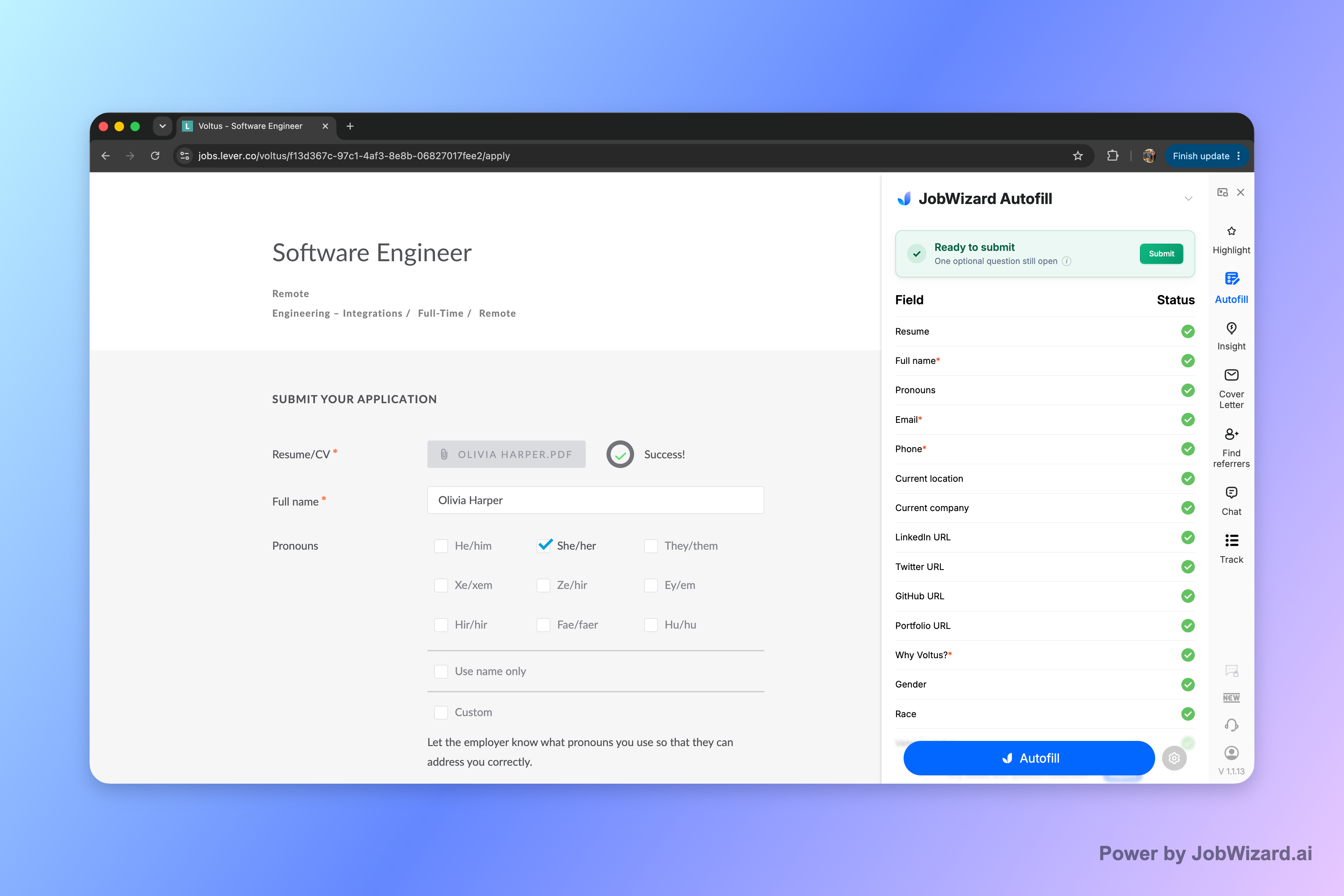
JobWizard’s workflow is designed around that “fill fast, review before submit” principle—so you can spot issues before they go out. Think of it as autofill plus a final human check, not a hands-off bot.
How autofill tools like applyblast-style extensions usually work (and what they shouldn’t claim)
An application autofill tool is best understood as a helper for repetitive form data—things like contact details, basic work history fields, and other standard inputs that show up across many job postings. In the approved workflow, the extension fills detected fields using your saved profile and resume data.
What you should never assume: that autofill will instantly complete everything perfectly, that it will work on every job site, or that it will auto-submit your application. Even when an autofill tool is working as intended, you still need to review responses and handle any information that is application-specific.
What “safe” looks like in the autofill workflow
- Fields are populated using your saved profile and resume data.
- You review every populated answer to ensure it’s correct for that specific job.
- Submission is still your action (the tool should not claim automatic submission).
- Required-field checks help prevent misses by identifying fields that still need attention.
Why “missing required field” is the real risk
The most common way an autofill workflow goes wrong isn’t usually that everything is wrong—it’s that one required question doesn’t get answered. A good tool workflow helps you find the remaining required fields and jump to the matching question so you can fix it before you submit.
That’s also why you should never treat autofill as “set it and forget it.” The whole point is to reduce the repetitive typing while keeping you in control of the final, job-specific details.
What to verify in a applyblast review before you trust the tool
When you read an applyblast review, focus less on hype and more on whether the tool’s workflow is clear about your responsibilities and the boundaries of automation. Look for explicit statements about autofill vs. auto-submit, required fields, and what you must review.
Checklist: the minimum proof you should look for
- Autofill uses saved data (profile + resume) to populate fields.
- You review before submitting and you are the one who clicks submit.
- Required fields aren’t silently skipped—the tool should help identify what still needs attention.
- Support isn’t universal—the tool should not imply perfect coverage across every applicant tracking system.
Where reviewers often get it wrong
Some reviews imply the tool can “just apply for you.” Don’t trust that framing. An autofill-first approach should always keep review and submission with you, especially for job-specific questions where context matters.
Also watch for claims that every field will be filled instantly with perfect accuracy. Even in well-designed workflows, you should expect to verify anything that could be role-specific (and anything that was not directly derived from your saved resume data).
Real-world workflow: fill repetitive fields, then do the job-specific review
The best autofill experience is the one that speeds up repetitive inputs while preserving accuracy for the parts that matter most to employers. With JobWizard’s Smart Autofill, the goal is to fill the repetitive fields fast, then surface anything that still needs attention so you can complete it before submitting.
In our usage, JobWizard has been used for 720,000+ applications submitted and 600,000+ autofill sessions. That scale reflects real demand for an efficient application workflow—while still following the “review-before-submit” model.
Verified workflow principle: autofill + review-before-submit. Repetitive fields get filled quickly, while sponsorship/salary/EEO/custom questions are left for the user to review before submitting.
What you should review first (a practical order)
When you open an application form that was autofilled, start with the questions that are easiest to get wrong or hardest to infer. A simple order helps you avoid missing something important.
- Eligibility and authorization responses that are job-specific.
- Sponsorship and EEO responses (these often require careful matching to your situation).
- Salary or compensation answers if the form includes them.
- Custom questions tied to the role, team, or location.
Why Workday-style flows can feel faster
Autofill value depends on the structure of the application form. In our usage, a majority of autofill-enabled applications are on Workday, with additional volume on Greenhouse, Ashby, and Lever—so the experience is often strongest on those systems.
That doesn’t mean you’ll never see variance on other ATS setups; it means the workflow tends to be most beneficial where forms are consistently structured and supported.
applyblast review verdict: When autofill is worth it—and when you should slow down
If your applyblast review question is “Will this help me apply faster without damaging accuracy?” the answer is: it can—when you treat it as autofill with a review step, not a blind auto-submit machine.
Use autofill when you’re facing repeated form fields across similar applications and you want to reduce typing and re-entry mistakes. Slow down when the job has lots of nuanced custom questions, or when you don’t have the information the form requires.
Best-fit situations
- High-volume searching where you’re repeatedly entering the same core profile details.
- Roles with standard fields where your resume information maps cleanly.
- When you want speed but still plan to review sponsorship/salary/EEO/custom answers.
Be extra cautious when…
- The form asks for nuanced role-specific context you must provide (not just data from your resume).
- You’re moving quickly and might miss one required field—always do a quick scan before submit.
- You’re applying through a system that may not fully support autofill detection.
Quick way to decide for yourself
Try the autofill workflow on a single application first. If it helps you quickly populate repetitive fields, and it clearly prompts you to review and complete any remaining required items, it’s likely a good fit for your process.
Next step: Install and try JobWizard’s Autofill on your next application, then review every answer before submitting.
Do this automatically with JobWizard
Skip the manual work — JobWizard's Smart Autofill handles this for you.
FAQ about applyblast review and application autofill workflows
What does an “applyblast” style tool actually do?
An “applyblast” style tool is typically an application autofill workflow: it detects fields on a supported job site, fills the repetitive details using saved profile and resume data, and then you review the populated answers before you submit.
Is autofill the same as auto-submit?
No. Autofill should not be automatic submission—your responsibility is to review every populated field and submit the application yourself.
How can I tell if a required field was missed?
After fields are populated, the tool can help identify required fields that still need attention—then you can jump directly to the matching question to finish what’s missing before submitting.
Which platforms does this kind of autofill tend to work best on?
This autofill workflow is commonly used on major application systems like Workday and Greenhouse. In our usage, a large share of autofill sessions are on Workday.
What should I review before hitting submit?
Review sponsorship/salary/EEO-related responses and any custom questions first, plus confirm personal details (name, contact info, location) and role-specific answers match what you intend to submit.
Frequently Asked Questions
Autofill your next job application
JobWizard is a free Chrome extension that fills applications, tracks statuses, and optimizes your resume.