What a Job Application Autofill Tool Should Never Submit Without Review (A JobWizard Checklist)
What a job application autofill tool should never submit without review comes down to one rule: autofill is for speed, not blind submission. Use this checklist to review every answer before you click submit.
Free Chrome extension
Autofill your next job application
JobWizard is a free Chrome extension that fills applications, tracks statuses, and optimizes your resume.
If you’ve ever clicked “Apply” and realized you answered the wrong thing—wrong location, wrong work authorization, wrong questionnaire response—you already know the problem. This is exactly why What a Job Application Autofill Tool Should Never Submit Without Review matters.
Autofill tools are meant to speed up the boring parts of an application form. But the moment an autofill tool assumes it can submit on your behalf, you increase the risk that an incorrect or outdated answer becomes part of your application. The solution is a simple, strict workflow: autofill repetitive fields fast, then review and submit yourself.
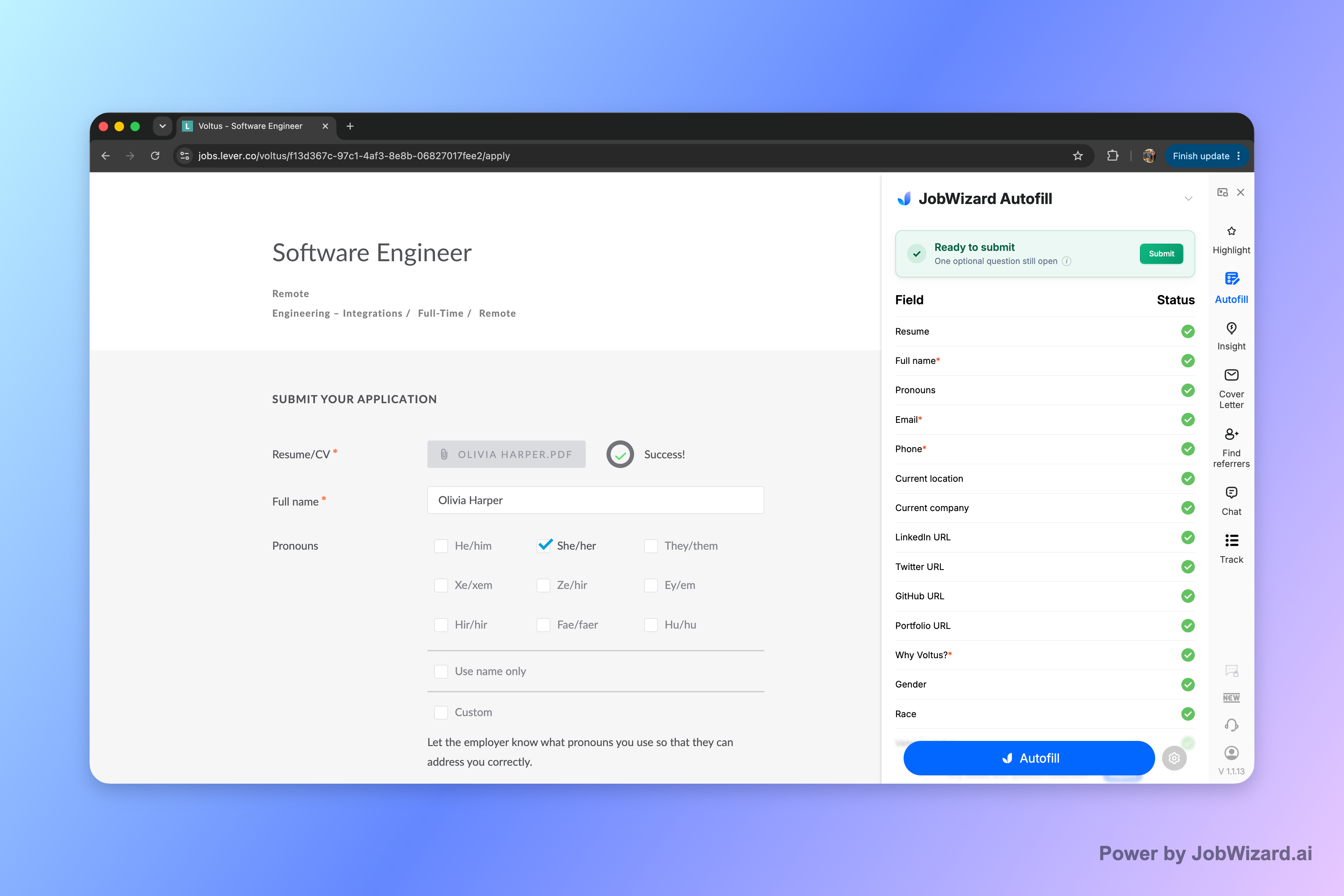
JobWizard fills the repetitive fields while keeping the final review and submission in the job seeker's hands.
Start with the one non-negotiable rule: no blind submission
The safest way to use an autofill workflow is to treat it as a drafting assistant—not a click-the-button autopilot. Even if a tool fills fields quickly, you still own the final accuracy because job forms commonly include job-specific and time-sensitive questions.
Concretely, What a Job Application Autofill Tool Should Never Submit Without Review is your final submission when any answers could be wrong or missing. JobWizard is built around this separation: its Chrome extension uses saved profile and resume data to fill detected fields on supported application pages, and then you review the populated fields and submit the application yourself.
- Good use: Draft repetitive fields using your saved data.
- Required action: Review every answer before you submit.
- Common trap: Missing or misunderstood required questions that the form expects you to answer precisely.
What must you review before submitting (and why)
Some fields are “copy/paste” candidates. Others can quietly derail your application if autofilled incorrectly. Use this checklist to decide what deserves your attention every time.
1) Required fields that depend on the specific job
Many application forms include required fields that are job-specific—sometimes near the end of the form. If a tool attempts to populate them without understanding the posting, you could end up with an answer that doesn’t match the requirement.
JobWizard includes a safety workflow here: when a required field still needs attention, it can identify it and let you jump to the matching question. Don’t treat that as “done”—treat it as a navigation aid so you can review what matters.
2) Sponsorship, citizenship, work authorization, and EEO-style questions
These questions are high-impact. Even small differences (wording, status, dates) can affect eligibility screening. If your work authorization status changed recently, an autofill tool may pull older info from your profile/resume data.
What a Job Application Autofill Tool Should Never Submit Without Review is your answers to questions like these without verifying they match your current situation and the job’s expectations.
3) Salary, compensation, or scheduling inputs
If the form asks for a minimum salary, salary range preference, or availability, you need to check the exact prompt. “Autofilled” numbers can be fine—but only when they match what the employer is asking for and what you’re comfortable with.
4) Custom questions and screening items
Applications often include custom questions that aren’t part of your standard profile. Examples include:
- “Why do you want to work at our company?”
- “Describe a project where you used X tool.”
- “Are you willing to relocate? If yes, where?”
- “Upload a work sample relevant to this role.”
Autofill can help you draft, but those responses should be reviewed for relevance and accuracy. If you submit without review, you risk sending a generic or mismatched response that doesn’t align with the role.
5) Resume-derived fields that might not be up to date
Autofill often uses saved profile and resume data. That’s a strength—until your resume changed since you last updated your saved data, or until the form expects details in a different format (dates, titles, locations, employment gaps).
Before submitting, skim the filled content the way a reviewer would. Ask: “Would someone screening this call me out for anything incorrect?” If the answer is yes, fix it now.
Use an “autofill + review” workflow that actually reduces errors
Here’s a practical step-by-step routine you can follow every time you apply, designed to match the reality that autofill is only as safe as your review habits.
Step 1: Confirm the form is the right job and right posting
Before you fill anything, verify you’re on the correct application page and the correct job opening. Autofill can only help you complete the form you’re currently viewing—not the posting you meant to apply for.
Step 2: Let the tool populate detected fields (fast)
Use Smart Autofill (or any autofill workflow) to handle repetitive inputs, such as name, contact info, and standard sections. For JobWizard, the extension fills detected fields on supported application pages using your saved profile and resume data.
Step 3: Do a “top-to-bottom sanity scan” (slow)
Your review shouldn’t be random. Use a deliberate scan pattern:
- Look for required markers and ensure everything required is complete.
- Verify high-impact questions (work authorization, EEO, sponsorship, location/relocation prompts).
- Check job-specific custom questions for relevance to the exact role.
- Review dates and formatting (employment start/end, education details, authorization dates).
Step 4: Treat “jump to question” as your review checklist
If a tool indicates a required field needs attention, don’t ignore it. Use it like a routing map:
- Jump to the flagged question.
- Read it carefully.
- Confirm your answer matches the prompt.
- Then proceed to the next section.
Step 5: Submit only after you’ve reviewed every answer
This is the end of the process—and the core answer to What a Job Application Autofill Tool Should Never Submit Without Review. You should submit the application yourself after you’re satisfied with accuracy. Don’t outsource judgment.
Autofill vs. auto-submit: how to choose the right tool behavior
Even when tools advertise “automation,” the deciding factor for safe job applications is whether you can control submission and ensure review before clicking “Submit.” A helpful autofill tool should clearly separate filling fields from submitting the final application.
Verified usage context: JobWizard has 720,000+ applications submitted and 600,000+ autofill sessions run through it. Its autofill workflow fills an average of ~18 repetitive fields per application (typically 11–23) while the user reviews before submitting. Across submitted applications, about ~65% are on Workday, ~19% on Greenhouse, ~12% on Ashby, and ~4% on Lever.
That doesn’t mean “you can apply blind.” It means the tool is designed to reduce repetitive typing while keeping the user responsible for final correctness.
| Workflow feature | What it should do | What it should never do |
|---|---|---|
| Autofill repetitive fields | Populate detected inputs using saved profile/resume data | Fill everything without any chance for review |
| Required-field handling | Identify fields that still need attention so you can jump and review | Leave required questions to chance without surfacing issues |
| Submission control | Keep submission under your control after you review | Submit without review—especially for eligibility, compliance, or custom screening answers |
Example workflow: Lever application with review before submit
Imagine you’re applying on Lever and you’ve got a form with both standard fields and a few required screening questions. The right approach is: let your autofill workflow populate the repetitive fields, then read each required question it surfaces, confirm your answers, and only then submit.
This is the exact model JobWizard follows: smart autofill fills detected fields while you review and submit yourself.
Example workflow: Workday application where custom questions matter
On Workday-like forms, the “last mile” often includes compliance or eligibility items. A safe routine looks like this:
- Autofill the basic sections (contact, standard employment/education fields).
- Review every compliance/eligibility response.
- Answer custom questions specifically for that role.
- Submit only after the final scan confirms nothing important is missing.
For deeper guidance on field-level decisions, use this resource: Workday Application Field Cheat Sheet What To Autofill and What To Review (By JobWizard).
Do this automatically with JobWizard
Skip the manual work — JobWizard's Smart Autofill handles this for you.
Use JobWizard to move faster—without violating the review rule
If your goal is to apply faster, you need a workflow that reduces repetitive typing but doesn’t compromise accuracy. That’s the balance: What a Job Application Autofill Tool Should Never Submit Without Review—and JobWizard is built around it.
When you use JobWizard’s Smart Autofill, it fills detected fields on supported application pages from your saved profile and resume data. Then you review the populated fields and submit the application yourself. If a required field still needs attention, it can identify it and help you jump to the matching question so you can finalize answers correctly.
If you want to build a repeatable system for autofill (and avoid the “oops I submitted the wrong thing” problem), start with:
- How to Autofill Job Applications (Step-by-Step with JobWizard)
- AI Application Assistant for Job Applications: Autofill, Review, Submit
- Autofill Resume: How to Speed Up Job Applications Without Auto-Submit Risk
CTA: Install JobWizard and use Autofill on your next application—but keep the review rule. Autofill the repetitive fields, jump to any required questions that need attention, and submit only after you’ve confirmed every answer is correct.
Should I use a job application autofill tool if it can auto-apply?
Use autofill for speed, but do not rely on it to submit for you. The safer workflow is: let the tool populate repetitive fields, then review every answer and submit yourself.
What fields should never be submitted without review?
Any field that depends on the specific job or your current situation should be reviewed—especially sponsorship/salary/EEO-type questions, custom questions, and required fields where the tool’s best guess might not match the posting.
How can I tell what a tool still needs me to review?
Look for flags or prompts that identify required fields that still need attention. With JobWizard, if a required field needs attention, it can identify it and let you jump to the matching question.
Is Smart Autofill designed for blind submission?
No. JobWizard’s Smart Autofill fills detected fields on supported application pages, but you review the populated fields and submit the application yourself.
Does autofill work across platforms like Workday and Greenhouse?
JobWizard can autofill repetitive fields on supported application pages, including common platforms like Workday, Greenhouse, Lever, and Ashby. Still, you should review before submitting because every posting can include custom questions and job-specific requirements.
Frequently Asked Questions
Autofill your next job application
JobWizard is a free Chrome extension that fills applications, tracks statuses, and optimizes your resume.