What to Fill in Highest Qualification: A Review-First Checklist That Matches the JD
Learn what to fill in highest qualification so it reflects the job description, using a review-first approach and JD keywords you can verify before applying.
Free Chrome extension
Autofill your next job application
JobWizard is a free Chrome extension that fills applications, tracks statuses, and optimizes your resume.
What to fill in highest qualification means: accuracy + JD alignment
When you’re figuring out what to fill in highest qualification, your goal is simple: enter the highest credential you actually earned, then make sure the rest of your application clearly shows the job requirements. Forms usually treat “highest qualification” as a factual education signal, so guessing or inflating can create mismatches.
At the same time, a perfect education level doesn’t help much if the rest of your application doesn’t map to the role. So use the job description (JD) as your source of truth, then fill the form with what’s real and relevant.
Use the job description’s qualifications section to guide your entry
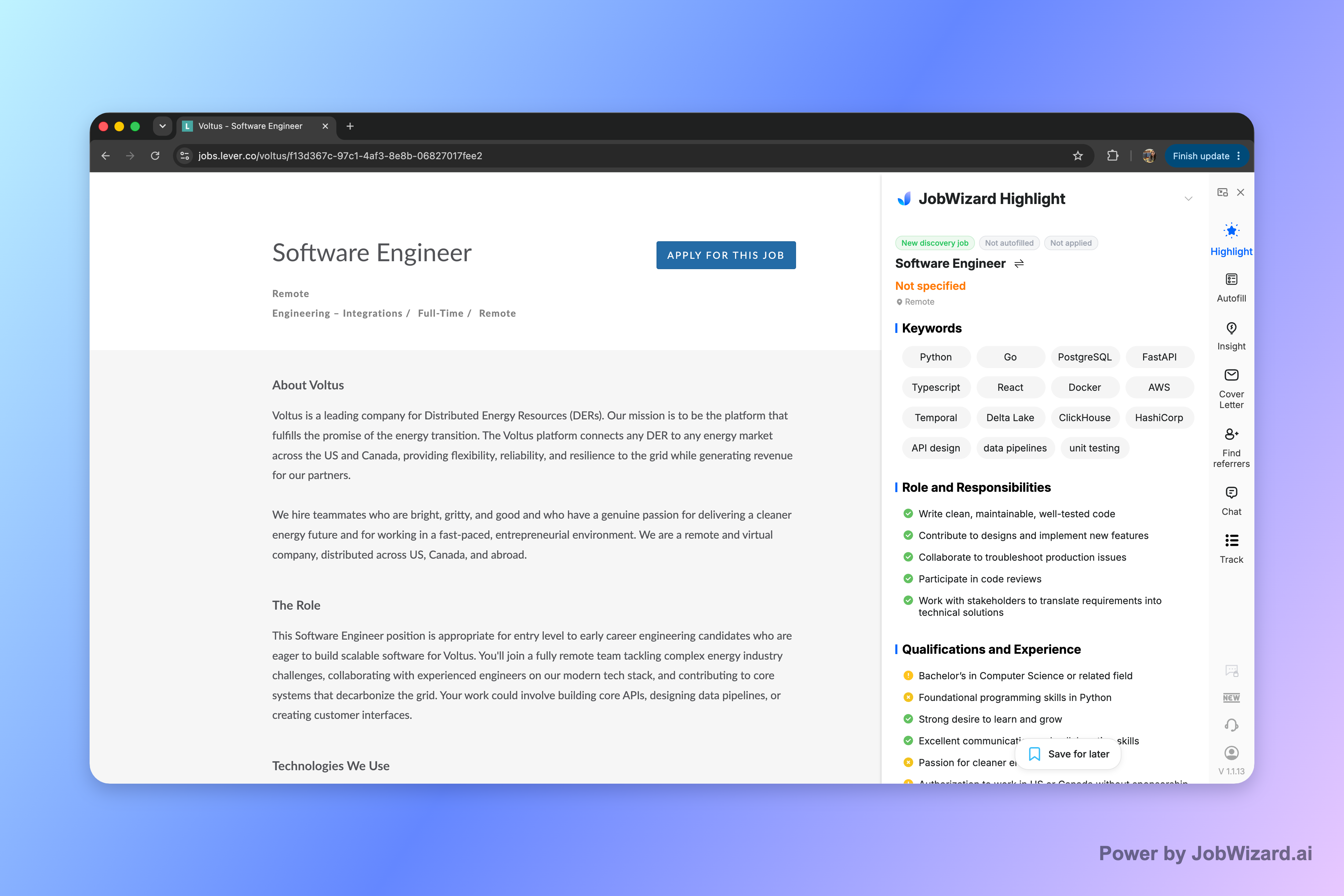
The fastest way to decide what to fill in highest qualification is to extract the JD’s stated requirements and compare them to your actual credential. JobWizard can organize a long job description into keywords, role responsibilities, and qualifications so you can review the requirements more systematically.
Before you touch the application fields, scan for recurring phrases and requirement categories such as education level, years of experience, certifications, and core responsibilities. This helps you distinguish “what the form asks” from “what the employer is really evaluating.”
Turn the JD into a short checklist
- Education signals: degree level, specialization, or certification requirements mentioned in the JD.
- Qualification keywords: the tools, domains, and technical or functional requirements repeated across the posting.
- Responsibilities that prove fit: what the role expects you to do day-to-day.
- Any “must-have” constraints: work authorization, eligibility wording, or required credential language (if present in the JD).
Then fill the field with your real highest credential
Once you know what the employer is looking for, enter the credential that’s truly your highest completed education/certification. If your highest credential is broad (e.g., a general degree) but the JD wants a specific track (e.g., compliance, analytics, project delivery), don’t try to force the field to become a skill summary.
Instead, keep “highest qualification” factual and use the rest of the application (skills, summary, experience bullets, and any “additional details”) to demonstrate alignment with the JD.
What to fill in highest qualification: practical scenarios (and what to avoid)
These common scenarios show exactly how to fill the field while staying accurate and relevant—because what to fill in highest qualification often depends on how your background compares to the JD.
Scenario A: You have the degree the JD requests (or higher)
- What to fill: the highest degree/certification you actually earned (even if it’s above the JD requirement).
- How to prove fit: in skills/summary, tie your experience to the JD’s qualifications and responsibilities.
- What to avoid: adding unrelated credentials in the “highest qualification” field just to sound more technical.
Scenario B: Your education is close, but the specialization differs
- What to fill: your true highest credential level.
- How to prove fit: map relevant coursework, projects, or work experience to the JD keywords (e.g., domain exposure, relevant tools, or delivery outcomes).
- What to avoid: selecting a different degree level or certification you didn’t earn.
Scenario C: You have a certification that’s more relevant than your degree
- What to fill: your highest credential overall (degree or certification, whichever ranks higher in the form’s logic).
- How to prove fit: emphasize the certification in skills/summary and in experience where you applied it.
- What to avoid: forcing the “highest qualification” dropdown to represent relevance instead of truth.
Scenario D: The form forces one selection, but you have multiple strong options
- What to fill: the option that matches your highest actual credential.
- How to clarify: use “additional details” or free-text fields to state the other relevant credentials.
- What to avoid: choosing the most relevant credential if it’s not actually the highest.
How to align your “highest qualification” with the rest of the form
The “highest qualification” field rarely carries the entire hiring story—so your best move is to align it with the JD while using other sections to show the match. In other words, don’t turn what to fill in highest qualification into keyword-stuffing; use structure.
Here’s a simple mapping approach you can apply to most application forms.
Review-first mapping checklist
- Extract requirements: identify the JD’s qualifications and repeated keywords.
- Enter the factual credential: choose the option that matches your real highest education/certification.
- Prove skill match elsewhere: reflect the JD keywords in skills, summary, and experience.
- Recheck “accuracy-sensitive” fields: confirm dates, credential titles, and eligibility answers before submitting.
Common mistakes that hurt alignment
- Inflating education: selecting a higher degree/certification than you have.
- Confusing relevance with rank: using the field to imply you meet a specialization you don’t.
- Ignoring the JD structure: skipping the qualifications section and guessing what the employer wants.
- Forgetting review-before-submit: auto-filled or drafted content still needs your final verification for accuracy.
Key principle: JobWizard helps you organize and review what the JD requires, but the user still reviews content and submits applications themselves.
Where JobWizard fits: structured JD review so you can fill confidently
If you’re applying to roles with long postings, JobWizard can make your “qualification decision” easier by giving you a structured JD view to review before you apply. JobWizard can organize a job description into keywords, responsibilities, and qualifications, so you can verify what the employer is asking for—then fill the form with the right credential and supporting details.
Why this matters for “highest qualification”
“Highest qualification” is a high-signal field, and it’s usually hard for an employer to interpret differently once submitted. By reviewing the JD qualifications and keywords first, you reduce the chance that your form entry is technically correct but mismatched with the role’s stated requirements.
Also, JobWizard autofills repetitive fields fast while you review sponsorship/salary/EEO/custom questions before submitting. That review step is what keeps accuracy-sensitive inputs under your control.
Do this automatically with JobWizard
Skip the manual work — JobWizard's Smart Autofill handles this for you.
FAQ: What to fill in highest qualification
What should I put in the “highest qualification” field if my education isn’t a perfect match?
Choose the education credential that is truly highest (degree/certification) and then align it to the job’s required skills in the rest of the application. If the posting emphasizes a specific area (e.g., data analysis, project management), use the next section(s) to show relevant coursework, certificates, or experience—rather than entering a higher degree you don’t have.
How do I know which qualifications the employer actually wants?
Start with the job description and extract the requirements and keywords the employer repeats (tooling, domains, certifications, years of experience, and core responsibilities). Then compare those items to your real background and only claim what you can support elsewhere in your application.
Should I copy the job description keywords into my “highest qualification” field?
No. Don’t use the field to rewrite the job description. Enter your real highest credential, then reflect the job’s keywords in areas meant for skills, summaries, or experience. This keeps your application accurate while still making your match easy to see.
What if the form forces a single choice (dropdown) and my best match is a different credential?
Pick the option that is closest to your actual highest credential. If you truly have multiple relevant qualifications, use any free-text or “additional details” sections to clarify the most relevant one(s). Avoid selecting an option that would misrepresent your education level.
How can I reduce mistakes when entering qualifications?
Review the job description’s qualifications and keywords, then check the form field by field before submitting. If you use JobWizard, open the target role and review the structured JD view (keywords, responsibilities, and qualifications) to confirm your inputs match what the employer lists—especially for accuracy-sensitive fields like education and eligibility questions.
Ready to apply with confidence? Open the target job in JobWizard and review the JD’s qualifications and keywords so you can enter the right education level in “highest qualification,” then verify everything before you submit.
Frequently Asked Questions
Autofill your next job application
JobWizard is a free Chrome extension that fills applications, tracks statuses, and optimizes your resume.