Resume for Accountant Example: A JD-Matched Template That Passes ATS Checks
Looking for a resume for accountant example that actually mirrors your job description? Use this JD Match Score workflow to spot skills gaps and tighten your accountant resume fast.
Free Chrome extension
See your resume's match score for any job
JobWizard compares your resume to each job description and shows the exact keywords to add — free.
If you’re searching for a resume for accountant example you can actually use to apply with confidence, you need more than a generic accounting template—you need a resume that mirrors the job description you’re targeting.
This guide shows a practical, JD-matched accountant resume approach, including a reusable example layout and a workflow to identify skills gaps. You’ll also learn how to use Insight / Match Score to turn those gaps into editable revisions before you submit.
What a recruiter-ready resume for accountant example should include
A strong resume for accountant example is structured so your experience reads like direct evidence of the job’s responsibilities—especially for ATS keyword coverage and hiring-manager scan speed.
Use this “accountant proof” structure (it works whether you’re applying for AP/AR roles, general ledger accounting, or staff/senior accounting):
- Header + target title: Accountant, Staff Accountant, Senior Accountant, or similar (match what’s in the posting).
- Accounting summary (3–4 lines): Your focus + domain depth + tools/ERP you’ve used.
- Core skills: A keyword-rich list that mirrors the JD (AP/AR, reconciliations, month-end close, journal entries, etc.).
- Experience bullets: Past-tense bullets that start with an action + process + evidence (volume, cadence, controls—only what’s accurate).
- Education + credentials: Degree, CPA (if applicable), licenses, and relevant coursework.
- Optional sections: Systems/ERP, audit/internal controls, certifications, and selected projects if relevant.
To keep it ATS-safe, avoid paragraphs that bury keywords in long text. Instead, use consistent headings and bullet formatting so the ATS can reliably extract skills and job duties.
For deeper ATS keyword guidance specific to accounting, see ATS Resume Keywords for Accountants.
Resume for accountant example: a JD-aligned template you can copy
Below is a resume for accountant example template written for tailoring—so each section is easy to update based on the job description.
NAME City, State • Phone • Email • LinkedIn (optional) • (Optional) Accounting Certifications
TARGET TITLE Staff Accountant | General Ledger | AP/AR | Month-End Close (choose one primary focus)
ACCOUNTING SUMMARY Detail-oriented accountant with experience supporting month-end close, reconciliations, journal entries, and AP/AR workflows. Comfortable working with ERP/accounting systems and documenting controls. Known for turning incomplete data into clean reconciliations and clear explanations for stakeholders.
CORE SKILLS
- Month-end close • Journal entries • Account reconciliations
- AP/AR processing • Billing support (if applicable)
- Fixed assets (if applicable) • Accruals • Deferrals
- Internal controls • SOX support (if applicable)
- Data integrity • Audit readiness • Stakeholder reporting
- ERP/Tools: QuickBooks / NetSuite / SAP (list what you truly used)
PROFESSIONAL EXPERIENCE Company Name — City, State Job Title | Month YYYY – Month YYYY
- Month-end close: Prepared or supported close activities by reconciling key accounts, posting journal entries, and documenting variances for review.
- Reconciliations: Performed account reconciliations (e.g., cash, AR, or GL accounts), investigated discrepancies, and resolved issues with clear notes.
- AP/AR workflows: Managed AP/AR tasks including invoice processing, payment coordination, and vendor/customer discrepancy follow-ups.
- Reporting support: Produced recurring reports and ad hoc analyses to support operational or finance stakeholders.
- Controls/audit prep: Supported internal control documentation and provided audit-ready explanations and supporting schedules (if applicable).
Company Name — City, State Job Title | Month YYYY – Month YYYY
- Process improvement: Streamlined a reconciliation or invoice workflow by improving data validation and standardizing documentation.
- System usage: Used [ERP/Tool] to maintain accounting records and ensure accurate postings for ongoing reporting.
- Cross-functional coordination: Partnered with [teams] to resolve billing/accounting issues and confirm corrective actions.
EDUCATION School Name — Degree, Major (Year)
CERTIFICATIONS CPA (if applicable) • Other relevant credentials
SELECTED TOOLS (Optional) ERP/Accounting software: … • Spreadsheet/BI tools: …
Tip: For your “experience bullets,” keep each bullet anchored to a JD phrase. You don’t need to copy sentences—just mirror the responsibilities and the order of operations (what you did first, what you produced, what you documented, and who reviewed it).
If you want a general ATS checklist that applies to any accounting resume, use How to Optimize Resume for ATS: A Practical 2026 Checklist.
Use JD Match Score to close accounting skills gaps (before you submit)
To tailor your resume for accountant example without guessing, use the job description diagnosis workflow: compare your resume to the JD, review the match score, and update only the gaps you can support with your real experience.
JobWizard’s Insight / Match Score compares the selected resume with the current job description and presents a match score, an overall assessment, and improvement suggestions. The JD-based diagnosis can identify resume expression gaps and turn them into an editable resume revision draft.
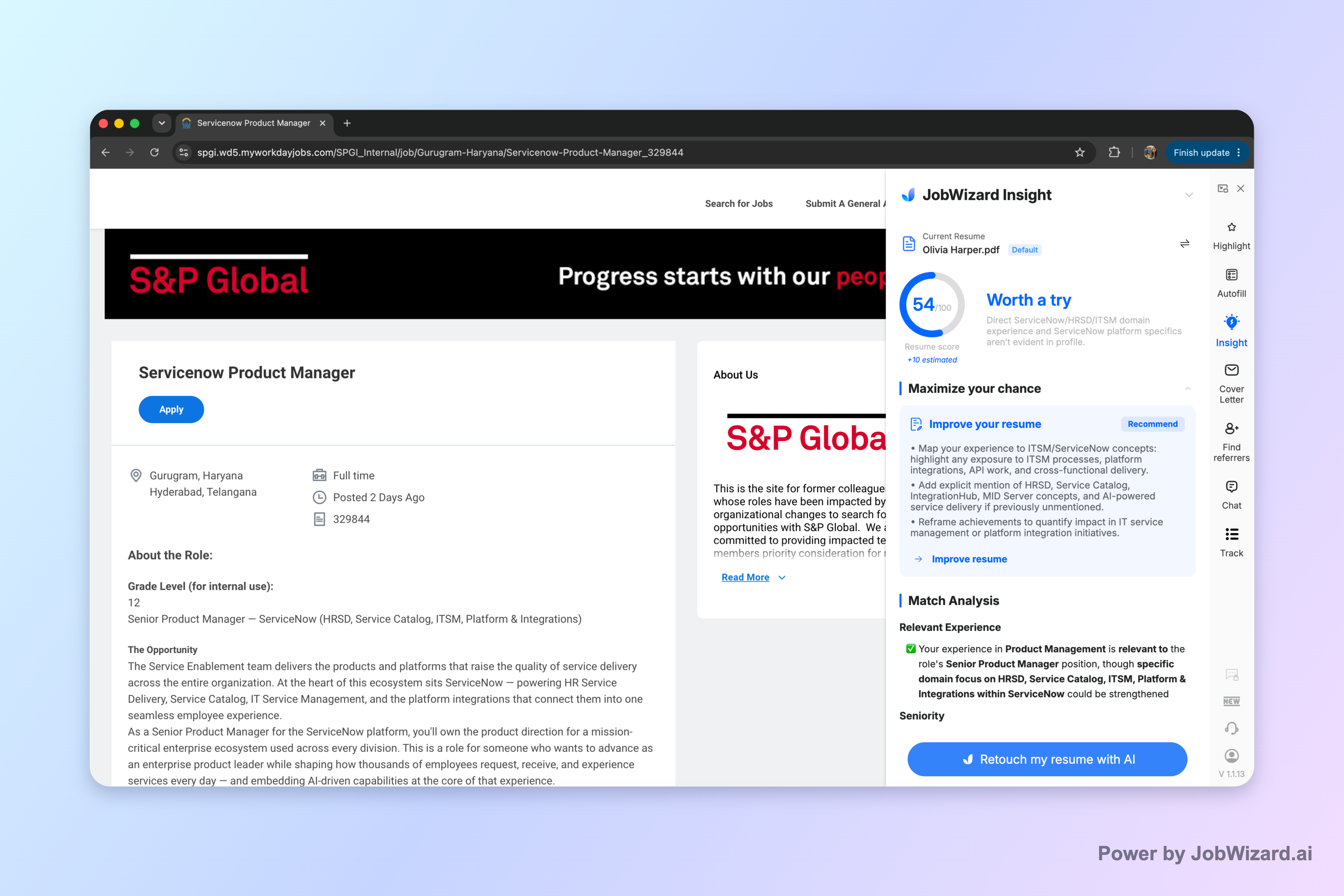
How to use this workflow for an accountant resume:
- Pick the right job posting: Use the exact JD you plan to apply to.
- Run Insight / Match Score: Review the overall assessment and the flagged expression gaps.
- Turn gaps into revisions: Use the editable resume draft to update your skills/duties wording.
- Verify every change: The score is not a hiring probability, and you must keep only accurate experience—review-before-submit is essential.
Important: The match score is not a hiring probability and does not guarantee ATS passage or an interview. Users must verify every suggested resume change and keep only accurate experience.
This is where many accountants lose time: they either rewrite from scratch or they leave keyword gaps because the resume “sounds right.” With JD-driven diagnosis, you get targeted revision prompts instead of random edits.
If you want to see how JD Match Score helps other candidates apply defensibly (and not generically), review Resume for Apple: Use JD Match Score Insights to Tailor a Defensible CV (Not a Generic One).
Fast tailoring tips for accountant roles (what to change first)
The quickest wins for a resume for accountant example usually come from updating the sections that map directly to what the employer screens for: your skills list and your top 6–10 experience bullets.
Use this priority order when tailoring:
- Core skills (first): Match the JD’s exact job functions (AP/AR, reconciliations, month-end close, journal entries, internal controls, reporting).
- Top experience bullets: Ensure your most recent bullets reflect the JD’s responsibilities and cadence (close cycle, monthly reporting rhythm, etc.).
- Tools/ERP wording: Use the terms in the posting if you truly used them; don’t “swap” tools you never handled.
- Summary alignment: Adjust the summary to match the role focus (general ledger vs. close vs. AP/AR vs. audit support).
Be careful with achievements: only include measurable results you can defend. If you can’t quantify, use process evidence (what you reconciled, what you documented, and what you prevented or fixed).
For accountants specifically, ATS keyword coverage is often about the way the JD spells out responsibilities. If you’re unsure which accounting terms tend to show up, go back to ATS Resume Keywords for Accountants and align your wording to the posting’s language.
Also, remember tailoring isn’t just ATS—it’s clarity. Your resume should read like you’ve done the work the JD describes, not like you’re learning it after the offer stage.
Do this automatically with JobWizard
Skip the manual work — JobWizard's Match Score handles this for you.
FAQ about resume for accountant example and JD-matched tailoring
What should I include in a resume for an accountant example?
A strong resume for an accountant example typically includes: a clear accounting summary, the specific tools/ERP you use (e.g., QuickBooks, NetSuite, SAP if relevant), your core duties (AP/AR, month-end close, reconciliations, journal entries), and measurable achievements (without exaggeration). Make sure the wording maps to the job description’s responsibilities and required skills so it reads like a match, not a generic accounting CV.
How do I tailor a resume for an accountant job without rewriting everything?
Tailor in small, evidence-based passes: (1) pull the job description into your tailoring workflow, (2) use Insight / Match Score to identify expression gaps between your resume and the JD, (3) convert the flagged gaps into editable resume revisions, and (4) verify each change is accurate and keep only what’s true from your experience. Then do a final pass to align keywords naturally—especially for ATS.
Does a JD-based match score guarantee ATS passage or an interview?
No. The match score is not a hiring probability and does not guarantee ATS passage or an interview. It’s an overall assessment with improvement suggestions so you can diagnose where your resume expression differs from the job description—and then you still must verify every suggested resume change and keep only accurate experience.
What are common ATS keyword gaps for accountants?
Common gaps often show up in the exact language around core accounting processes (e.g., “month-end close,” “account reconciliations,” “journal entries,” “AP/AR,” “internal controls,” “SOX” if applicable) and the tools/ERP terms the employer lists. Even if you did the work, your resume may not use the same terms or structure the ATS expects—so matching the JD’s responsibilities and required skills is key.
How should I use this resume for accountant example when applying to multiple roles?
Use the example as your baseline, then tailor per job description. Start with the JD-focused gaps workflow (Insight / Match Score), update the relevant skills/duties sections with accurate, specific details, and review-before-submit sponsorship/salary/EEO/custom questions yourself. The goal is autofill + review—not blind auto-apply—so your application stays truthful and role-specific.
Ready to tailor your resume with less guesswork? Compare your resume to the exact job description using JobWizard Insight / Match Score, review the flagged skills gap suggestions, and revise the parts of your resume for accountant example that truly need alignment—then submit with review before submit.
Frequently Asked Questions
See your resume's match score for any job
JobWizard compares your resume to each job description and shows the exact keywords to add — free.