loopcv vs simplify: which one avoids bot-submission mistakes—and what to do instead
loopcv vs simplify is a common question when you’re trying to apply faster, but bot-style submissions can produce wrong answers and trigger spam filters. JobWizard uses review-first autofill so you fill seconds, check everything, and submit yourself.
Free Chrome extension
See your resume's match score for any job
JobWizard compares your resume to each job description and shows the exact keywords to add — free.
You’re probably comparing loopcv vs simplify because you want to apply faster—but the real question is what happens when “auto-apply” turns into bot-submission mistakes you can’t undo.
Here’s the trade-off in plain terms: bot-style workflows often fill and submit with little context, which can cause wrong answers to screening questions, resume mismatches, and employer-side anti-spam filtering. JobWizard takes a different path: autofill + review-before-submit, so you can fill repetitive fields quickly and still submit only after you’ve checked everything.
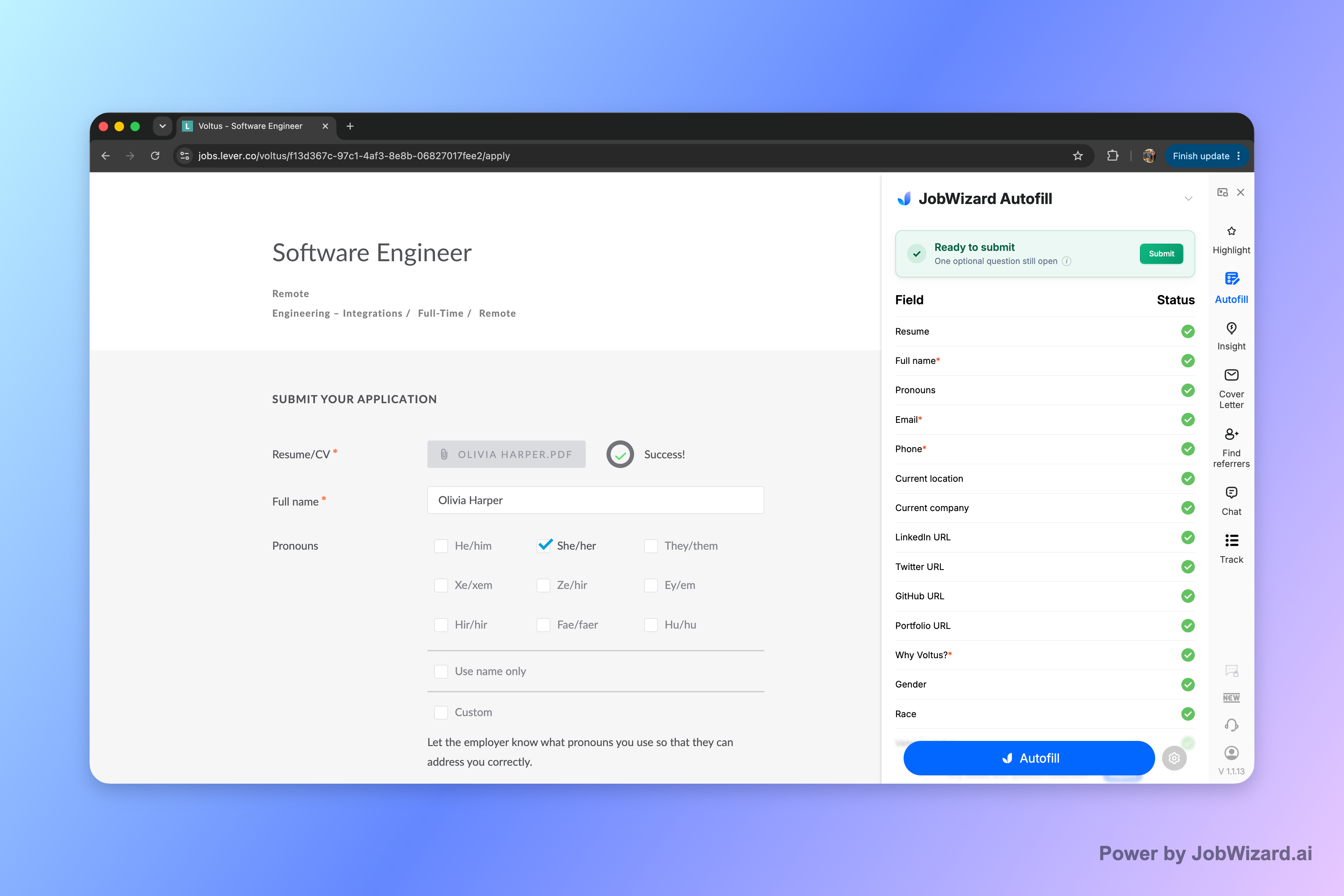
JobWizard fills the repetitive fields while keeping the final review and submission in your hands.
What goes wrong with bot submissions when you compare loopcv vs simplify
Bot submissions fail when they answer the wrong question—or answer the right question with the wrong context.
Even when an auto-apply tool is well-intentioned, applications still have to survive real screening forms. Those forms include custom questions, required fields, and job-specific phrasing that your resume may not match word-for-word.
- Wrong answers to screening questions: A single mismatched response (employment dates, eligibility, location, experience details) can route your application to rejection faster than you can correct it.
- Resume mismatch problems: If the job description expects specific skills or experience wording, a generic fill-in can make you look unqualified—especially when the application asks for details that aren’t clearly present in your CV.
- Employer-side anti-spam / filtering: Repeated automated attempts can increase the chance that employer systems flag patterns rather than evaluate candidate quality. That doesn’t mean you’re doing something “bad”—it just means the application pipeline may treat automation differently.
- Damaged reputation with a company you want: If you submit incorrect info even once, you may get removed from consideration at that specific employer. And if your responses are inconsistent, you can create avoidable confusion.
That’s why the best “faster” strategy isn’t blind speed—it’s speed with verification. Your application should be quick to complete, but accurate enough to withstand screening.
loopcv vs simplify: how to evaluate them without getting tricked by the promise of “auto”
When you compare loopcv vs simplify, prioritize control points—not buzzwords.
Instead of asking only “Will it apply faster?”, ask whether the workflow forces you to verify key inputs tied to screening and qualifications. You can do this with a quick checklist.
| What to check | Why it matters | What “safe” looks like |
|---|---|---|
| Review-before-submit | Most bot failures are answer-level mistakes. | You confirm each populated response before submitting. |
| Custom question handling | Screening questions are usually job-specific. | Required answers either prompt you to confirm or highlight missing attention. |
| Resume-to-job alignment | Generic entries create skills/experience gaps. | You can compare your resume against the job description and edit accurately. |
| Data consistency | Small mismatches hurt (dates, roles, tools, eligibility). | Autofill reduces typing, but you stay responsible for correctness. |
JobWizard is built around this “control first” approach. It uses autofill to populate the repetitive fields on the application page, then you review everything and submit yourself—rather than letting the process run away from your intent.
If you want the pricing/tactical differences angle for Simplify specifically, see: Simplify Jobs Pricing: a no-surprises checklist for application autofill tools. And if you’re specifically curious about how a review-focused Chrome extension flow works, read: Simplify Chrome Extension Job Applications with JobWizard Autofill + Review Control.
What to do instead of bot-style auto-apply: autofill, then verify in seconds
You can apply faster without risking wrong answers by switching to review-first autofill.
Here’s what that looks like in practice: JobWizard fills repetitive fields using saved profile and resume data on supported application pages, and then you review before you submit.
- Step 1: Autofill repetitive fields: Contact details and common profile inputs are filled so you don’t waste time retyping.
- Step 2: Spot-check the screening-critical answers: Any sponsorship, salary/EEO-related prompts, and custom questions should be reviewed as carefully as you would if you typed them manually.
- Step 3: Jump to the matching question when something needs attention: If a required field still needs attention, JobWizard can identify it so you can go straight to the relevant question.
- Step 4: Submit yourself: You remain the final decision-maker, which helps prevent “automation mistakes” that happen when nobody verifies.
Realistically, this is where review-first tools win: you keep the speed benefits while avoiding the biggest failure modes of bot-style submissions.
If you want a deeper walkthrough of the full workflow, use How to Autofill Job Applications (Step-by-Step with JobWizard). And if you’re specifically comparing the “review-first” approach to Simplify-style auto-apply patterns, this is the direct companion read: simplify auto apply: why bot submissions backfire and review-first autofill wins.
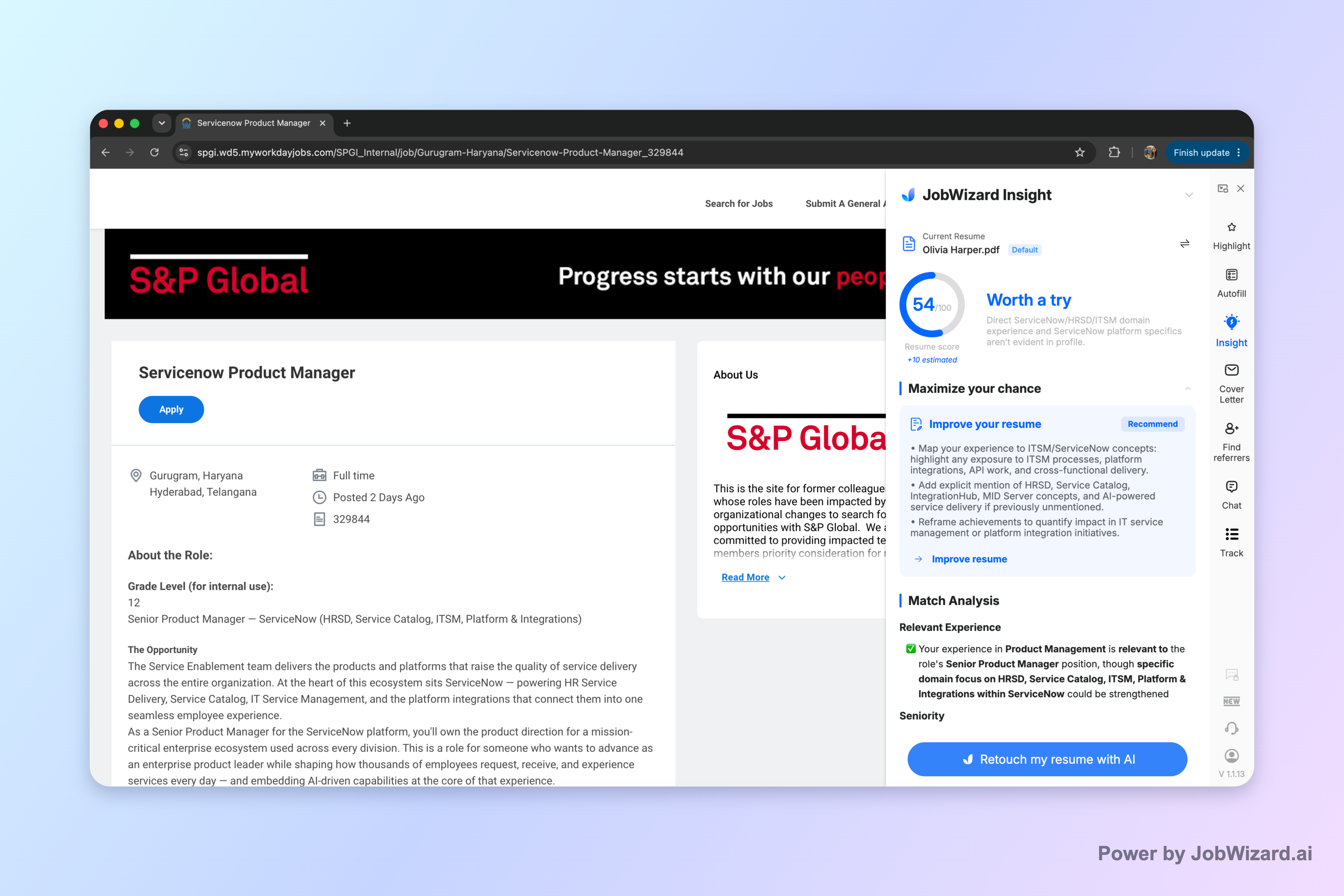
Insight compares the selected resume with the job description and turns the gaps into specific next steps.
Use job-matching to reduce resume mismatch surprises
Review-first autofill helps with form accuracy; job-matching helps with resume relevance.
When you apply quickly, it’s easy to reuse a resume that’s “good enough” for your history but not aligned with the job’s phrasing. JobWizard Insight compares your selected resume with the current job description and presents a match score, an overall assessment, and improvement suggestions. It can also identify resume expression gaps and turn them into an editable resume revision draft.
Important: the match score is not a hiring probability and doesn’t guarantee ATS passage or an interview. You still need to verify suggested changes and keep only what’s accurate to your experience.
Do this automatically with JobWizard
Skip the manual work — JobWizard's Smart Autofill handles this for you. On these platforms: JobWizard vs Simplify, JobWizard vs LoopCV.
loopcv vs simplify FAQ: review-first choices that keep you in control
Here are the answers job seekers usually want before they risk bot-style applications.
Does simplify or loopcv automatically submit applications for me?
Most “auto-apply” workflows are designed to push applications forward with minimal user involvement. That’s the risk: if answers get auto-filled incorrectly or don’t match the screening questions, you still have to deal with the consequences. JobWizard’s autofill is review-first—fields are populated while you stay in control, and you submit your application yourself.
What’s the biggest problem with bot submissions—wrong answers or spam filters?
Both can matter, but the root cause is usually the same: the form data doesn’t match the specific job’s screening questions, resume context, or custom prompts. When that happens, you can get rejected for screening mismatches, and repeated automated attempts can also increase the chance of employer-side filters. A safer approach is to autofill repetitive fields, then carefully check every answer before submitting.
How can I avoid resume mismatches when applying fast?
If the job description uses different phrasing or asks for specific experience, a “one resume fits all” approach can create gaps. JobWizard Insight compares your selected resume with the current job description and shows a match score plus improvement suggestions—then you keep only the changes that are accurate to your experience.
Will a review-first autofill tool still speed up my applications?
Yes. The goal is to remove repetitive data entry (like contact info and standard profile fields) while you review sponsorship, salary/EEO/custom questions, and any required fields that still need your attention. That’s how you keep momentum without turning your applications into blind submissions.
Which is better for loopcv vs simplify: speed or control?
Control is what prevents the expensive mistakes—wrong answers, mismatched context, and avoidable screening failures. Speed comes from autofilling repetitive fields, but you should still review every answer before submitting. If you want the fastest *safe* workflow, look for a tool that supports review-before-submit and highlights fields that need attention.
Real usage snapshot: JobWizard has helped users submit 720,000+ applications and run 600,000+ autofill sessions. The value is in autofill + review-before-submit—filling repetitive fields quickly while you verify the answers that matter.
Ready to apply faster without risking bot-submission mistakes? Try JobWizard’s review-first autofill on your next application, verify every screening-critical answer, and submit with confidence.
Frequently Asked Questions
See your resume's match score for any job
JobWizard compares your resume to each job description and shows the exact keywords to add — free.